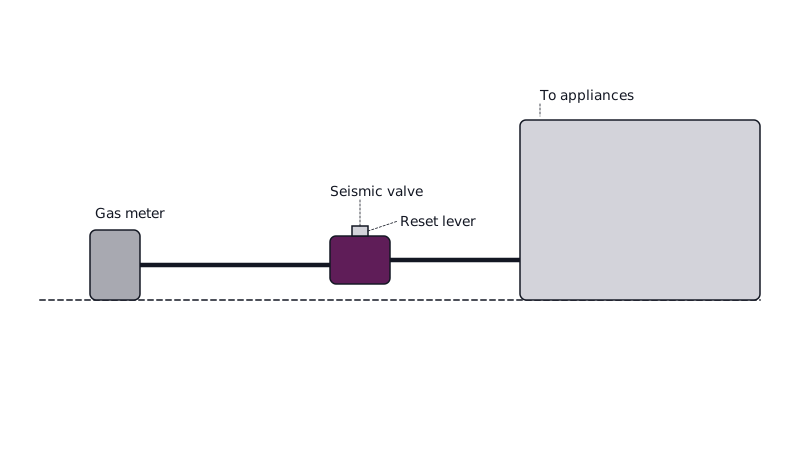
This device on your home's gas line closes by itself once shaking passes a set level, so gas stops flowing into a house whose pipes or appliances may have been damaged. A plumber mounts it on your own piping after the meter. This page covers how it works and what to expect, and it goes with our gas line plumber page.
What makes an automatic earthquake gas valve shut off?
Inside the valve a small steel ball or a weighted mechanism rests in a seat. Strong shaking knocks it loose and it drops or rolls into place, blocking the gas passage. Nothing needs power, a signal or a person at home. The valve stays shut until someone resets it by hand.
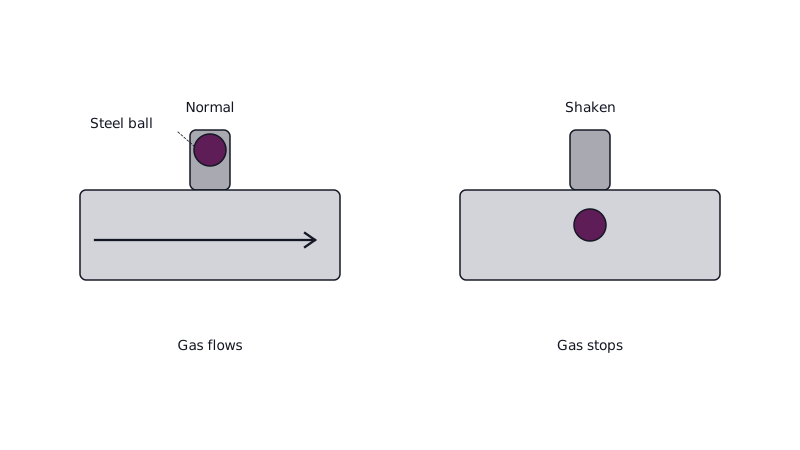
That mechanical design is the whole point. A quake can take down power and phones, so the valve relies on gravity and springs. Some models trigger on a vertical or sideways jolt of a particular strength. They will not react to a truck passing, and they are not meant to react to a small tremor.
This kind differs from an excess-flow valve, which closes when gas moves too fast, as with a broken pipe. Ask the plumber which kind is being quoted, and whether the model carries approval for California use.
You will also hear about the manual shutoff at the meter. That one is yours to close by hand in an emergency, with the correct wrench, and it is not automatic.
What is the valve's location, and does it work with a gas meter?
Installers usually place the valve on the pipe immediately after the meter, on your side of the line, which lets it protect each gas appliance in the home. It is separate from the utility's own equipment. Do not alter, remove or add anything on the meter itself. Ask SoCalGas if you have questions about the meter.
Typical installation details:
- A straight, accessible section of pipe, upright if the model needs it.
- Space to see the indicator and reach the reset lever or button.
- A location outdoors on the supply pipe, in most homes.
- Correct orientation. A valve installed crooked can trip falsely or fail to trip.
Meter position differs from lot to lot, and a clear side-yard run keeps access simple, while a tight run behind a fence or planter makes the job slower. See how installing one works for the process step by step.
How do you reset the valve once it has tripped?
After a trip, no gas reaches the house. Sniff for gas before anything else. Where there is a smell, leave and call SoCalGas on 1-800-427-2200 once you are outside. With no smell, resetting usually means moving a lever, pressing a button or using a magnet, as the maker describes. Follow the instruction card on the valve.
Practical steps:
- When the shaking stops, look at the valve. Most have a flag or indicator.
- Close all appliance valves, where that is safe.
- Check for damage and for gas odor around the house.
- Reset only when you are sure there is no leak, using the manufacturer's method.
- Pilot lights on some appliances need to be relit. Follow each manual.
If you are unsure at any point, do not reset it. Call SoCalGas or a plumber. After a major quake, utility crews may be busy, so know the basics in advance.
What decides the price of installing a seismic gas valve?
The main factors are the valve type, the pipe size of your line, the ease of reaching the pipe, whether any pipe needs adjusting, and whether a permit applies. We do not invent a figure. The visiting plumber prices the job after seeing the meter and pipe layout.
Go through these in order:
- Pipe size. A bigger line needs a bigger valve.
- Valve model. Models differ in how they are triggered and reset.
- Access. A clear, upright run costs less than a cramped one.
- Permit. Some cities and counties treat this as permitted gas work, others do not in the same way. The City of Murrieta Building and Safety Division can say what applies inside the city. County offices handle unincorporated areas.
- Extra work. Old pipe, missing unions or a damaged regulator add time.
The cost article, plumber gas line costs, explains the same drivers for other gas jobs.
Who should think about getting one?
Any gas-fed home where strong shaking is possible can benefit, and Murrieta is in earthquake country, like the rest of Southern California. The Northridge earthquake of January 1994 is the quake people usually mention when they talk about gas safety here.
Insurers, lenders and local ordinances sometimes ask for them, particularly for buildings that change hands or undergo big renovations. Whether that applies to your address, we cannot say. Ask your building office or insurer.
Homes with propane tanks work differently. A rural place near the Santa Rosa Plateau or in De Luz might use propane, and its shutoff sits at the tank. Check before ordering a valve made for a natural gas line.
Not sure if you need one? Say so on the quote request. It is passed to a nearby plumbing company; companies that take requests pay us a fee. For other plumbing help, visit the Murrieta Creek Plumbing home page.
Common questions
How long does fitting the valve take?
Often one to two hours, provided the plumber has the correct part on hand and the pipe is simple to access. Longer if the pipe needs altering. Gas is off while it is done, so heaters, stoves and the dryer will be down. Ask for a pressure check and a leak test at the end.
Which questions come before picking an installer?
Learn which valve model will be fitted and what trips it, whether the model is approved in California, who pulls any permit, whether the price includes the leak test, and how to reset it. Ask for the manual to be left with you. A good plumber will show you the reset steps.
Can the valve trip when there is no earthquake?
It can, if it was installed crooked, if the pipe is jolted by heavy work, or if the unit is faulty. A false trip is a nuisance, not a danger, since gas stops. Follow the reset steps, and if it trips again, call the plumber who fitted it.
Are all earthquake gas valves the same?
No. Some are triggered by ground motion, others by flow, and they differ in size, reset method and approval. Marketing terms overlap, so compare the model name and ask what standard it meets. The plumber should tell you in writing what is being installed.
Last changed