For most Murrieta households the choice comes down to hot water habits and the pipes already in the wall. A storage tank wins on install price and simplicity. A tankless unit wins on running cost for small and medium households, and on space. Considering a swap? Begin at water heater repair and replacement, then use this page to pick a type.
Should a Murrieta home get a storage tank or a tankless unit?
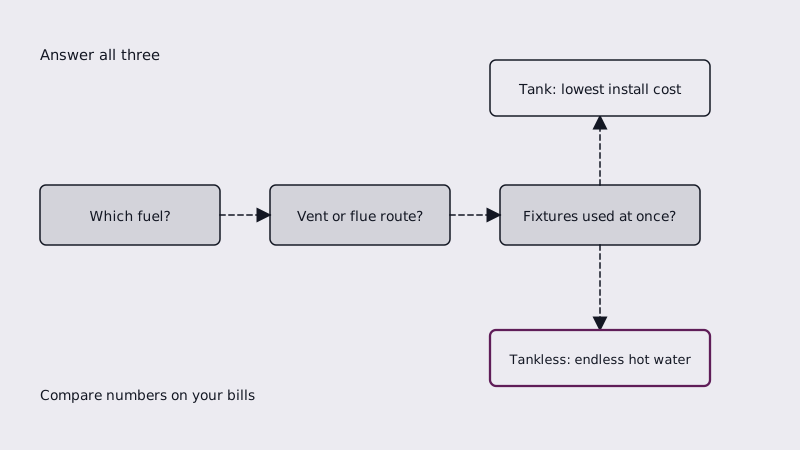
Neither wins everywhere. A tank suits a household that wants the lowest install bill and a plumber on any street who knows the unit. Tankless suits a home that wants endless hot water, a freed-up garage corner, and lower gas or power use. Gas line size, venting path, and the number of fixtures running simultaneously decide it.
Ask three questions before shopping:
- Does the house have natural gas, propane, or only electricity?
- Where would the vent or the flue go, and how long is the run?
- How many showers, dishwashers and washers are in use at the same moment?
Tankless units are rated by how many gallons a minute they can heat at a given temperature rise. A family running two showers and a washer needs a bigger unit than a couple living alone.
How do the running costs compare, and can you work out your own?
Federal energy guidance credits tankless units with a saving of roughly a quarter to a third for light users, around 41 gallons of hot water daily or fewer, and only about 8 to 14 percent for households near 86 gallons. The more hot water you pull, the smaller the gain.
You can build a calculator on paper with no website. Take the heater's energy label in kilowatt-hours or therms per year. Multiply by the rate printed on your own utility bill. Do it for both models and subtract. The result is your annual cost difference. Then divide the extra purchase and install price of tankless by that difference to get years to pay back. If the answer is longer than the unit's life, the tank is the better buy.
Electric units add a twist: resistance heating converts nearly all power to heat either way, so the saving is mostly from not keeping a tank warm. Standby loss on a modern insulated tank is modest, so the gap shrinks.
What a swap involves is itemized in our water heater replacement cost guide.
What does installing a tankless heater involve?
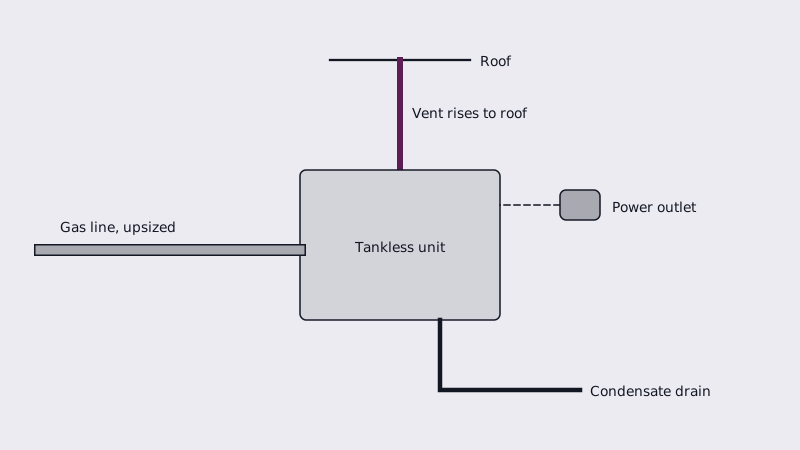
Replacing a tank with tankless is rarely a like-for-like swap. Gas models usually need a larger gas pipe, a new vent made for the high-heat exhaust, a condensate drain, and an electrical outlet to run the fan. Electric models draw a heavy load and may need a new circuit or a panel upgrade. A permit applies, and the plumber normally pulls it.
Permits in the City of Murrieta go through Building and Safety (951-461-6062, per the city page; confirm before calling). Wildomar addresses go through that city's own Building and Safety desk, and French Valley or Winchester through Riverside County. A tank also needs earthquake bracing, a California requirement that an inspector checks.
California regulates gas work, so enlarging the pipe is a job for a contractor, not a weekend. Read gas line plumbing and tankless water heater installation costs for more.
What about propane or a mini tank?
A propane heater works like a natural gas one but burns a different fuel, and the burner or orifice kit has to match. Some rural homes run on propane or electricity instead of piped gas, so have the plumber confirm which fuel applies before you order a unit.
A mini tank, usually 2.5 to 10 gallons, is a compact electric storage unit that serves a single sink or a bathroom far from the main heater. Whole-house use is out of the question. It tops up a distant tap with short bursts of hot water. For a tiny ADU with a single bath, a compact tankless or a small tank may be the sensible pick; the plumber sizes it by fixture.
How long does each type last, and who repairs it?
According to the Department of Energy, tankless units last more than 20 years and storage tanks about 10 to 15, though actual life depends on water quality and care. Third-party estimates call Murrieta water moderately hard to hard (roughly 6 to 11 grains per gallon, so check your district report), which makes scale control matter for both types.
A tank usually fails by leaking, and you replace it. A tankless unit usually fails in parts, so it is repairable: igniters, flow sensors, fans and the heat exchanger. Descaling with vinegar or a pump kit once a year slows buildup. Brand-specific help lives on our Navien repair and Rheem repair pages. Softening the supply protects both; see water softener installation.
Is the older 2016 comparison still valid?
The basic physics holds, but the numbers in 2016 articles are dated. Efficiency standards for water heaters tightened in 2015, which pushed larger tanks toward heat pump or condensing designs and raised tank prices. Use current manufacturer sheets and your own bills rather than a figure from an old post.
Talk of banning gas heaters circulates online. The regional air board decided in June 2025 to leave Rules 1111 and 1121 as they are, so nothing there forces a different heater on a replacement you plan today. Rules can change, so confirm with the air district before a big purchase.
To get pricing for both options at your address, use the quote request and tell us the fuel type and the number of bathrooms.
Common questions
Can I keep my gas tank heater and just add a tankless later?
You can, but plan the swap carefully. The tank's vent and gas pipe will not carry a tankless unit's load, so those get replaced then. A plumber may suggest sizing the gas line upward at the next repair visit so the later change costs less. Ask for that in the quote.
Does a tankless heater really give endless hot water?
Only up to its flow rating. It heats as long as water moves through, so it never runs out like a tank, but it cannot heat more gallons a minute than its rating allows. Open too many fixtures together and the temperature falls. Size it by your busiest hour.
Should I consider a heat pump water heater?
Possibly, since it can draw far less electricity than a standard electric tank. It needs air space around it, throws cool air, and costs more up front. Check current utility and state rebate pages before deciding, and ask the plumber whether the garage or closet has the clearance.
Do tankless heaters need yearly maintenance?
Most makers advise an annual flush to clear scale, and hard water makes that more important. Skipped flushing is a common reason for error codes and lower output, and some warranties ask for proof of it. A tank benefits from a yearly drain, along with an anode rod inspection.
What should I do right now about a leaking water heater?
Shut the cold inlet valve on top. Then turn off the breaker, or turn the gas dial to off or pilot, and phone for help. A dripping fitting or relief valve can mimic a failed tank, so have a plumber look prior to buying an entire new unit.
More services are listed on plumber murrieta.
Last changed