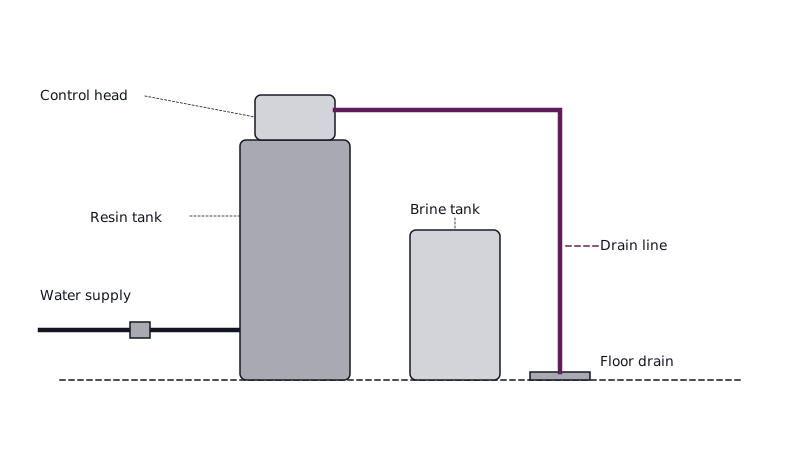
A water softener trades the calcium and magnesium that cause scale for sodium or potassium, and the plumbing around it decides whether it works. Your request goes from us to a local plumbing business. Its plumber visits, inspects your supply line, drain and outlet, then writes the install quote. The home page lists our other services.
What work is involved when a plumber puts in a water softener?
A plumber cuts into the main supply after the meter or pressure regulator, fits a three-valve bypass, connects the softener inlet and outlet, installs a drain line for the regeneration cycle, and sets an air gap so brine cannot flow backwards. Then they program the valve to your water hardness and test for leaks.
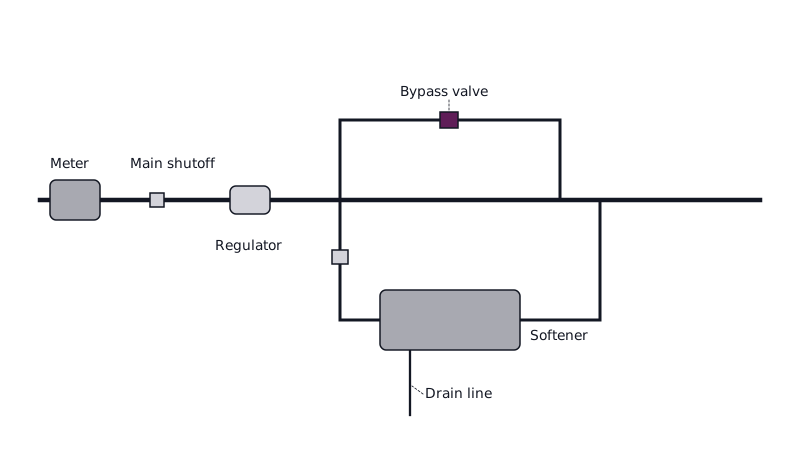
Here is what a typical job covers, in order:
- Find the best spot: near where the main line enters, with a grounded outlet within reach and either a floor drain or a standpipe. A garage wall next to the heater is a popular choice.
- Shut off the water, cut in the bypass, and make the connections.
- Run the drain hose to a legal discharge point, with an air gap.
- Load salt, flush the media, and program the head.
- Open the water slowly, check every joint, and show you the bypass.
A "loop" is a short stub of supply pipe, with a drain and an outlet, left near the main when a house is built so a softener can plug in later. If your builder left one, labor drops. Without one, the plumber must build that run from scratch.
Dealer-installed brands such as Whirlpool, Kinetico or Aquasana follow the same pattern. Read the manufacturer's manual for the head you bought, and ask any dealer whether the quote includes the plumbing or only the unit.
Which factors set the cost of fitting a softener?
The published guide we checked puts labor for a professional install at roughly $300 to $600, and a salt-based unit installed for a one to three person household at roughly $800 to $1,800. For larger units, installed prices reach $1,500 to $3,000. These are national averages, so your quote will differ.
What changes the number:
| Item | Guide range | Why it varies |
|---|---|---|
| Labor, standard install | $300 to $600 | Pipe material, distance to drain |
| Salt-based, 32,000 grain, installed | $800 to $1,800 | Brand and valve type |
| Salt-based, 48,000+ grain, installed | $1,500 to $3,000 | Larger family or harder water |
| Salt-free conditioner, installed | $1,000 to $2,500 | No drain, no salt |
| New electrical outlet | $100 to $200 added | Only if none is nearby |
| Permit fee | $75 to $200 | Where a permit applies |
Source: alertplumber.com water softener installation guide, national averages, read November 2026. Treat the table as a rough guide only. A plumber sets the actual price after seeing the pipe.
Two cost drivers show up locally. First, pipe buried in a slab may be harder to reach than pipe in an attic. Second, a softener needs a drain nearby, and a garage without one needs a standpipe built.
What tells you a Murrieta house could use a softener?
The signs are white crust on faucets and shower glass, spots on dishes, poor lather from soap, and a rumbling water heater. Murrieta tap water is generally rated moderately hard to hard, roughly 6 to 11 grains per gallon in third-party estimates (waterhardness.org, 2023 to 2025), but your address may differ.
Which district bills you matters: in Murrieta the supplier is most often Eastern Municipal Water District (EMWD), with Western Water and Rancho California Water District covering some addresses, so check your bill. EMWD publishes a yearly water quality report. Compare its number against a test strip, which costs a few dollars.
Wildomar and Canyon Lake are usually served by Elsinore Valley Municipal Water District, which can supply its own report on request. Rural homes on a well need a lab test, because a well can carry iron or other minerals that change the equipment you need. A softener alone may not fix that.
If you are weighing what to buy, our pages on softener installation costs, whole-house softener installation cost and preventing hard water scale explain the choices. Already dealing with buildup? Read about removing hard water scale.
What extra jobs come up: shower head softeners, brine tanks, loops?
A shower head filter is a small cartridge you screw on yourself and does not need a plumber. A brine tank is the salt reservoir that comes with most whole-house units and sits beside the control head. A loop is the pre-plumbed stub described above. Whole-house systems are the plumber's job.
Shower-head "softeners" use vitamin C or similar media to remove chlorine, and they do not remove hardness. That makes them a different purchase. They are useful if skin and hair are the complaint but will not stop scale in pipes or the heater.
The brine tank needs refilling with salt every month or two. The plumber can place it somewhere easy for you to reach, clear of the garage door and the car. Some rural lots have septic systems, and on one of those you should ask whether regeneration discharge is acceptable for the tank. Some local agencies limit softener discharge, so confirm with your water district and, in an HOA, the HOA.
Permits can apply. Ask the plumber whether your city or county wants one: the City of Murrieta Building and Safety Division, the City of Wildomar, or the county for unincorporated French Valley and Winchester. You can read how a plumber installs a softener step by step, how the service is quoted, and how a softener affects the water bill.
Common questions
How much time will the plumber spend at the house?
Expect a few hours where a loop already exists, and as much as a whole day for a first install that needs fresh pipe, a drain stub and an outlet. After looking at the garage or utility room, the plumber gives a time estimate, with the written price alongside it.
What should the written quote list?
Valves, the drain run, any new outlet, a permit if one applies, the brand and grain size, and what happens if the old pipe turns out to be corroded. Check as well that the business holds a California contractor license; the state generally requires one when labor and materials come to $1,000 or more.
Does an adult have to stay at home during the work?
Plan on an adult being there when work begins, to agree where the unit sits, and again when it finishes, to learn the bypass and the settings. In between, the plumber just needs open entry to the garage or utility room and the main shutoff. Agree access first if you will be out.
How does this site work?
You submit a quote request on this page, and it is forwarded to local plumbing businesses. Those businesses pay this site a fee for the referral. The one that replies writes a price for the job and carries out the work. This site does not do plumbing, and no price is binding until you agree it with that business.
Guides in this section
- Water softeners and treatment
A working softener adds only a little water use, but a stuck valve or bad setting can send water to the drain all day.
- Hard water and softeners
Hard water scale prevention in Murrieta: how to read ppm and grains per gallon, what slows scale on heaters and fixtures, and where…
- Softener install
How a whole-house water softener goes in: where it sits, the plumbing, drain and power it needs, and what to check for a Murrieta or…
- Removing hard water scale
How to remove hard water scale from faucets, showerheads, glass and water heaters in Murrieta, what not to use, and when a softener is the…
- Costs
What sets the price of a water softener installation in Murrieta: loop, drain, plumbing changes, brand and permits, plus how to compare…
- Water softener installation service
What a water softener installation visit covers in Murrieta and Wildomar: bypass, drain air gap, wells and septic, permits, manuals and…
- Softener installation cost
What drives the price of a whole-house water softener install in Murrieta: hardness, sizing, drain and power, salt-free options, permits…
Last changed