Scale forms when dissolved calcium and magnesium come out of water, mostly where it is heated or evaporates. You prevent it by finding your hardness number, keeping water heaters at a sensible setting, flushing tanks, wiping fixtures and, where the number is high, treating the water before it reaches the pipes. A softener is one option; the plumber for softener installation page covers the job itself.
Murrieta tap water is typically rated somewhere between moderately hard and hard, so scale is a fact of life here, not a defect in your house. The point is to slow it. Below you will find how the numbers read, what actually helps, and where claims about gadgets need caution.
How do ppm and grains per gallon measure hard water?
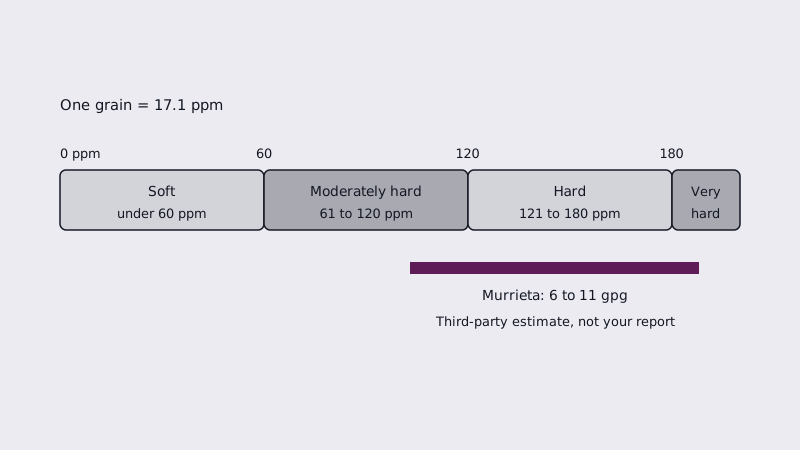
Hardness is dissolved calcium and magnesium, reported as parts per million (ppm, or mg/L) or grains per gallon (gpg). One grain per gallon equals about 17.1 ppm. A common scale calls under 60 ppm soft, 61 to 120 moderately hard, 121 to 180 hard and above 180 very hard. Reports use one unit or the other, so convert before comparing.
For Murrieta, a third-party aggregator lists a citywide average of 187 ppm (about 10.9 gpg) and an EMWD figure of 106 ppm (6.2 gpg), with report years 2023 to 2025. Those two disagree, which tells you the number varies by source and by address.
Treat that as a rough range of about 6 to 11 gpg, and confirm with your own district's report. Your water bill names the district that serves you, and that district puts out a water quality report every year.
What does scale buildup actually do?
It narrows pipes, builds a coating on heating elements and at the bottom of tanks, clogs aerators and showerheads, leaves white film on glass and spots on tile, and makes soap work poorly. A water heater with scale on the bottom works harder, and a scaled element can fail. Because the damage is slow, people tend to overlook it.
Signs to watch for: weak flow at one faucet, a gritty noise from a tank, white crust around the foot of a spout, or a heater slower to deliver hot water.
Scale rarely causes a sudden burst, yet anything that heats water wears out sooner because of it. Our pages on water heater replacement timing and the anode rod tie into this. For existing crusted fixtures, go to removing hard water scale.
What slows scale down without a softener?
Several small habits help: set the water heater thermostat no higher than you need, since scale forms faster at higher temperatures; flush the tank once a year to wash out sediment; wipe shower glass after use; soak aerators and showerheads in vinegar when they clog; and swap out the anode rod ahead of the point where it is used up.
None of these removes the minerals, so they slow the damage rather than stop it. If you already have a high number, they are first aid, and treatment is the next step.
Wiping works because scale is the residue of evaporated drops, and removing the drops removes the residue. A squeegee in the shower takes seconds and beats scrubbing later.
Tankless heaters scale too, and numerous manufacturers require a scheduled descaling flush; the manual gives the interval. If you are comparing tank and tankless, look at your own water first.
Does a water softener prevent scale?
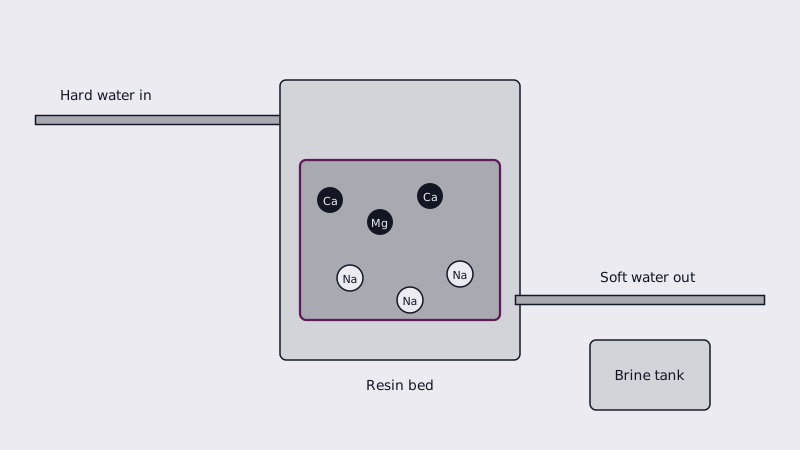
Inside the resin tank, a salt-based softener swaps out calcium and magnesium in exchange for sodium, leaving the outgoing water soft and does not form hard scale. It is the most direct way to prevent scale on the whole house. The cost is salt, maintenance, drain water from regeneration, and local rules in some California districts.
Ask your water district and city before you buy, because California allows local limits on salt-regenerating units where wastewater salt is a concern. Sizing should follow your hardness and the household's water use; see softener installation cost for the quote lines and how installation works.
Some households keep a softener off the kitchen drinking tap. Another point to weigh: whether softened water affects your bill, which is covered on the water bill page.
Do anti-scale conditioners work?
Evidence is mixed. Template-assisted crystallization devices claim to change how minerals form so they do not stick, and some people report less crust. They do not remove hardness, so soap and taste stay the same. Treat advertising claims with caution and ask a seller for independent test data covering water like yours.
A conditioner may suit someone who wants less scale without salt or drain water, and who accepts a smaller effect. A softener suits someone who wants a clear reduction. Which one fits comes down to your number, your budget and local rules.
Magnetic or electronic gadgets that clamp onto a pipe have weaker support than either. Ask for evidence before paying.
Does hard water scale affect pH or taste?
Hardness and pH are separate measures. Hard water is often slightly alkaline, but pH tells you how acidic or basic the water is, not how many minerals it carries. Taste is more affected by chlorine and other dissolved solids than by calcium. Softening barely shifts pH, though it raises sodium slightly.
For people on low-sodium diets, ask a doctor about softened drinking water. Plumbers can keep one tap unsoftened.
Blue-green stains point to copper from slightly acidic water rather than scale, and need a different check.
How do rural wells and other districts differ?
Well water on rural lots in Fallbrook, Rainbow, De Luz and the Santa Rosa Plateau edge can be harder than treated city water, and it has no utility report to check. Test it. One Rainbow report listed about 15.6 gpg in 2021, which shows how much it can vary from Murrieta. Do not assume.
A lab test measures hardness, iron and other minerals together, which matters when choosing a treatment. Iron and sulfur need different equipment than a standard softener.
Requests sent through the form below are passed to a nearby plumbing business, which pays a fee for the introduction; that business quotes the work and carries it out, not this site. Start from the Murrieta Creek Plumbing home page to see other jobs.
Common questions
What hardness number counts as a problem?
Most guides treat anything above about 120 ppm (7 gpg) as hard, and scale becomes visible above that. At the 6 to 11 gpg range described for Murrieta, expect spots on glass and crust on heaters. A test strip gives a first reading, and your district report gives a better one.
How frequently is flushing a water heater needed against scale?
Many manufacturers advise roughly an annual flush, with extra flushes where the water is hard. Flushing washes out loose sediment, not hard crust. Follow the heater's manual, and if the heater is old, have a plumber inspect the drain valve before you open it, since old valves can fail.
Is vinegar safe for removing scale?
On faucets, showerheads and glass, yes, soaked for a while and rinsed well afterward. Avoid natural stone, which acid will etch, and never mix vinegar with bleach. Do not pour it into a water heater on your own; read the manufacturer guidance for that appliance first.
Will softened water fix existing scale?
It stops new scale from forming and may loosen old deposits slowly, but it will not remove thick crust that is already there. Existing buildup on fixtures needs to be cleaned off by hand with vinegar, or the worn part needs to be replaced.
Can scale hurt a tankless heater?
Yes, it can. Scale coats the heat exchanger inside a tankless unit, reduces flow, and can trigger error codes or shutdowns. The manufacturer publishes a descaling schedule for each model, so follow it, and do the flush more often if your water is on the hard end.
Last changed