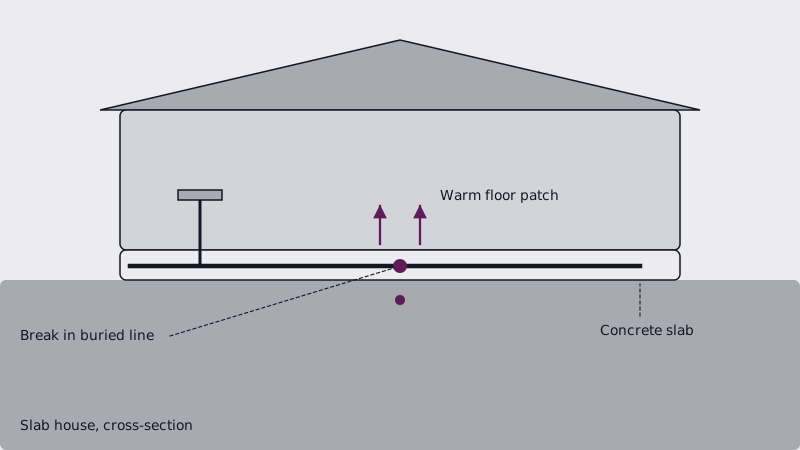
A slab leak means a water line buried in or beneath the concrete foundation has failed. The choice is a targeted spot repair, with the floor opened right above the break, or a repipe, with fresh lines routed via the attic or walls and the old ones capped. A single leak where the rest of the pipe is sound favors the spot repair, while repeated leaks favor the reroute. For the broader topic, visit our leaks and burst pipes page.
What tells you the leak is below the floor?
Typical signs: a warm patch of flooring under your feet, the sound of water moving although every fixture is shut, a meter still turning after the house is shut down, damp carpet or lifting laminate, and a bill that climbs for no reason. A warm spot points to the hot line, because heat travels up through the concrete.
None of these proves it. Roof leaks and plumbing in walls can give the same hints. Begin with the shutoff test: turn off the main valve where it enters the house and watch the meter. If it stops, the leak is on the house side; if it keeps moving, the problem is outdoors, between meter and house. After that, a plumber uses listening gear, a thermal camera or pressure checks on isolated lines to narrow it to a patch of floor. Costs and methods are covered in how slab leaks are found and fixed.
Should you repair the leak under the slab?
A direct repair makes sense when it is the first leak, the rest of the pipe looks sound, and the break sits somewhere reachable such as a hallway or a closet rather than under a kitchen island. The plumber cuts through flooring and concrete above the break, replaces the damaged section, pressure-tests it and patches the slab.
You will pay for more than the pipe. Flooring may need pulling up, the concrete needs patching, and finishing the surface to match tile or wood is often a separate trade. Ask in advance who handles flooring, baseboards and drywall, because that is where surprise bills appear. Dust control matters too: concrete cutting produces silica dust, so ask how the area will be sealed off.
The weak point of this approach is that it fixes one spot of a line that may be wearing along its whole length. If the pipe failed from corrosion or from pressure that ran too high for years, another pinhole elsewhere can follow within a few years. That is the argument for the other option.
When is a repipe smarter than patching the pipe again?
A repipe makes sense after a second or third slab leak, when the pipe type is known to wear out, when several walls already have pinholes, or when the break lies under something expensive. You swap one larger job for an end to digging in the floor.
In a rerouted system, the plumber seals off the buried lines and installs new supply pipe, usually PEX or copper, through the attic or inside walls to each fixture. The slab stays intact. In single-story homes, attic runs are often straightforward. In two-story homes the route is harder, since lines must drop through walls to reach ground-floor fixtures.
Fresh piping also lets the plumber put in a pressure regulator and a shutoff you can reach. The whole-house version of this decision is in repiping a house, and for materials see PEX versus copper. If a plumber names a different method such as lining the pipe, ask what it does to hot-water lines and how long the lining is expected to last.
How should a house on a slab be repiped?
Typically the old buried lines stay in the ground unused while new ones go overhead, tied into a new manifold or branch lines near the water heater. The floor stays intact, and the pipes become reachable for later work. Because the best choice depends on the house layout, have the plumber sketch the route before work starts.
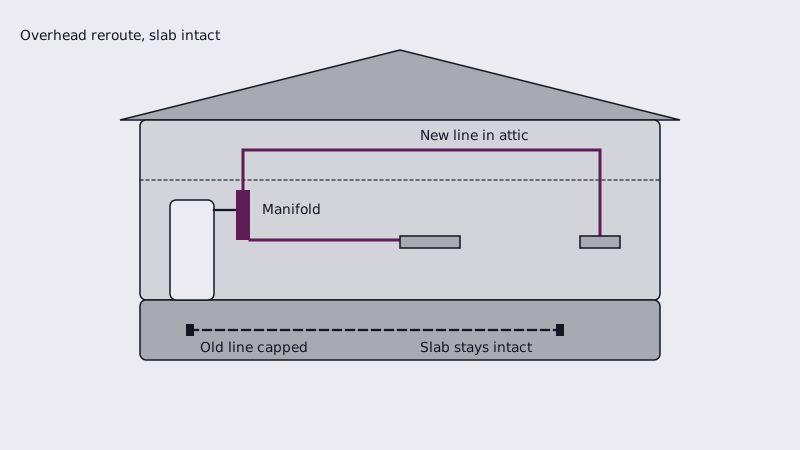
Ask to see where each line will run, how many wall and ceiling openings it needs, who closes them up and paints them, and how the water will be off during the day. A tidy repipe for a single-story house is often a matter of days, not weeks. The attic route also lets the plumber label the shutoffs.
Mention the age of the home. Murrieta homes from about 2000 on make up a large part of the housing here, with the median year built around 2000 in third-party census summaries, so most are old enough for pipe wear but too young for galvanized steel. Older properties around Old Town Murrieta may have mixed materials. Our guide to older galvanized lines covers that case.
Is a permit required for slab leak work?
Often yes. A repipe alters the plumbing system, so the building department for your address usually wants a permit for it. Within the City of Murrieta, phone Building and Safety on 951-461-6062. Unincorporated areas such as French Valley and Winchester come under Riverside County Building and Safety, so check with the county before work starts.
In California, a contractor license is generally required once a job needs a permit, or once labor plus materials reaches $1,000. Request the license number and check it on the state board's website, cslb.ca.gov. A written contract is expected once work passes a small threshold, and down payments are capped, so be wary if anyone asks for a large cash deposit. Which office applies depends on your street, and the areas we cover page lists the communities by name.
What happens in the days after a slab leak is found?
First cut the water to the broken section, or to the whole house at the main valve, so the leak stops washing soil away from the foundation. Next, take photos of the damage and tell your insurer before repairs begin. Many policies treat the resulting water damage differently from fixing the pipe itself.
Next comes the choice between repair and repipe, ideally with a separate written quote for each option. Compare what is included: flooring, patching, permits, drywall, and drying. On timing, a spot repair is typically a one- or two-day job, while a repipe takes days, though access and permits change that. We hand your request to one local plumbing business that pays us a fee for taking it, and that business then visits and gives the quote. For costs, see slab leak repair cost, and you can submit a request through the price request page.
Common questions
Can a leak under the slab harm the foundation?
A long-running slab leak can wash soil out from under the concrete and soften the ground, which is one reason not to wait. Minor leaks can take a long while to matter. Large or hidden ones can add up to big water bills and wet subfloor. A structural engineer, not a plumber, judges any cracking.
Why do slab leaks happen in newer tract homes?
The usual culprits are copper that wears from the outside against concrete, high water pressure, hard water, shifting soil and a pipe that was nicked during construction. Plumbers find all of these. Third-party estimates put Murrieta tap water in the moderately hard to hard range, so check your district's water report for your address.
Does home insurance cover a slab leak?
Policies differ. A number of them cover the water damage after a sudden break but exclude the pipe repair and gradual leaks. Some will also fund removing and replacing flooring to reach the pipe. Read your policy, phone the insurer before work begins, and keep the plumber's written findings safe.
How long can a slab leak go unnoticed?
For weeks or months, if the leak is small. The meter and the water bill are the best early warning. EPA reports an average household loses more than 9,300 gallons per year through leaks, and a concealed leak under concrete can exceed that sooner. Do the meter test with everything off.
Is a repipe the better long-term fix?
Often, if the pipes are old or the leaks are repeating. It costs more up front and means opening walls or ceilings, but it ends the cycle of digging. If this is the first leak in a newer house, a spot repair is a reasonable choice. Whichever one the plumber recommends, you should hear the reasoning.
More services are listed on plumber murrieta.
Last changed