Plumbers fit both materials into Murrieta houses, and both are approved by the California Plumbing Code for water supply. PEX is a flexible plastic tube, cheaper and quick to install. Copper is a stiff metal with decades of history behind it. If you are planning a full replacement, the house repipe page covers the whole job, and this page covers the pipe choice itself.
Which suits a Murrieta house better, PEX or copper?
For most whole-house repipes, PEX is the sensible choice: it bends around corners, needs fewer fittings, and shortens the job. Copper fits better where pipes are exposed, near a heater flue, or where an owner wants metal for resale. Neither is wrong. Clean workmanship and water that suits the metal count for more.
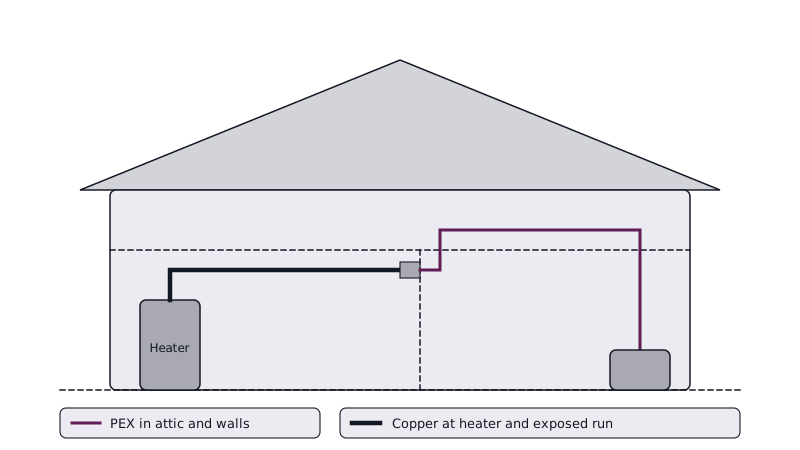
Think about where each line runs. Within a wall or attic, PEX saves labor. Across a garage ceiling in view, copper looks tidy and resists knocks. At the water heater, many plumbers still use a short copper stub before the PEX because of the heat and, in some cases, because the code wants a set length of metal connector.
Local housing helps frame this. Census-based estimates put the median Murrieta home near the year 2000, so the choice often arises when old pipe in a slab or an attic needs rerouting rather than in a fresh build. An older Old Town or Hot Springs house may carry galvanized steel, which is a different story; see galvanized pipe replacement.
How does the cost compare?
PEX tubing costs noticeably less per foot than copper, and a PEX job takes fewer labor hours, so a repipe in PEX typically quotes lower. Copper prices move with the metal market, which makes copper quotes less stable. We are not printing a dollar figure because no source we read gives a current local number; ask for itemized quotes in each material.
When you compare quotes, check what each includes. A copper job needs soldering, which means a fire watch, and sometimes more drywall repair around the cuts. A PEX job relies on crimp or expansion fittings plus a manifold. Drywall patching, painting and permit fees are often separate lines. Our PEX repipe cost page lists the cost drivers in detail.
Does half-inch copper or half-inch PEX move more water?
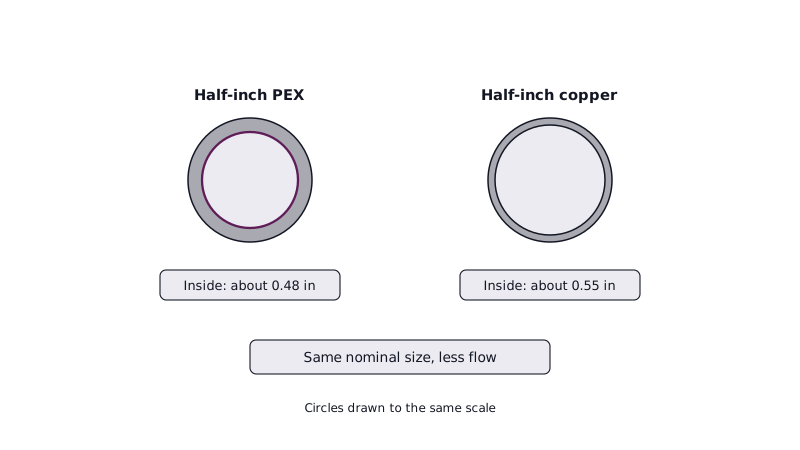
Copper moves slightly more. Nominal half-inch PEX tubing has a narrower inside diameter than half-inch copper, roughly 0.48 versus 0.55 inch in common manufacturer tables, so friction loss is higher in PEX at the same size. Plumbers offset this by sizing up one step or by running home-run lines from a manifold.
For a typical home the difference is small, and good design hides it. One 3/4 inch trunk feeding a manifold with 1/2 inch branches gives each fixture its own supply, so one shower rarely drops when another opens. Where a long run feeds a hot tub or an ADU, the plumber may pick the next size up. If you notice poor pressure after a repipe, the cause is often an undersized trunk or a regulator, not the material.
How long does each last, and how does cold weather matter?
Copper has a service record of many decades when the water is kind to it. PEX makers state long design lives, commonly 40 to 50 years, but PEX is younger, so the evidence is shorter. Murrieta rarely sees hard freezes, yet cold snaps do happen on the Plateau and in rural pockets, and PEX tolerates ice better because it expands slightly instead of splitting.
Pinhole leaks are copper's known weakness, and water chemistry is the usual cause. Read your water district's quality report. A pinhole in one spot often means more elsewhere; read the guide on repairing pinhole leaks in copper pipe before patching it yourself.
PEX has its own limits. Sunlight breaks it down, so it cannot sit uncovered outside, and it is not meant for gas. Rodents and some chemicals can damage it. Soil contact needs the right sleeving and fittings.
What are the connection types: crimp ring, stainless clamp, expansion, push-fit?
PEX joins with a copper crimp ring and a calibrated tool, with a stainless cinch clamp, with expansion fittings of the Uponor type, or with push-in connectors that need no tool. Each needs its own tool and fitting set, and the parts are not interchangeable. Push-fit parts are quick for repairs, but check with the building office before using them behind walls.
Why this matters to you: a repair needs the right fitting for the system already installed. Mixing crimp and expansion systems on one joint is a common mistake, and a failed joint behind drywall is costly. Ask the plumber which system is in your walls and keep the name.
Copper joins by sweat-soldering with lead-free solder, or by press fittings that use a power tool. For the home handy owner, the gap is a torch and practice: soldering wet pipe is hard, and a bad joint may seep for months.
What about health, PVC and CPVC, and mobile homes?
Both materials are sold for drinking water under national product standards, and neither is considered unsafe when installed properly. Some owners prefer metal and others dislike the metal taste or pinholes. CPVC is a rigid plastic used in some tract homes and handles hot water; PVC is for cold lines and drains, not hot supply.
Mobile homes have used PEX widely under the floor, since flexible tube survives vibration and cold better. Details for those jobs live on the mobile home plumbing page.
In California, repiping a house takes a contractor with a license, plus a permit from the city or county. In Murrieta the permit comes from Building and Safety, 951-461-6062 (city page; confirm), and the plumber normally files for it. For old plastic supply lines, see polybutylene replacement.
To compare itemized PEX and copper quotes at your address, use the quote request and say how many bathrooms you have and if the house sits on a slab. We pass the request to a nearby plumbing company; companies that take requests pay us a fee.
Common questions
Can PEX and copper be joined together?
Yes, with the right transition fittings: a copper stub with a PEX crimp or expansion adapter, or a push-fit coupling rated for both. Many repipes mix them, with copper at the water heater and PEX in the walls. Joints between dissimilar metals, such as steel and copper, need a dielectric union instead.
Does PEX freeze and burst like copper?
PEX can ride out a few freezes thanks to its stretch, yet freeze-proof it is not. Fittings and the area where tube meets a hard part can still split. Insulate lines in unheated garages and attics, and leave outdoor faucets covered on the cold nights that do occur around the Plateau.
Does PEX affect water pressure compared with copper?
Not in a well-designed system. At the same nominal size PEX is narrower inside, so the plumber upsizes trunk lines or runs a manifold. Pressure complaints after a repipe usually trace to the regulator or an undersized trunk. Pressure above 80 psi is a problem under the plumbing code, so have it tested.
Is it safe to leave PEX in a sunny spot?
No. Ultraviolet light weakens PEX over weeks or months, so makers limit exposure before installation and require covering afterward. Outdoor runs need sleeves, paint rated for it, or a different material such as copper. Ask the plumber about any section crossing an exposed wall.
How do I tell what pipe is in my house?
Copper looks like a pipe in brown, orange or green patina and is rigid. PEX is flexible plastic, often red for hot, blue for cold or white, with printing along the side. Gray flexible plastic with a stamp reading PB is polybutylene, which is its own concern. Look at the heater connections and the lines below sinks.
Every service and price guide is on plumber across Murrieta.
Last changed