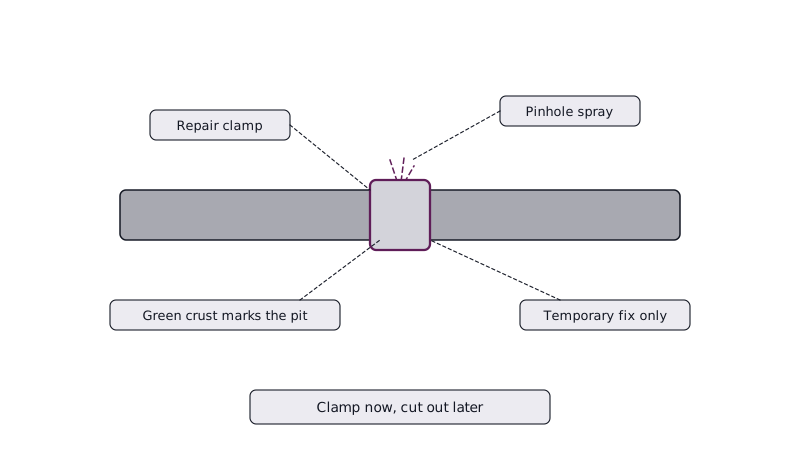
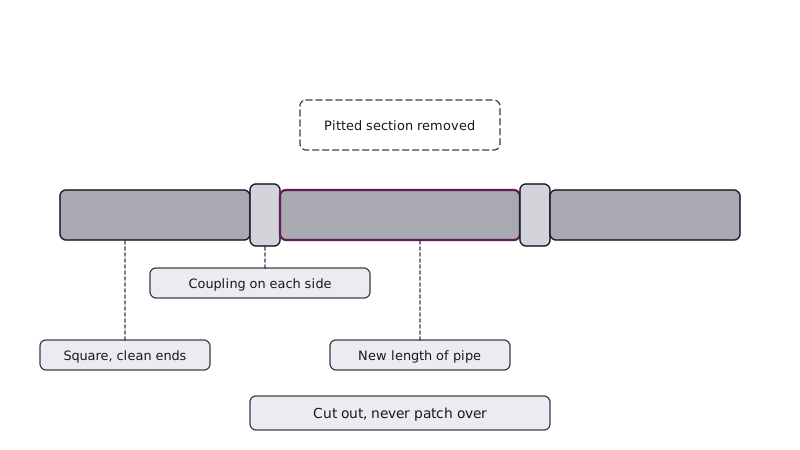
Shut off the water, wipe the pipe dry, and seal the hole for now with a pipe repair clamp, epoxy putty or self-fusing tape. After that, plan the real repair: cut out the pitted section and fit a new length of pipe with solder fittings or push-fit couplings. One pinhole usually means thinning elsewhere, so check the rest. Wider help sits under plumber for leaks.
Copper pinholes start inside the pipe, where water chemistry, flow speed and sediment eat small pits through the wall. You see the result as a fine spray, a green stain, a damp spot on drywall or a ceiling stain. The steps below cover finding the leak, a safe temporary fix, a lasting one and the cleanup.
What stops a pinhole leak immediately?
Close the main, or whichever local valve feeds that line, and empty the pipe through the lowest tap. Dry the spot. Wrap a rubber-lined repair clamp around the pinhole and tighten it, or press epoxy putty over it, or wind self-fusing silicone tape tightly with overlapping turns. Restore the water slowly.
A clamp is the most dependable of the three, and putty works only on a bone-dry, scoured surface. Any of them is a stopgap. Do not leave a patch for months in a wall or ceiling, where a failure would damage drywall and insulation.
For a leak behind a wall or above a ceiling, read about the warning signs of a ceiling leak and stopping water coming through a ceiling to judge how much needs opening up.
How do I find the pinhole in the first place?
Follow the water. Wipe the suspect area, then watch for beads or a mist, and check copper for a green or white crust. A damp ceiling stain is usually below the leak, not at it. A moisture meter or a sheet of dry paper held against drywall helps. Turning every fixture off and watching the water meter confirms a leak exists.
If the meter moves with every tap closed, a leak exists somewhere. EPA figures put typical household leakage at over 9,300 gallons a year. Pinholes in slab or buried lines need detection tools; see slab leak detection and leak detection cost.
Hot water lines pit sooner than cold, so check near the water heater first. One warm patch of floor hints at a leaking slab line, and that is a plumber's job.
What is the permanent fix for a copper pinhole?
Cut out the pitted section, clean the ends, and join a new piece with soldered copper fittings or push-fit couplings. Solder must be lead-free, as California requires for drinking water lines. Push-fit couplings are faster and need no flame, but the pipe ends must be square, clean and fully seated.
A capable owner can handle a short stretch of exposed pipe. Hand it to a plumber when the leak is inside a wall, beneath a slab, on a long run, or near gas or electric. California generally requires a contractor license for jobs of $1,000 or more in labor and materials, or jobs that need a permit; the CSLB site has the current rules.
The solder kit is pipe cutters, deburring tools, flux, lead-free solder, a torch and a fire cloth, while push-fit needs only a cutter and a depth gauge. Skip the torch if working with one near a wall makes you uneasy.
What if I find a second pinhole, or more?
More than one pinhole in a short time is a sign the pipe is failing in general, from corrosion that has weakened a whole run. Patching one at a time is chasing leaks. A plumber can inspect, pressure test and quote either a section replacement or a repipe. Our repipe house page covers the larger job.
Hard water, high flow speed and certain water chemistry shorten copper life. Murrieta tap water is usually moderately hard to hard, and the supply may come from more than one district, so check your district's report.
Pinholes in copper under a slab often show as a hot spot, the sound of running water or a higher bill. For the clues, read high bills with no visible leak.
What about a leaking PVC joint or a burst pipe outside?
After the pipe is drained and dry, a leaking PVC joint is normally cut away and swapped for a coupling, set with primer and cement. For a burst pipe outside, shut the supply at the main, empty the line, and remove the split section to fit a coupling. See stopping a leak in plastic pipe.
For a temporary fix on plastic, use a clamp, or a rubber patch held with a hose clamp. Cement only cures on dry pipe.
On rare cold nights, outdoor lines in Murrieta and the rural areas around Winchester and De Luz can freeze; insulation and draining hose bibs help. For an underground burst, start with the general leaking pipe repair guide, then read telling whether a pipe has burst.
How should I dry out a ceiling or wall after a leak?
Stop the water source first. Then remove soaked drywall or insulation, run fans plus a dehumidifier, and aim for dry material within a day or two. Mold can begin within a couple of days in damp material, so speed matters. Sagging drywall should be cut out where wet instead of waiting.
Photograph the damage for any insurance claim, and see what to ask in our page on insurance and burst pipes. Inspect electrical items in the wet area, and when in doubt, switch off the breaker.
Do not paint over a stain until the area is dry and the leak is fixed.
Submitting the form passes your request to a nearby plumbing company. The company gives the quote and does the work, and it pays this site a fee for the referral. Other jobs are listed on the Murrieta Creek Plumbing home page.
Common questions
Can I solder a pinhole leak without cutting the pipe?
Not reliably. Solder will not bond to a wet or corroded surface, and a patch of solder over a pit often fails. The pipe around a pinhole is already thin, so the better repair is a cut-in section. A clamp is a better short-term choice than solder over the pit.
How long can a repair clamp hold?
It varies. Some hold for years, others weep within weeks, depending on pressure, pipe condition and installation. Treat it as temporary and schedule a permanent repair. Look at it daily at first, and watch the surrounding wall or ceiling for stains.
Does epoxy putty work on pressurized pipe?
Sometimes, when the pipe is drained and bone dry and the putty is pressed in firmly, but it is the least dependable option. Putty must cure for the time the manufacturer states, and plenty of brands are not rated for constant pressure. Use a clamp if you can.
Why do copper pipes get pinholes?
Water chemistry, flow speed, sediment, flux left from soldering and electrical grounding currents can all pit the wall from inside. Hard water scale sometimes protects a pipe but can also trap corrosive deposits. Examining the pipe and the water lets a plumber say whether the cause is local or general.
Is a pinhole a reason to phone a plumber?
Yes, when the leak is hidden inside a wall or below a slab, keeps returning, sits near the electrical panel, or you would simply prefer not to use a torch. The plumber can establish how far the damage runs and quote a section repair or a repipe.
Last changed