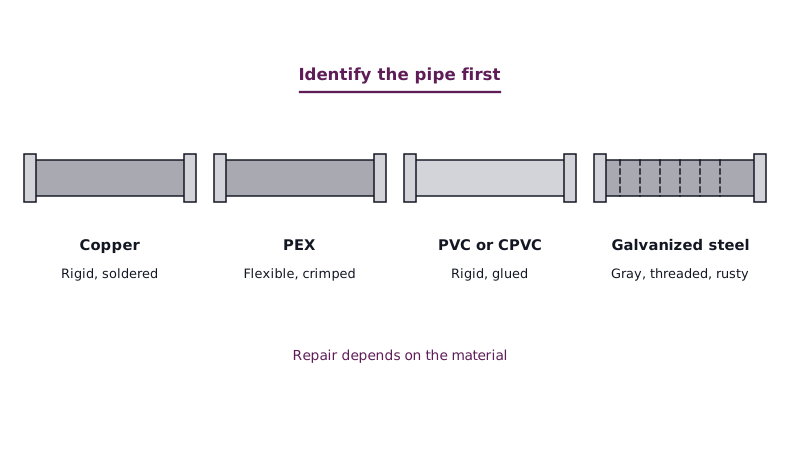
Before any repair, close the main shutoff, open the lowest tap in the house to drain the line, and look at the pipe. Color and feel tell you the material: orange-brown metal is copper, flexible red, blue or white tubing is PEX, rigid white or cream plastic is PVC or CPVC, and gray threaded steel is galvanized. For the broader view, see the leaks and burst pipes guide.
What kind of pipe is leaking?
Copper is rigid, metallic and joined by soldered or push-fit fittings. PEX is flexible plastic tubing with crimped or expansion fittings, and the colors are red for hot lines and blue for cold. PVC and CPVC are rigid plastic joined with solvent cement. Galvanized steel is dull gray with threaded joints and often rusty. Polybutylene is gray, flexible and was used mainly before the mid 1990s.
Most Murrieta homes were built around 2000 or later per third-party census summaries, so galvanized steel is less likely, though your own pipe is what counts. Older houses near Old Town Murrieta and Murrieta Hot Springs may differ, and an addition may mix materials. Only you can check what your house has, so inspect the pipe at the heater outlet, beneath the sinks and by the main.
How is a leaking copper pipe repaired?
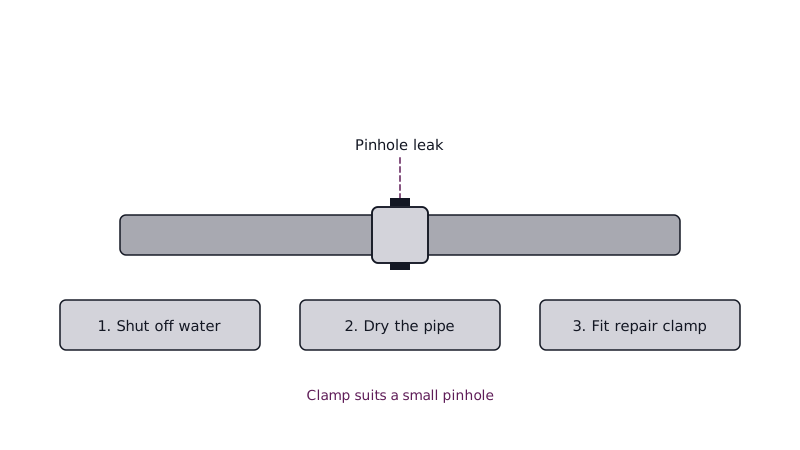
A small pinhole calls for closing the water, drying the pipe, and putting a repair clamp or push-to-connect coupling over a clean stretch of it. For a failed soldered joint, a plumber cuts it out and sweats in a new fitting. If pitting is visible in several places, replace the run instead of chasing leaks.
Copper pipe that leaks from the inside out, with green crust or tiny pinholes, is wearing from water chemistry, pressure or both. A repair holds, but another often follows. A section replaced with PEX or copper through a coupling may be the sensible fix. See pinhole leaks in copper for detail, and PEX versus copper for a comparison of materials.
Soldering needs a torch near wood and insulation, so there is a fire risk. If you are not trained, use push-fit couplings or call someone.
How do you mend a leaking PEX line?
With a PEX cutter, remove the damaged length, then reconnect the ends using a crimp ring, clamp ring or PEX-rated push-fit coupling, with the tool that suits the system. PEX does not take solder, tape or glue. Repair sleeves are a short-term fix. A leak at a fitting usually means the ring was not seated.
Match the system: crimp and clamp tools differ, and expansion systems need their own tool. Keep PEX out of long sunlight, because UV weakens it. Many repairs are quick once the water is off. Ask a plumber where the line runs through walls or the attic, since leaks near manifolds are common.
How is a leaking plastic pipe repaired?
On PVC or CPVC, remove the leaking section and glue in a coupling with the correct primer and cement, working only on dry pipe. Repair tape and epoxy hold briefly. Use CPVC cement on CPVC. Do not mix pipe types without the right transition fitting. A cracked fitting should be replaced, not patched.
Wait out the curing period stated on the can before you bring the pressure back. For a slow weep at a glued joint, the joint was likely never fully welded. A pressurized plastic line that sprays at a joint needs a full redo. For sprinkler lines the same applies, and you can find a longer walkthrough in stopping a leak in plastic pipe.
What about leaking galvanized steel?
Galvanized steel rusts away from the inside, so a leak signals the pipe is nearly worn out. A clamp can buy time, but threaded joints seize and break when you try to unscrew them. In most cases the right fix is to replace the run with copper or PEX.
Galvanized pipe also narrows with rust, which drops water pressure before it leaks. Brown or rusty water from the tap is another sign. Houses old enough to have it are most likely in the older parts of town. For the full story see galvanized pipe replacement.
What about polybutylene pipe?
Gray flexible polybutylene was used in many homes up to the mid 1990s and has a history of failures at fittings. If you find it, a plumber can assess it. Most owners replace the whole system rather than repair one joint. Most Murrieta homes are newer than that, but check older ones.
Read polybutylene pipe replacement for what to look for. If an insurer asks, a plumber's written report of the material is useful.
Can a leaking joint be fixed without replacing the pipe?
Tighten threaded joints a little after draining them, wrap threads with fresh tape or paste, and replace washers on compression fittings. A leaking solder joint needs reheating or a new fitting. A leaking slip joint on a drain needs a new washer. If the pipe is crusted or deformed, replace it.
Sealants labeled for pipe repair might close a weep for a while. They do not belong on a gas pipe, and they are not a permanent answer for pressure lines. Keep expectations modest and plan the real repair.
When is a leak a job for a plumber rather than a weekend project?
Hire a plumber when the leak is inside a wall, under a slab, in the main line, at the water heater or on a gas line, or when the shutoff refuses to close. Do the same if repairs need a permit or the total passes $1,000, since California's contractor license requirement covers those jobs.
Gas leaks are a different emergency: get out of the building first, then phone SoCalGas on 1-800-427-2200 from the yard or street, and call 911 if anyone is in danger. For a water leak you cannot stop, close the main valve at once; if that fails, shut the meter valve if allowed, and call. To check a plumber's license, use the state board's hiring a contractor page.
How do you tell the leak is really fixed?
Open the water slowly, check the repair for five minutes, then dry it and look again after an hour and again the next day. Do the meter test: with everything off, the meter should be still. Pressure rising overnight in a closed line may show up as a late drip.
By the EPA's estimate a typical home wastes upwards of 9,300 gallons each year, and slow leaks are easy to overlook. A paper towel wound around the repair will show tiny beads.
For a bigger problem, such as several leaks, a house repipe could end up costing less than a string of repair calls. We pass your request to a nearby plumbing company, which visits, quotes the job and pays us a fee for the referral. Begin on the price request page. Our other jobs are listed on the home page.
Common questions
Can I use epoxy on a leaking water pipe?
Yes, as a stopgap for a small leak, provided the water is off while it cures and the pipe is clean and dry. Follow the label. Epoxy is no substitute for a proper repair and should not be used where a plumber can reach and replace the section.
What is the lowest-cost way to repair a leaking pipe?
The least expensive permanent fix is replacing the failed fitting or the short section, with the right coupling. Patches cost less but fail. Cost varies by where the pipe is, so get a written quote. We do not publish prices here.
Why does the leak return after a repair?
Common reasons are a joint that was not fully seated or dried, pressure that stays too high, pipe that is worn along its length, or a second leak nearby. Check house pressure and have a plumber examine the surrounding pipe.
Is a leaking pipe an emergency?
When a valve stops it, the repair can wait for a scheduled visit. If water sprays, soaks a wall or ceiling, or reaches electrical items, shut the main and phone right away. Slow leaks still waste water and damage materials, so do not leave them.
Is a permit required for a pipe repair?
Often not for a small repair to an existing pipe, though repiping or changing the system usually does need one. For an answer, ring the City of Murrieta's Building and Safety Division on 951-461-6062, and so can whoever quotes the job, since the plumber knows what is required.
Last changed