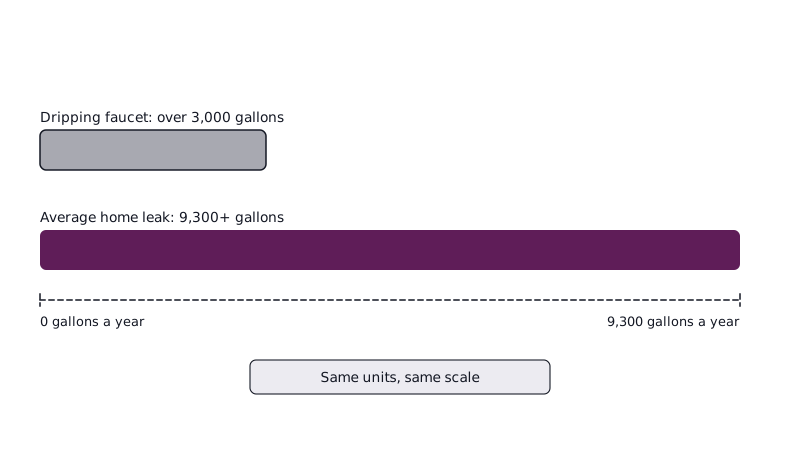
Yes, a leaking faucet raises your bill, but usually by a modest amount. According to EPA WaterSense, a single drip every second can waste upwards of 3,000 gallons in a year. That is real money on a tiered rate, yet it seldom explains a doubled bill. If the jump is large, look further, starting with the fixtures and disposals hub.
How much does a single dripping faucet waste?
By the EPA's figure, a faucet dripping once each second loses more than 3,000 gallons in a year, about 8 gallons a day. Quicker dripping or a thin continuous stream multiplies that. A hot-water leak costs more, because heating the water that runs away adds to your gas or power bill, not the water bill.
You can measure your own drip. Hold a measuring cup under it for ten minutes, multiply the volume by 144 to get a daily figure, then by 365 for a year. Compare that with the usage line on the bill.
Many water districts bill in units of 748 gallons, so 3,000 gallons is about four units. Your own bill shows the unit and the price per tier. The top of the bill names the district for your address. In Murrieta that is usually Eastern Municipal Water District, although Western Municipal Water District or Rancho California Water District supplies parts of the city.
Why would my water bill jump when only a faucet drips?
If the bill climbed by thousands of gallons, a faucet is unlikely to be the main cause. Bigger sources are a toilet that runs, an irrigation timer or broken sprinkler head, a leaking water heater, a pool autofill, a slab or underground line, and a regulator that lets pressure climb. Watering in summer also lifts bills.
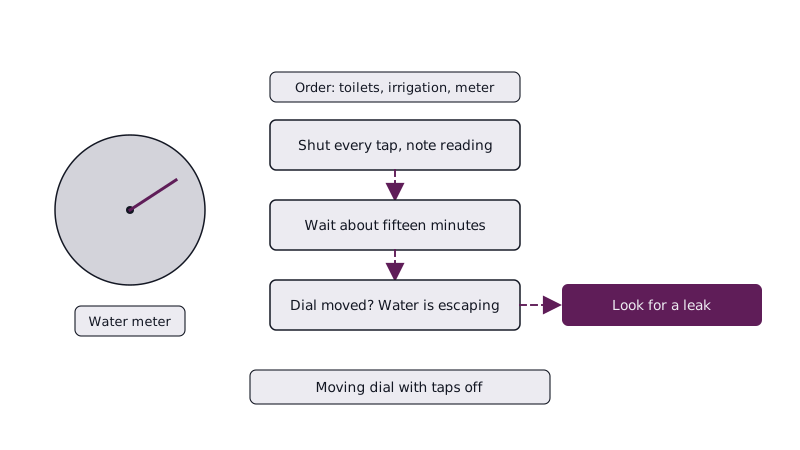
Check in this order. First, the toilets: a flapper that keeps running can lose hundreds of gallons a day (see toilet runs after flushing). Second, irrigation: run each zone and look for geysers or soggy spots. Third, the meter: close every tap, write down the dial, wait fifteen minutes, and read again. If the low-flow dial spins or the leak indicator moves, water is getting out somewhere.
For more depth, read a bill that rises with no leak in sight; the remaining causes are in reasons for a high water bill. Excess pressure worsens every leak: the limit in the plumbing code is 80 psi, so a regulator check is worthwhile.
Why do faucets leak, and what is the fix?
Behind most drips sits a worn rubber washer, an O-ring, a cartridge, or a pitted valve seat. Two-handle compression faucets use rubber washers. Single-handle faucets use a cartridge or a ceramic disc. To fix it, close the supply, remove the handle, replace the worn part, and reassemble.
Match the part to the faucet, not the look of it. Look for the make and model on the spout or cartridge, and photograph the parts as you take them out so the hardware store can match them. Hard water leaves scale on seats and cartridges, so a deposit may be the cause rather than a torn washer; soaking the part in vinegar can help.
Step-by-step pages: fixing a leaky faucet, single-handle faucets, and leaky sink faucets. A wet spout base or a puddle under the sink points to a different part, and a leak at the shutoff valve may mean the valve itself is failing.
Do outdoor hose bibs and other small drips count too?
They do, and they are easy to miss. A hose bib that weeps behind a bush, a hose left connected to a leaking sprayer, or a drip irrigation line with a split tube can lose as much water as an indoor faucet and no one notices because the water drains into soil. Walk the yard once a month with the sprinklers running.
Look also at the supply lines under every sink and the angle stops, the small valves feeding each fixture. A slow weep there leaves a damp cabinet floor, a white crust of minerals or green corrosion on brass. Wipe a dry paper towel along each connection: any dampness on it means a leak worth fixing. Garden hose bibs have a vacuum breaker cap on top that can drip when worn; replacing the cap is a few minutes' work.
In a home built around 2000, as many Murrieta homes are by census estimates, rubber washers and flexible supply lines are now old enough to fail, so a general check of all fixtures at once is a smart use of one plumber visit.
When should I repair the faucet and when should I replace it?
Repair when the faucet is fairly new and the part is cheap. Replace when parts are no longer made, the finish is pitted, or the body is corroded. If you are replacing the faucet, price the new fixture plus labor against the repair; our faucet replacement cost guide lists what moves that price.
A rule of thumb many plumbers use: if the repair would need more than one part, or the faucet is past ten to fifteen years, replacement is often the better buy. It also lets you choose a model with a washerless cartridge that drips less often.
To have a plumber look at it, send the price request form and Murrieta Creek Plumbing forwards it to a local business. Businesses that accept requests pay us a fee.
Common questions
How many gallons does a slow drip really use?
A drip every few seconds may waste a few hundred gallons a year, while a steady drip can run into the thousands. For one drip per second, the EPA's number is above 3,000 gallons annually. Put a cup under yours for ten minutes to get your own figure.
Is a running toilet worse than a dripping faucet?
Usually, yes. A flapper leak can drain hundreds of gallons in a day without a sound, while a faucet drip is limited by the size of the opening. Because toilet leaks are silent, they are a top suspect for a bill that rises without explanation.
Will my water district help with a leak?
Some districts offer leak adjustments or alerts for customers. Rules differ, and we did not verify a program for every district, so call the one on your bill and ask what it offers. Keep your repair receipt, since districts often ask for proof.
What shows that the leak is inside the wall?
Watch for a stain, soft drywall, a musty smell, water sounds while everything is off, or a meter that still turns with every fixture closed. A plumber can confirm with listening gear or pressure testing without opening the wall first.
Is a slow drip an emergency?
No, but fix it soon. A drip landing in the cabinet below can rot the base and grow mold, which costs more than the water itself. While the faucet awaits repair, close the valves beneath the sink if they still turn, and set a bowl under the drip.
Last changed