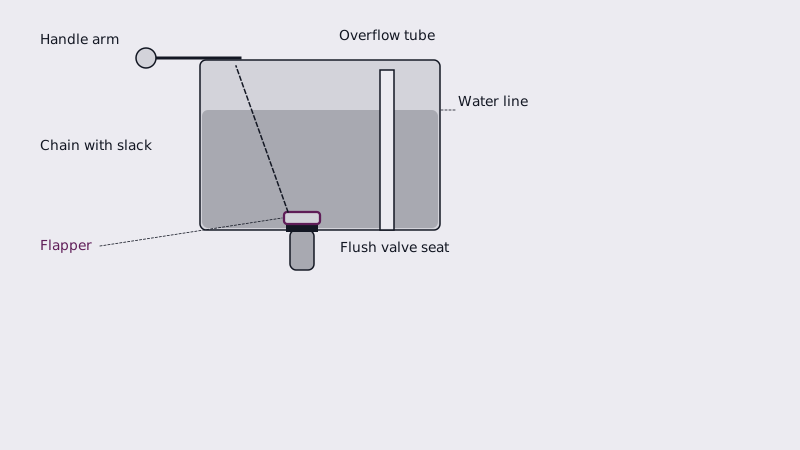
Lift the tank lid and watch one flush. Most often, the fault is the handle arm, the chain, the rubber flapper or the flush valve seat underneath it. This page walks through each part in order, and the toilet repair hub covers the rest of the fixture should the trouble lie somewhere else.
Why does my toilet flush weakly or not at all?
A weak flush means the tank is not releasing enough water quickly. The usual reasons are a chain with too much slack, a flapper that closes early, a water level set low, or a partial clog in the bowl rim or trap. Check the chain and level first, since both take a minute and cost nothing.
Look at the water line inside the tank. Most tanks carry a mark roughly one inch under the rim of the overflow tube. If the water sits much lower, adjust the float or the fill valve so the tank holds more. Then flush and observe the flapper, which should rise all the way and stay open until the tank is almost empty. Too tight a chain keeps it propped open and wastes water; too loose a chain never raises it far enough.
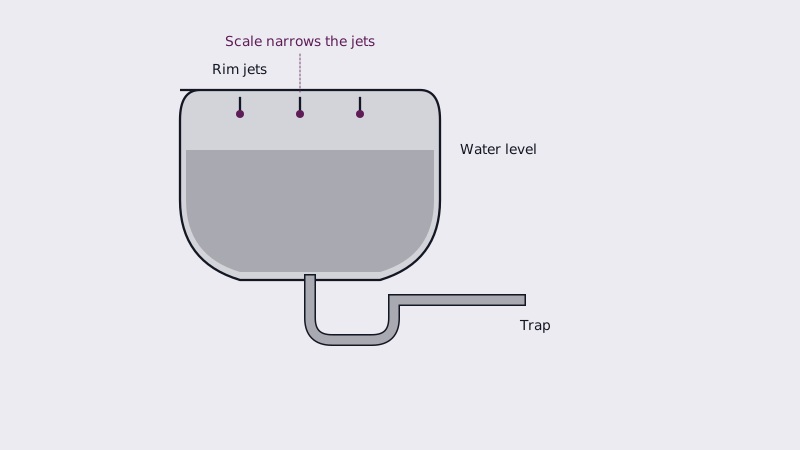
If the tank behaves and the bowl still swirls slowly, the problem is probably downstream. Clogged rim jets are common where mineral scale builds, and third-party estimates rate Murrieta water as moderately hard to hard, so scale is a plausible culprit. See clearing a blocked toilet.
How can I deal with a flush handle that sticks, spins or wobbles?
A handle that sticks is usually corroded at the nut or arm, and one that spins freely has a broken arm or a chain that slipped off its hook. Both are quick fixes. Shut the water, flush the tank down, unscrew the handle nut, which turns the opposite way from normal, and replace the whole handle set.
Handle sets cost little and come in front, side or angle mount, so match the position of the old one. Hook the chain onto the arm hole that leaves roughly a half inch of play once the flapper is seated shut. If the handle keeps loosening, the mounting hole in the tank may be cracked, and a cracked porcelain tank means a new tank or toilet, not a new handle.
Plastic arms break more often than brass ones. A brass or stainless replacement lasts longer, which matters in a hard-water area.
Why does my toilet keep running after the flush ends?
Two things cause a toilet to keep running once flushed: water seeping out of the tank into the bowl, or a fill valve that fails to shut. To tell which, stir food dye into the tank water and give it twenty minutes with no flushing. Color in the bowl points to a leaking flapper or seat. Hissing with a clear bowl points to the float or the fill valve.
Parts are cheap. Pick a flapper that fits your flush valve, since 2-inch and 3-inch outlets are both common, and bring the worn one to the store to compare. A fill valve goes in with a couple of wrenches, and fill valve replacement walks you through it. For step-by-step detail, try flapper repair and why a toilet keeps running.
EPA WaterSense reports a typical home losing over 9,300 gallons yearly to leaks, and a seeping flapper is one quiet source. The water bill often tips you off first, so see a bill that rises with no leak in sight.
At what point should the flush valve itself be replaced?
The flush valve is the wide drain fitting installed at the base of the tank; the flapper seals against it. When the seat is pitted, cracked or crusted with scale, even a new flapper leaks. To replace the valve, drain the tank, lift it off the bowl, swap the valve and its rubber gasket, then bolt the tank down again with fresh hardware.
With the right gasket kit this takes one to two hours, and it is where a repair starts to cost close to a new toilet. If the toilet is over about two decades old, burns a lot of water on each flush, or the porcelain is cracked or stained beyond cleaning, a replacement toilet may make more sense. Most models sold in California are built to use about 1.28 gallons or less per flush, which makes a swap a water saver too. Our toilet replacement cost guide lists what drives that price.
Can I do this repair myself, and when should a plumber step in?
Chain adjustment, handle sets, flappers and fill valves are within reach of most owners with a screwdriver and a pair of pliers. Hire a plumber when the tank or bowl is cracked, the toilet rocks and leaks at its base, the shutoff valve will not close, or a sewage smell lingers, since those involve the wax seal or the drain.
Never force a shutoff valve under the tank that is stuck, because a snapped stem floods the bathroom. Read about toilet shutoff valve repair, and learn where the whole-house main valve is.
California rules require a contractor license for plumbing work above a modest dollar amount or work that needs a permit; a simple flapper swap does not. Murrieta Creek Plumbing arranges a local plumber once the fix is bigger than a weekend job, and the local business that quotes pays a fee for the introduction. Submit the details using the quote form.
Common questions
Why does my toilet refill by itself every so often?
That is called phantom flushing. Water creeps from the tank into the bowl, the level drops, and the fill valve kicks in. The flapper seal or seat is almost always the culprit. Replace the flapper first, clean the seat with a scrub pad, and if it still repeats, the flush valve is the next suspect.
Is it normal for a new toilet to need adjusting?
Yes, slight tuning is normal. The float height and chain slack may be off from the factory or after shipping. Adjust until the tank fills to the mark and the flapper seals fully. Should a new toilet flush poorly even then, ask the retailer about that model.
What size flapper do I need?
Measure the flush valve outlet or read the size stamped on the old flapper. Nearly all toilets use either a 2-inch or a 3-inch outlet. Some brand-specific toilets use proprietary flappers, so take the old one along to compare, or look up the toilet's model number in the tank.
Can hard water damage flush parts?
It shortens their life. Scale builds on the flapper seat, plastic floats and fill valve screens, and rubber flappers harden and warp. Rinse or replace the parts every few years, and consider a softener if scale is a constant issue in your home.
Should I use tablet cleaners in the tank?
Many plumbers say no. Chlorine tablets sitting in the tank can degrade rubber seals and flappers faster, which makes leaks more likely. A rinse in the bowl with a brush and a plain cleaner does the job without hitting the tank parts.
References
- EPA WaterSense, fix a leak week
- California Plumbing Code, water closet flush volume
Last changed