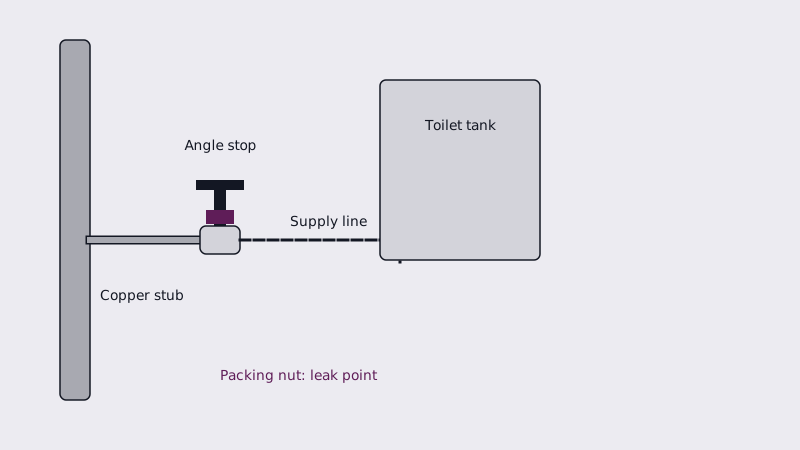
An angle stop is what plumbers call the small wall-mounted fitting that feeds the toilet tank, operated by an oval or round handle. If it drips, seizes or will not shut off completely, any tank repair becomes messy and risky. This page helps you judge it. For the wider job of fixing a toilet, begin with toilet repair in Murrieta.
How does a toilet shut-off valve operate, and why does it fail?
The valve is a small gate or a quarter-turn ball that cuts the supply to the tank, letting you work on the toilet. It fails because it is seldom turned: mineral scale builds up inside, the rubber seals dry out, and the stem packing leaks. Hard water speeds this along, and third-party estimates put Murrieta tap water at moderately hard to hard.
Two types are common. A multi-turn valve closes after a few spins, with a washer pressing onto a seat. A quarter-turn valve has a ball inside and moves from open to closed in a ninety-degree twist, and it lasts longer. Look at the handle to identify yours, because the type decides which repair is possible.
Typical failure signs are a drip from behind the handle, a wet supply line connection, a handle that spins without stopping the flow, and a crusty green or white deposit on brass. Treat any of these as a repair job, not something to put off.
How do I stop a valve that drips behind the handle?
A drip from behind the handle usually comes from the packing nut or stem seal. With the supply closed at the main, snug the packing nut about a quarter turn with an adjustable wrench. If the drip stops, you are done. If it does not, the packing or the valve itself is worn, and replacing the valve is more reliable than patching.
Never crank a packing nut until it binds, since that can crack the valve body. Also check whether the water is really coming from the stem or running down from the connection above, where the supply line meets the valve. A wipe with a dry cloth, then a fresh look a minute later, tells you which.
When the leak is at the flexible supply line, tighten the compression nut slightly, or replace the line. Lines are inexpensive, and braided stainless ones last. Replace the line whenever you replace the valve.
What should I do when the stop valve will not turn?
Never force it. A stuck valve can snap its stem or let a joint go, and a flooded bathroom costs far more than a valve. Try a few gentle back-and-forth motions, using a dry cloth for grip. If it stays stuck, shut the main valve for the whole house and plan to replace it.
Where is the main? Usually in the water meter box near the curb, or at a valve near the house where the line comes in. Learn where yours is before you need it. If the main will not close either, that is an emergency call; see emergency plumbing in Murrieta.
Penetrating oil sprayed on a brass valve can loosen it a little, but oil can damage rubber seals. When a valve will not close fully, even though it turns, replacement is the right answer.
How is a toilet shut-off valve replaced?
With the main closed, flush the toilet and sponge the tank dry, detach the supply line, and then deal with the valve itself. Compression valves screw off a copper stub with a compression nut and a brass ring. Valves soldered to copper need cutting or heat. Push-fit or crimp types are used on PEX. Match the type to the pipe you have.
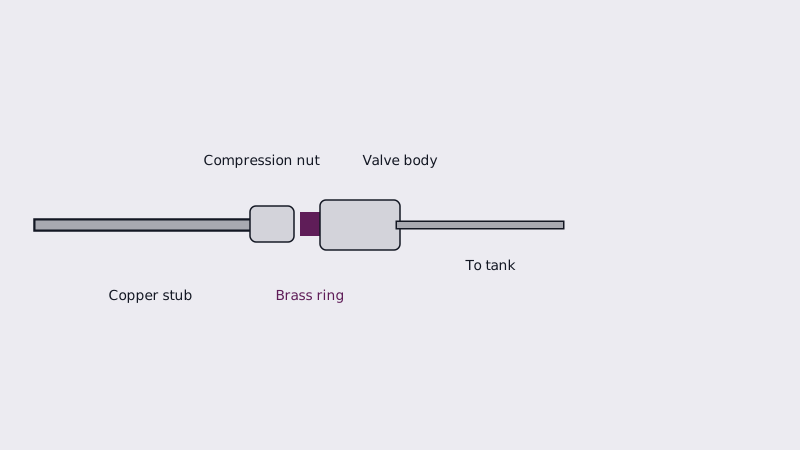
For a compression valve the steps are: unscrew the compression nut, slide the old ring off or cut it, install the new nut and ring on the stub, tighten the valve, connect a new supply line, reopen the main slowly and check for drips for a few minutes. If the old ring will not budge, a ring puller helps.
Soldered joints and PEX connections are easier for a plumber, particularly when the pipes are inside a wall. Valves in a slab-on-grade house come off lines in the wall, so a slip can mean opening drywall. If that sounds beyond you, stop and call someone.
Further toilet troubleshooting is in toilet flapper repair and repairing a toilet fill valve. The toilet commode repair page covers broader problems.
When do I need a plumber, and does the job need a permit?
Phone a plumber if the stub is corroded or loose, the pipe runs through a wall, the main will not close, or you are unsure. Swapping in an identical valve does not usually need a permit, but changes to piping can; ask the City of Murrieta's Building and Safety Division on 951-461-6062 (city page; confirm), or the county for French Valley and Winchester.
A contractor license is generally required in California once a job hits $1,000 in labor and materials, or involves permit work, so most valve jobs sit below that line. Still, get a written price from a local plumber before work begins. Murrieta Creek Plumbing passes your request to a nearby plumbing company, and companies that take requests pay us a fee.
A neglected drip wastes water, and the EPA says the average home loses more than 9,300 gallons per year to leaks. To see what that does to your bill, read reasons a water bill jumps. To get a price, send the quote request.
Common questions
Is a new supply line needed with the new valve?
Yes. The old line has been through the same years of water, and removal can damage its nut seats. A new braided line is inexpensive and prevents a later leak at the same joint. Pick a length that reaches the tank without strain or a tight loop.
Why does the valve drip only when I flush?
The flush draws the fill valve open, raising pressure at the stop. A leak that shows only then points to a weak seal at the supply connection or a worn packing under the handle. Tighten the nut gently, and replace parts if it persists.
Can a stuck valve be freed with oil or heat?
Oil may help a bit, but it can damage rubber seals, and heat near a pipe with plastic parts or a soldered joint risks new leaks. A valve that stays put after gentle effort is safer replaced, and a plumber can do that quickly.
How often should I exercise the valve?
Turn each stop off and back on once or twice a year, slowly. That keeps scale from locking the stem. Do it gently and be ready to close the main if the valve starts to leak. Do not do this on valves that already feel crusty.
Is a leaking shutoff valve an emergency?
A steady spray is, so close the main and call right away. A slow drip is not, though you should fix it within days, since water under a toilet can rot a subfloor. Put a towel or small bowl under it meanwhile and check it every day.
Last changed