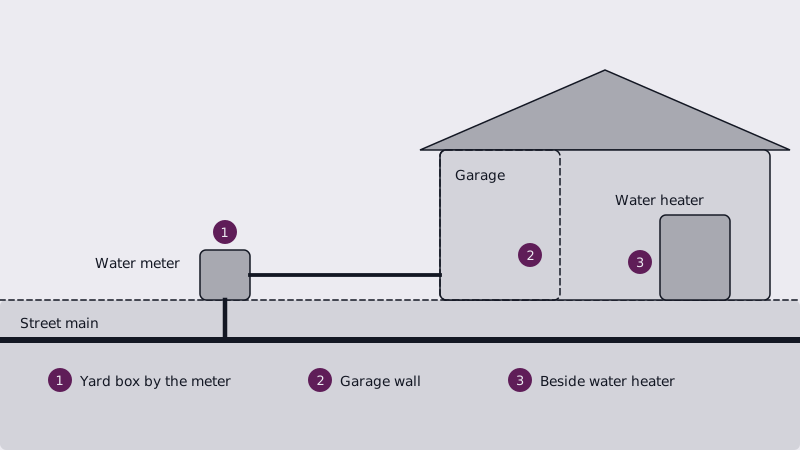
If water is leaking in your house right now, close the main shutoff valve before you do anything else, then call. The valve is typically facing the street or sitting next to the water heater. After that, a plumber traces where the water is escaping and repairs it. We set up that visit from the Murrieta Creek Plumbing home page or by phone, and the plumber who arrives quotes the job.
What should you do right after a leak starts?
Close the main valve, open one faucet on the lowest floor to drain the lines, and turn off the electricity to any soaked area before touching anything near it. Clear rugs and furniture out of the way, take pictures of the damage for your insurer, and then phone for a plumber. Hoping the drip stops by itself only lets the damage grow.
The main shutoff may sit in a box in the front yard by the meter, at the garage wall, or beside the water heater. Find yours today, before anything goes wrong, and check that it really turns. Valves left alone for years can seize. If yours is stiff or will not close, say so when you call. The plumber might need to close the supply at the meter instead, and some districts expect only their own crews to do that.
Mixing water and electricity is dangerous. If the leak sits in a ceiling with a light fitting or near an outlet, switch that circuit off at the panel and stay out of the room. Our page on a leak coming through a ceiling light fitting covers that case in detail.
Which water leak do homes get most often?
Homes get the dull ones most: a toilet flapper that has stopped sealing, a dripping faucet, and a worn supply line or valve under a sink. Tired toilet flappers and dripping fixtures are among the usual causes, and by EPA figures the typical household loses more than 9,300 gallons yearly to leaks.
Those leaks are easy to see or hear, and cheap to fix. The expensive ones are the hidden ones: pinholes in copper inside a wall, a failed joint above a ceiling, a fitting that sweats behind a tub, or a supply line cracking under a concrete slab. In houses built from about 2000 on, copper or PEX is more likely than old galvanized steel, run through the attic or the slab. Pressure that runs too high, aggressive water and plain age wear those lines from the inside. If your water bill climbs and you cannot find a reason, read why a water bill goes high with no visible leak.
How is a concealed water leak located?
A plumber narrows a concealed leak down in stages: reading the meter with everything off, isolating sections of pipe, and then listening, scanning or imaging to pinpoint the spot. The goal is to cut into as little wall, ceiling or concrete as possible, so you pay for one small repair, not a demolition.
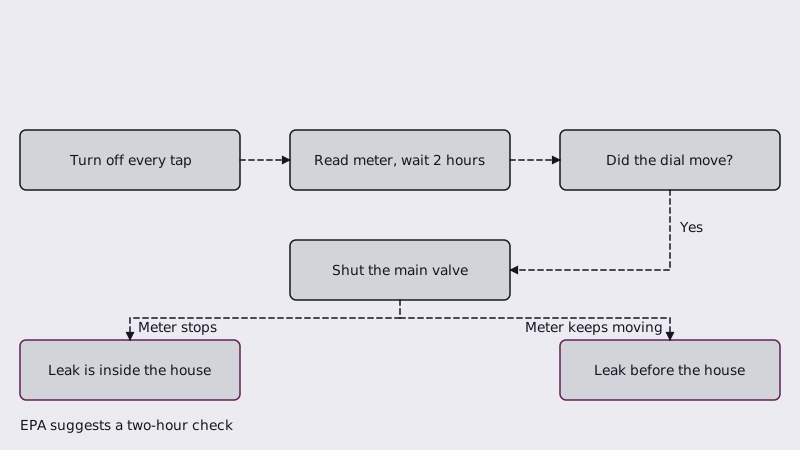
You can do the first stage yourself. Turn every tap and appliance off first, and after that go and read the meter. If the small dial or the low-flow triangle keeps turning, water is escaping somewhere. EPA suggests a two-hour test: note the reading, use no water, check again. A change means a leak. Next, close the house's main valve. If the meter stops, the leak is in the house lines. If it keeps turning, suspect the run from meter to house, which is often a buried line.
Plumbers then bring listening gear that detects pressurized water hissing, thermal cameras that show warm lines in walls, moisture meters, pressure tests on isolated branches, and tracer gas for stubborn cases. Leaks under a slab have their own page: slab leak detection and repair. For cost, see what leak detection costs.
Is it a leak, or something else?
Stains and damp spots do not always come from plumbing. Condensation on a cold pipe, rain getting through the roof, an overflowing air-conditioner drain pan and a leaking tub seal all look alike from below. Look at the timing: a spot that grows after rain points to the roof, while one that grows after a shower points to the bathroom above.
To read the clues, use our guide to the signs of a water leak in a ceiling; for false alarms, try the page on water spots on a ceiling with no leak. Hearing running water while everything is off, or feeling a warm floor underfoot, means you should treat it as a real leak until proven otherwise.
What can you use to fix a leaking pipe until the plumber arrives?
For a short-term stop, you can wrap a pinhole or small crack in self-fusing silicone tape, or in a rubber patch held by a hose clamp, or fit a push-on repair sleeve. All of these are temporary. They buy you time once the water is back on, but the damaged section still needs replacing by a plumber.
Epoxy putty and repair tape grip best on clean, dry pipe, so close the valve and wipe the spot dry first. A rubber-padded clamp can hold a copper pinhole for a while. Keep all of these out of any wall or ceiling you cannot see into. When the damaged pipe sits behind drywall, the safest stopgap is the shutoff valve. Cut into the wall only when a plumber says so.
For a leak at a joint, see fixing a leaking water pipe. For a steady spray, treat it as a burst: what to do when a water pipe bursts.
What is the best product to fix a leaking PVC pipe?
For PVC, the dependable fix is to remove the bad piece and glue a new section in with a coupling, using PVC primer and cement. Repair tape, epoxy and slip couplings can hold a small leak for a short time, but a glued joint that weeps normally has to be redone after the pipe dries.
In Murrieta, PVC and ABS appear mostly in drain and vent lines and in irrigation, not as the pressurized supply inside the house. Supply leaks in homes of this era are more likely copper or PEX. A drain joint that drips only while water runs is a separate job from a supply line that leaks around the clock. Never glue a wet joint. Never mix primer-and-cement with a gas appliance nearby. If the plastic pipe is the main line from the street, call a plumber instead of patching it.
Is soldering required to fix a leaking copper pipe?
No, not for a small leak. Push-to-connect couplings and compression repair sleeves seal copper without a torch, and they are legal, common fixes on clean, round pipe. Solder is still the standard for permanent work, and a torch beside framing and insulation is a fire risk that many homeowners should not take.
When copper develops a pinhole, the wall of the pipe is often thinning from within, so another leak may show up a few feet along. Green or white crust, rough pitting, or a second leak are reasons to consider replacing the whole run. At that stage the topics pinhole leaks in copper pipe and repiping the house start to overlap.
How fast can a copper pipe leak be stopped?
The quickest safe route: shut the supply, drain the line, wipe the pipe dry, then either slide a push-fit coupling over a clean cut or clamp a repair band across a pinhole. It takes only minutes. On a pitted pipe it remains a stopgap, and the plumber can assess that on site.
Before you start, check your water pressure. Residential pressure over 80 psi is above the plumbing code limit, and high pressure is one reason copper and fittings fail early. If your faucets spray hard or the pipes bang, ask about adjusting or replacing the pressure regulator.
When is a leak an emergency?
It is an emergency when water runs into walls, near electrical equipment or through a ceiling, or when you cannot stop it at the valve. Those call for a same-day phone call. A slow drip under a sink can normally wait for a booked visit. Our burst pipe guide and the article on what causes a pipe to burst explain the urgent end, and burst pipe prevention helps you avoid it.
California requires a contractor license whenever labor and materials add up to $1,000 or more, and whenever a permit is needed. Ask for the plumber's license number and look it up on the state board's site; the state contractor board explains how.
What does a leak repair visit cover?
A visit covers locating the source, isolating and testing the section, making the repair, and testing again under pressure. The price is written down before work begins. Cutting into walls or concrete, plus drywall repair and painting, are frequently billed separately, so confirm what is included before you agree.
Your request goes from us to a local business, which does the work and sets its own price. Businesses taking requests pay us a fee. Costs vary with access and pipe type, so no single figure appears on this page. For slab leaks specifically, compare slab leak repair or repipe with the slab leak repair cost guide.
Common questions
Will homeowners insurance cover a pipe burst?
Frequently it does, for the sudden and accidental portion. Many homeowners policies pay for water damage when a pipe bursts without warning, but they exclude slow leaks, wear and the expense of fixing the pipe itself. Wording varies, so review yours and call your insurer before repairs begin. Take photos and keep the plumber's report. Our page on insurance and burst pipes has more.
What is the usual repair time for a burst pipe in an apartment?
A straightforward burst somewhere accessible can be repaired within a few hours, whereas a pipe hidden in a wall or ceiling takes longer, since the crew must get access and let things dry. In a rental, tell the property manager at once, since shutting off water to a building often needs their approval. The plumber who comes can give a realistic time once they see it.
How common are burst pipes in an apartment?
Burst pipes make up a small share of apartment water problems. Most are slow leaks from fittings, supply lines and appliance connections. Bursts usually follow failed fittings, very high water pressure or physical damage. Frozen pipes are rare in Murrieta's mild climate, so a burst here is more often pressure, age or a bad connection than weather.
Is leak repair something plumbers handle?
Yes. Finding and fixing leaks in supply lines, drains, fixtures, water heaters and slab lines is core plumbing work. Some plumbers also offer leak detection using listening and thermal equipment. Roof and window leaks belong to other trades, and the plumber will tell you if pipes are not the source.
Is Murrieta, CA on a fault line?
Southern California is an active earthquake region, and we cannot give a fault map for your street here. Check the California Geological Survey's maps for your address. For plumbing, the useful step is the same everywhere: make sure the water heater is strapped, and ask whether a gas shutoff valve that trips in a quake makes sense for you. See the earthquake gas shutoff valve guide.
Guides in this section
- Burst pipe prevention
In Murrieta pipes burst from pressure, age and bad connections more than from frost.
- Burst water pipe
A burst water pipe in your Murrieta home: shut the water, protect the electrics, document the damage and get a plumber and your insurer…
- Ceiling water leak
Water coming through a ceiling in Murrieta: shut off, make the room safe, find the source (pipe, AC line or roof), dry it fast and know…
- Leaks and burst pipes
How home insurance usually treats a burst pipe: what tends to be covered, what is excluded, and the steps to take before the plumber and…
- Leaks and burst pipes
Burst pipe in Murrieta or Wildomar? Stop the flow, then ask us to arrange a local plumber.
- High bill, no visible leak
Water bill up but nothing is dripping? A Murrieta guide to the meter test, silent toilet leaks, irrigation, slab lines and when to call…
- Leaks and burst pipes
How to know if a pipe burst: the sounds, stains and meter checks that give it away, what to do in the first minutes, and when to call a…
- Leaks and burst pipes
Stop a pinhole leak in copper pipe: shut off the water, a temporary clamp or tape, a permanent cut-in repair, what a second pinhole means,…
- Leaks and burst pipes
How to tell if a pipe burst underground: wet or sunken ground, a meter that spins, low pressure and sewer clues, plus who to call and what…
- Leaking water pipe repair
Fixing a leaking water pipe depends on what the pipe is made of.
- Leak detection cost
What a plumber charges to find a hidden leak in Murrieta depends on method, access and leak type.
- Signs of water leak
Brown rings, bubbling paint, a sagging patch or a musty smell: the signs of a ceiling leak, how to tell plumbing from roof, and what to do…
- Slab leak detection
Warm floor spots, a running meter, a high bill?
- Costs
What drives slab leak and burst pipe repair costs in Murrieta, which line items to expect on a quote, and how to compare bids fairly…
- Leaks and burst pipes
Hot floor, humming meter or damp carpet? Compare a spot repair under the slab with rerouting the lines overhead, and see when each makes…
- Water leak in ceiling
Water dripping from a light fixture is a shock risk.
- Water spots on ceiling
Brown ceiling stain but nothing dripping?
- Burst pipes and leaks
What causes a pipe to burst in Murrieta homes: pressure, age, corrosion, shifting soil, roots, frost and summer heat, and what to turn off…
Last changed