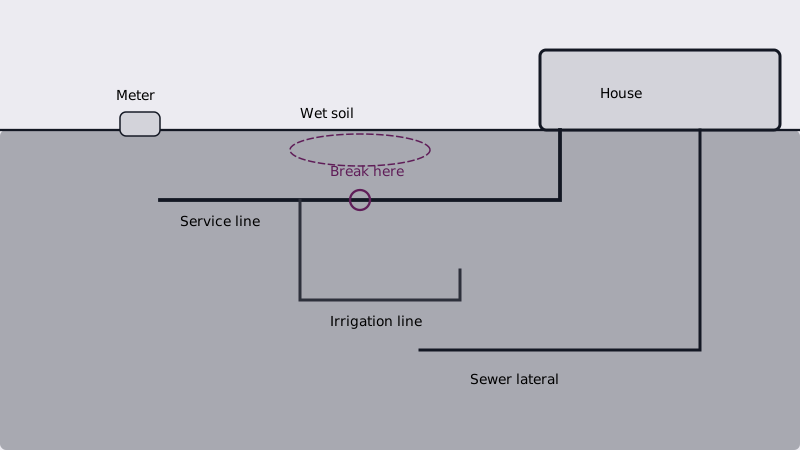
An underground pipe break usually shows as ground that stays wet or soft with no rain or watering, a water meter that moves with everything shut off, low pressure, or a bill that jumps with no explanation. Which pipe is broken decides who fixes it. The article belongs to the guidance we give on leaks and burst pipes.
How can you recognize a burst buried water line?
Look for patches of wet soil or a damp strip across the yard, grass that is greener or boggier than the rest, a sunken spot, water seeping up near the foundation or curb, and the sound of flow outdoors. Inside the house, pressure drops and taps sputter. The meter keeps turning even with everything off.
The meter test is the anchor. Shut off every fixture, check the leak indicator on the meter and read the dial twice, two hours apart. EPA WaterSense gives that as a basic way to detect a leak. A change points to a leak somewhere on your side, but the meter alone does not say whether it is underground or inside the walls.
Add the pressure story. If the supply pipe feeding the house from the meter breaks, pressure tends to drop throughout the property, which a leaking fixture normally does not cause. Hot water that is fine while cold water is weak, or the reverse, suggests the break is on one of those lines rather than the main.
What does a broken sewer line look like?
A broken sewer line shows up as slow or gurgling drains in more than one fixture, sewage smells outdoors, soft or sunken ground along the line, lush strips of lawn and, in bad cases, sewage backing up in the lowest drain. It is a drain problem rather than a pressurized one, so the meter does not move.
Root intrusion, shifted soil and age can crack or separate the pipe. Many Murrieta homes are newer construction, and the sewer lateral may be plastic, but we do not know the material in any specific home. A camera inspection shows the actual condition and is usually the next step.
With sewage backing up, stop running water, keep people and pets clear of the affected area, and phone a plumber. Never pour chemicals into a backing-up line. If it turns out to be an ordinary clog and not a break, how to unclog a drain will help.
How are underground leaks found and repaired?
Plumbers confirm the leak with pressure tests and acoustic listening, then pinpoint it with ground microphones, thermal imaging or a sewer camera. Repair means digging down to the break, replacing the failed section or trenchless lining where suitable, then backfilling and restoring the surface. If the line is old, a new pipe may be a better choice than a patch.
Get the finding and the proposed method in writing, with excavation and restoration costed apart from the pipe repair. Under California rules, work reaching $1,000 in labor and materials, or work that requires a permit, generally needs a contractor who has a California contractor license, which you can look up on the CSLB website. Main line work is not for DIY.
We can line up a nearby plumber for you. Send the price request form; we forward it to plumbing businesses that pay us a fee, and the one that visits gives its own quote. For the first checks indoors, see signs a pipe has burst, or return to the home page.
What comes first, before digging or phoning?
Shut the supply at the main valve, keep vehicles off the wet area, and photograph it with a note of when you first saw it. Never dig for the pipe yourself. Ring 811 ahead of any digging so buried utilities, gas included, get marked. Then arrange for a plumber to locate the leak.
Digging blind can hit gas, electric or other lines and turn one repair into several. Wet clay can also collapse. The meter reading, the photos and any recent bill history help the plumber narrow the search. EPA WaterSense puts the typical household leak at upward of 9,300 gallons yearly, which is why a suspected break should not be left running.
If you ever smell gas, get out first. Then, from outside, use the SoCalGas line, 1-800-427-2200, and call 911 when anyone is at risk. Gas lines run underground too, and gas leaking near a burst water line is an emergency.
Which buried pipe is the one leaking?
Turn off the house main, then watch the meter. If the dial still advances, the leak sits in the service line between the meter and your home. If the dial halts, the leak is in the house, the slab, or the irrigation. Closing the irrigation valve and checking again isolates the last one.
Here is a quick guide to what the signs usually mean.
| What you notice | Likely line |
|---|---|
| Meter moves with the house main closed | Buried service pipe feeding the house |
| Meter stops when the main closes but moves when it opens | Plumbing inside the home or in the slab |
| Wet ground only in a lawn zone, stops when sprinklers are off | Irrigation line or valve |
| Sewage smell, gurgling drains, wet ground with an odor | Sewer lateral |
| Low pressure plus warm patch on the floor | Hot line under the slab |
Use this as a pointer, not a diagnosis. Several faults can overlap, and a plumber with a listening device or camera is the only way to confirm the spot. If a tile floor feels warm, read the next steps under slab leak detection and repair.
Whose pipe is it, and who do you phone?
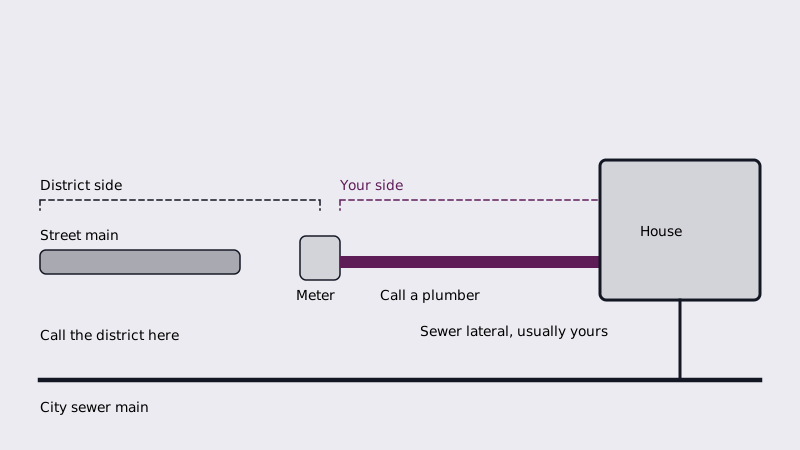
On the water line, the district generally owns the meter and the connection up to it, while the property owner generally answers for the pipe that carries water onward into the house. Practice can vary, so call your water district to confirm where its responsibility ends. Sewer laterals are usually the homeowner's up to the main.
Which district serves you depends on the address. In Murrieta it is most often Eastern Municipal Water District, with Western Water and Rancho California Water District in parts. Wildomar usually falls under Elsinore Valley Municipal Water District. Fallbrook is covered by Fallbrook Public Utility District, and Rainbow Municipal Water District serves Rainbow. Check your bill, since your bill names the district.
A leak at the meter or upstream of it is the district's to handle, so phone them. If it is on your side, a plumber handles it. For rural lots on a private well, a pump that runs constantly or cycles often can also point to a leak in the line.
Common questions
Is it possible for a buried burst pipe to soak the yard gradually?
Yes. A pinhole or hairline break may seep for weeks, soaking the soil without a visible puddle, because the ground absorbs it. Signs are lush patches, mud near the foundation, a gradual pressure fade and a higher bill. The meter test gives the earliest answer.
Will my water bill show an underground leak?
It usually will, because the meter counts water that escapes underground. The bill may lag, since reading dates and billing periods vary. Compare usage across months and run the meter test now instead of waiting for the next bill. Call the district if the readings seem wrong.
How long can a buried pipe leak before it causes damage?
It depends on the volume and the soil, but a steady leak can undermine paving, soak foundations and rot wood framing over time. Water running next to the house is worse than one far from it. Treat any confirmed underground leak as something to fix soon, not someday.
Can I use the meter to measure how fast it is leaking?
Roughly. With every fixture off, note the dial and time it over a set interval, then convert using your meter's units. Many meters read in hundred-cubic-foot units, and one is about 748 gallons. Treat the figure as a rough guide, since a plumber can estimate more precisely.
Last changed