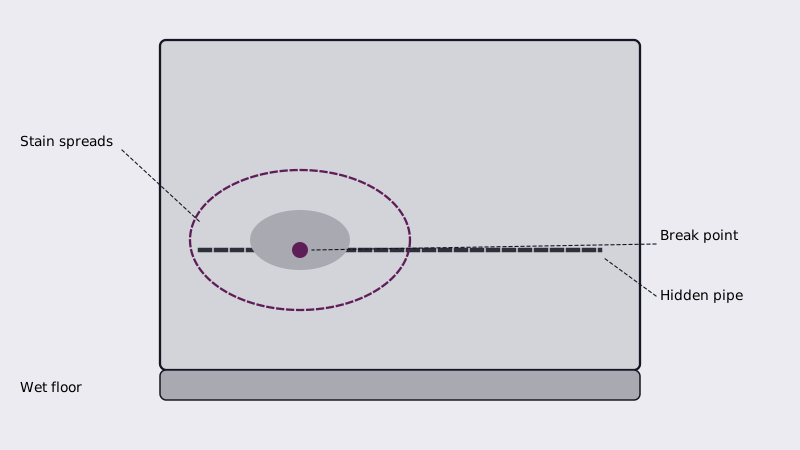
A burst pipe usually gives itself away in one of four ways: water where none belongs, running water you can hear while every fixture is closed, sudden low pressure, or a dial on the meter that will not stop moving. Any one of those is reason to act. The sections below tell real bursts from false alarms, and leaks and burst pipes offers broader help across Murrieta.
Which signs suggest a pipe has burst?
The clearest signals are pooling or spraying water, a hissing or rushing noise behind a wall, a stain that spreads across a ceiling or floor, and taps that suddenly sputter. Rusty or cloudy water and a musty smell also point to a break. A sharp pressure drop across the whole house suggests the failure is on the supply side.
Look at the pattern, not just the single clue. If a stain keeps spreading hour after hour, water is still arriving. A stain that stays the same size for a week may be an old leak that has dried. Hold a dry paper towel to a damp wall; if it is wet again after you wipe the surface, something behind the wall is still leaking.
Sound helps. Close every tap, turn off the dishwasher and ice maker, and stand quietly in the hall. A faint trickle or hiss from inside a wall or floor is a strong hint. To find the loudest spot, hold a glass against the wall and press your ear to its base.
How do plumbers find leaks?
Plumbers find leaks by pressure testing the lines, listening with acoustic devices tuned to the noise of water escaping, scanning with thermal imaging, and sometimes using tracer gas or a camera. They start by isolating sections of pipe so the problem narrows to one run before anyone opens a wall.
The order usually goes: confirm the leak with the meter, close off fixture groups one at a time, then use a listening device on the floor or wall over the suspect line. A thermal camera shows a warm streak at the spot where a hot line leaks into a slab. If the line is a drain, a camera on a cable can see it directly.
Good leak detection saves demolition. Cutting a square in drywall at the right spot costs far less than guessing. Ask the plumber to explain which method they used and how they arrived at the location, and ask for the finding in writing before any wall or floor is opened.
Is there a way to stop a leaking pipe without replacing it?
A temporary stop is possible with a repair clamp, a rubber sleeve with a hose clamp, self-fusing tape or epoxy putty, or a push-fit coupling on copper or PEX. These buy time, not a permanent repair. Start by shutting off the water and drying the pipe, and expect the section to be replaced properly later.
Plastic pipe is different. Cement will not cure on a wet joint, so a leaking PVC fitting generally needs the joint cut out and a new coupling glued in, after the water is off and the pipe is dry. A slip coupling lets you do that without moving long runs. Threaded plastic connections sometimes just need the thread tape redone and the fitting snugged by hand, not wrenched.
Copper pinhole leaks are often a sign of wider pipe wear, and a clamp on one hole does not stop the next. The cause matters: pressure that is too high, aggressive water or old solder can all lead to repeat failures.
In California, contractor licensing rules generally apply to work that needs a permit, or whose labor and materials reach $1,000 or more. Before hiring, search for the contractor on the CSLB website. Gas piping and main supply line work are not DIY jobs. After a major break, read urgent steps for a burst pipe.
What reveals a burst pipe beneath the floor of a house?
Signs of a break beneath the floor include warm spots on the slab, the sound of running water at night, floors that feel damp or lift at the edges, wet baseboards, and a meter that still turns after everything is shut off. In a slab home, one hot spot on a tiled floor often marks a leaking hot line.
Most homes in Murrieta were built around the year 2000 or later, and many sit on concrete slabs, so lines often run in or under the slab rather than in a crawl space. That makes a slow break harder to spot until the floor shows it. Check cabinet backs and closets along exterior walls, where moisture shows first.
Walk barefoot over the floor in the evening. Warm tiles with no heater beneath them are a classic signal. Also listen at the water heater: a heater that refills or fires up when nobody has used hot water may be feeding a leak.
Underground breaks outside the house follow different rules. Soggy ground, a green patch in dry weather, or low pressure with a dry interior all fit. The underground case is explained in spotting an underground burst, and the steps once you have confirmed it appear under slab leak detection and repair.
Does the cause of a burst matter for fixing it?
Yes. A pipe that failed from a one-off knock is a simple section replacement, while one that failed from high pressure, corrosion or movement means the same thing will happen elsewhere. A plumber should ask about pressure, pipe age and recent work before quoting.
Murrieta tap water is generally rated moderately hard to hard, and scale can narrow fittings and wear at connections over time. Check the water district report or a test strip for your address. The billing district differs from street to street, and is most often Eastern Municipal Water District, so read your own bill.
Pressure over 80 psi stresses every line and fixture, and a gauge threaded onto a hose bib shows the number within a minute. Causes are covered under why pipes burst, and ways to prevent a repeat under burst pipe prevention. A quote should list the section being replaced, the access needed and the repair to the wall or floor afterward. For pricing, see leak detection cost. The home page covers other plumbing topics.
What comes first in the opening ten minutes?
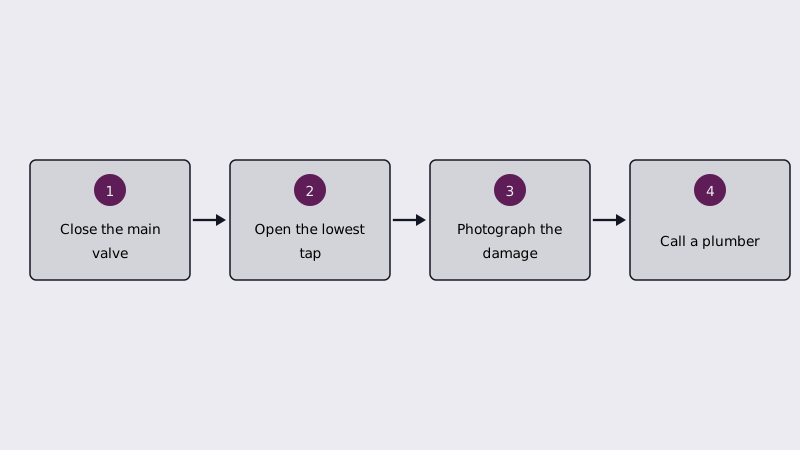
Close the main valve before anything else, then open the faucet at the lowest point of the house so the pipes drain. Carry valuables and rugs out of the wet zone. Water reaching outlets, ceiling lights or the breaker panel is a shock risk: stay clear, and only switch circuits off from a dry spot you can reach safely.
The main shutoff is normally a ball or gate valve on the pipe running between the meter and the house, frequently beside the front hose bib or inside the garage wall that faces the street. Find it today, before you need it, and check that the handle turns. A valve that has seized is a problem on its own.
Take photos of the damage ahead of any cleanup, and soak up standing water with towels or a wet vacuum. Open cabinet doors and run a fan to keep wall cavities from staying wet. Your insurer will want dates and photos if a claim follows.
A gas line is the exception to all of this. When you smell gas, exit the house before anything else. From the yard or street, use the SoCalGas line, 1-800-427-2200, and ring 911 for a strong smell or if anyone feels unwell. Never flip switches or strike a flame while hunting for the source.
Once the supply is off and the room is safe, describe what you found and we forward it, so that a local plumber can visit. Use the price request form or the number shown on every page. Businesses that take these requests pay this site a fee. The one that visits gives its own quote.
How do you test for a burst you cannot see?
Use the water meter. Make sure nothing in the house is using water, find the meter box (typically by the curb at the lot's front edge), and record the reading or the small low-flow dial. Wait two hours with all water off. A changed reading means, per the EPA, that you probably have a leak somewhere from the meter through to the fixtures.
That test works for slow leaks and bursts alike, and it costs nothing. If the dial spins fast the moment you open the lid, the break is large, so shut the water off next. If it creeps, you may have a pinhole or a failing joint instead.
Toilets are the usual false alarm. Add a little food dye to the tank water and leave the lid off for ten minutes without flushing. If color reaches the bowl, the flapper is seeping; that wastes water but is no burst. Replace that part first, then run the meter test again.
EPA WaterSense puts the average household loss from leaks above 9,300 gallons each year, which makes even a quiet drip worth chasing. If your bill jumps although your habits have not changed, check why a water bill gets so high for the other likely causes.
Common questions
How does a burst pipe sound?
Typical noises are a steady hiss or rush inside a wall, drumming in the ceiling, or knocking each time a tap opens and closes. A large break can sound like a running shower. If you hear flow with every fixture off, assume a leak and check the meter.
Is a damp wall always a burst pipe?
No. Condensation, a roof or window leak, plant irrigation or a failing shower seal can all dampen a wall. A burst supply line keeps getting wetter and shows up on the meter test. Wipe the area dry, trace the outline of the stain in pencil, and look again later to see if it grows.
Will a burst pipe show on my water bill?
Often, but late. A big break can double usage in one billing cycle, and the billing schedule depends on which district serves you. The meter test works faster than waiting. Compare the last few bills and call your water district if the jump is unexplained.
Can I wait until morning for a small leak?
When the main is closed and nothing drips, waiting is usually fine, but weigh it against the damage. Wet drywall and flooring start to degrade fast, and mold can follow. If the water cannot be stopped, it is urgent, so send a request at once during the listed hours.
Last changed