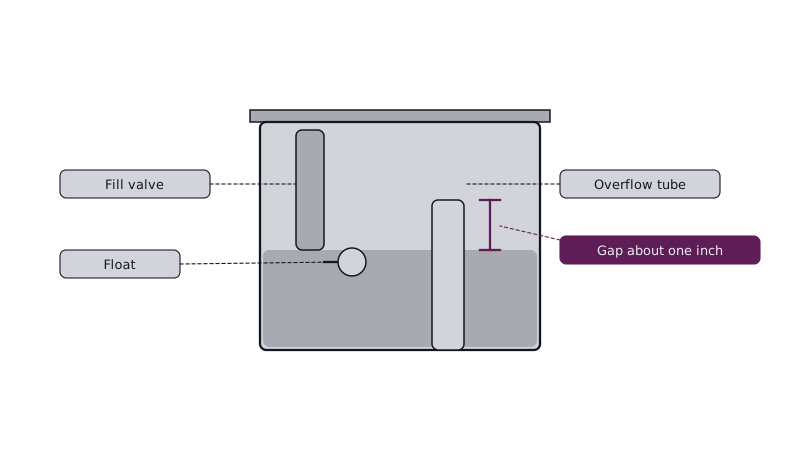
In the middle of the tank stands an open, upright pipe, and its job is to send surplus water to the bowl if the fill valve sticks. Water that keeps spilling into it means the tube is too short or the fill level was adjusted too high. A tube that leaks is cracked. It is one of the parts covered under toilet repair.
Why does a toilet tank have an overflow tube?
Think of it as a safety drain. Once the tank water climbs to the top of the tube, the excess flows down into the bowl and away, rather than going over the tank rim onto your floor. The refill tube also uses it to rinse the bowl after a flush.
On many toilets the tube is built into the flush valve assembly, which also holds the flapper. On others it is a separate plastic pipe that can be cut to height. In both cases it fixes the highest level the tank can reach, and the fill valve is set a little below that.
How do you know the overflow tube is at fault?
Remove the lid and inspect the tank. If water sits at the top of the tube and a steady trickle runs down it, the fill valve is set too high or is not shutting off. A low level that still drains away hints at a cracked tube. A hairline split in plastic often shows only when wet.
A hiss while the water sits at the tube's rim is a fill valve issue. A tank that drains slowly overnight despite a normal flapper suggests a crack in the tube or a loose seal at its base. Dry the tank, add colored water and watch where the color turns up.
How should the water level be set?
Set the float so the tank fills to about an inch below the rim of the overflow tube. Many valves have a screw on top or a clip on the float arm, and cup-style floats slide along a rod. Change it slightly, flush and look again. The tank should refill and shut off cleanly.
A lot of tanks have a water-line mark inside; if yours does, aim for that line. Too low a level weakens the flush, while too high a level sends water wastefully down the tube. Then check the refill tube, a thin flexible hose from the fill valve, which should clip above the rim of the tube and not hang inside it.
How is a cracked or loose overflow tube repaired?
A separate tube can simply be replaced. When the tube is part of the flush valve, the entire assembly must come out, and that requires lifting the tank off the bowl. The steps are: shut the water, empty the tank, unscrew the tank bolts, exchange the assembly and the tank-to-bowl gasket, then lower the tank back.
Hardware stores sell repair kits for universal flush valves. Measure the existing tube starting at the bottom of the flush valve and pick a kit that matches. Seal with the supplied gasket, avoid overtightening the nuts, and check for leaks at the tank base after refilling.
What if the tube stands too high or too low?
With an overly tall tube the flapper cannot be set properly and the tank may hold less water than it needs. An overly short one lets the tank overflow before it fills. Some can be trimmed with a hacksaw, but only slightly, and the cut must be clean.
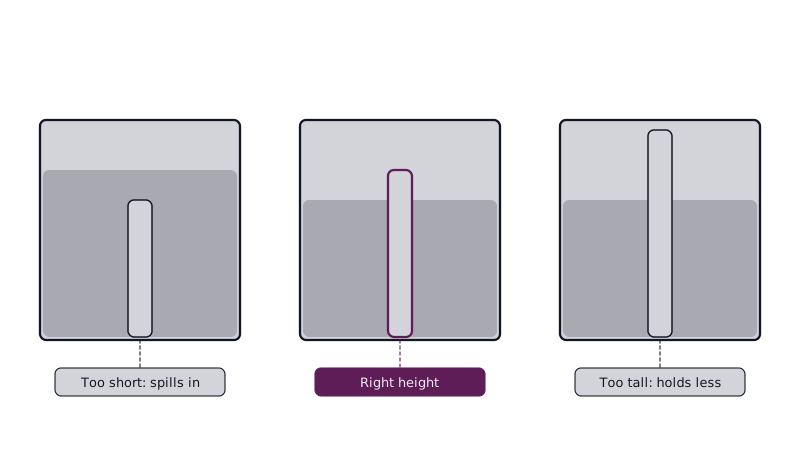
Do not trim a tube that is molded into the valve. A mismatched replacement often explains why a toilet still runs after repair, or flushes weakly. Should the flapper chain wrap around the tube, shorten or lengthen it until a little slack remains and nothing can snag.
How does a cracked tube differ from a leaking flapper?
Both let water pass from tank to bowl, but the leak point is different. A flapper leaks at the bottom, where it seals. A cracked tube leaks higher up. Add food coloring, note where the color first shows up, and follow the full test in toilet running causes.
EPA figures show a typical household losing more than 9,300 gallons of water per year to leaks, and a toilet is a common source. When you replace the tube, inspect the flapper too, because it sits on the same assembly. The other two parts are explained in swapping a flapper and replacing a fill valve.
When does replacing the whole toilet make more sense?
Think about it when the tank itself is cracked, parts for the model are discontinued, the porcelain is badly stained, or the toilet still flushes weakly after the repairs above. A new toilet is a straightforward job for a plumber, priced in toilet replacement cost.
Old toilets in older homes can be difficult to fit with modern parts, and replacing them reduces water use. If the toilet is newer, the plumber can swap in a universal flush valve and avoid a full replacement.
Common questions
Can I just push the overflow tube down?
No. The tube is attached to the flush valve, and pushing hard on it can crack the base. If it stands too tall, fit a shorter flush valve, or trim a separate tube. Adjusting the water level with the float is the correct fix for most overflow problems.
What causes noise as the tank finishes refilling?
The refill tube may be hanging inside the overflow tube and pulling water in, or the fill valve is noisy. Clip the refill tube above the rim and check that the valve is seated and its screen is clean. If noise persists, replace the fill valve.
Does a running toilet always involve the overflow tube?
No, the flapper is more common, followed by the fill valve and float. The tube matters only if the water level sits above where it should or the tube is cracked. Start with the dye test and the water level check. They find the cause in a few minutes.
Is a plumber needed to swap a flush valve?
Not always. With the right kit it is a manageable DIY job, but heavy tanks, seized bolts and cracked porcelain can complicate it. If the tank bolts will not budge, or the porcelain is damaged, call a plumber. Never force corroded hardware.
How can I arrange a plumber?
Fill in the quote page with your details. A local plumbing business receives them and carries out the repair, and such businesses pay us a fee for taking requests. We do not employ plumbers. How it works explains more, and the other jobs are on the home page.
References
Last changed