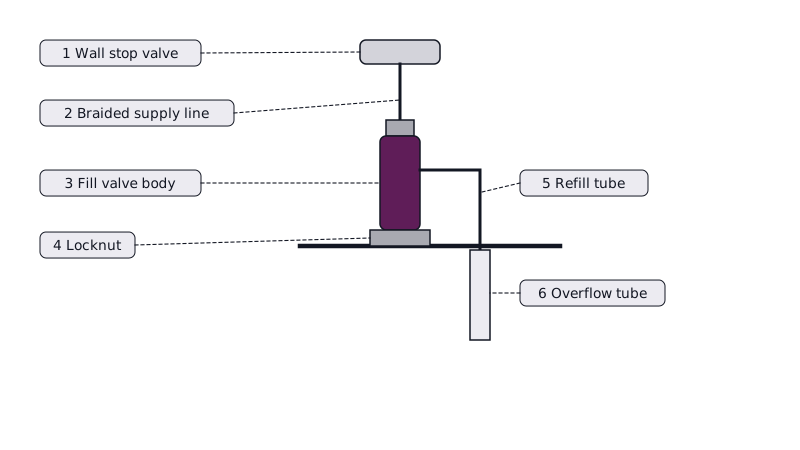
When the tank hisses after you stop flushing, takes forever to refill, or keeps trickling down the overflow tube, suspect the fill valve. The work means shutting off the supply, draining the tank, unscrewing the old valve and installing a new one, typically about thirty minutes. For other fixes, see the toilet repair page.
How can you tell the fill valve is bad?
Take the tank lid off and flush. A failing fill valve shows one of four signs: water that never stops running, water that climbs above the overflow tube, a loud hiss or whistle during refill, or a very slow refill. If the water level looks right yet the sound still bothers you, check the flapper next.
Check for a leaking flapper as a separate test. Add a little food coloring to the tank, wait fifteen minutes with no flushing, and watch the bowl. If the bowl turns colored, the flapper leaks and the tank keeps topping up in small bursts. A fill valve that cannot shut off sends the water down the overflow tube instead.
A much older toilet may have a brass ballcock with a float arm instead of the modern plastic tower. The replacement steps are similar, and a universal kit covers both.
How is the fill valve replaced?
Close the wall supply valve, flush the tank dry, and sponge up the remainder. Disconnect the supply line under the tank, remove the locknut holding the old valve, and lift the valve out. Drop the new valve in, set the height according to the manual, tighten the nut by hand, reconnect the line, and test.
Step by step:
- Turn the oval handle on the wall pipe clockwise until it stops.
- Flush and keep the lever pressed until the tank drains, then sponge out what is left.
- Unscrew the coupling nut that attaches the supply line, with a towel and small bucket for drips.
- Loosen the plastic locknut under the tank and lift the valve out.
- Set the new valve with its rubber washer seated, then spin the locknut on by hand and add a quarter turn.
- Clip the refill tube to the overflow pipe so it points into the tube without reaching below the water.
- Reattach the supply line, open the water slowly, and set the float so the fill ends about an inch below the top of the overflow tube.
Bring the old valve to the hardware store, or pick up a universal fill valve, which fits most toilets. Use a maker whose instructions you can read, a trusted brand with spare parts on the shelf, rather than the cheapest bag of unmarked parts.
Do not overtighten. Porcelain cracks, and a cracked tank means a new toilet.
When should you hand this to a plumber?
Bring one in if the shutoff valve cannot be closed or drips, if the tank cracks, or if water shows up around the toilet base after you fix the valve. A stuck stop valve is a common reason to stop. A broken valve while you are working can flood the bathroom.
Describe what the toilet does in a quote request. We send it to local plumbing businesses that pay this site a fee for introductions, and the one that replies sets the price and carries out the repair. Other jobs are on the home page.
What if a toilet supply line bursts?
Close the wall valve at once. If it is stuck, shut the main shutoff at the spot where the supply enters the house. Mop up and dry the area fast, then replace the braided supply line, which is a cheap part. A burst line is usually the flexible connector, not the toilet.
Replace connectors every several years: they are the weak point in a toilet install. Do not reuse the old ones when you swap a fill valve. If water has soaked through the floor or into a ceiling below, call both a plumber and your insurer, and read handling a burst water pipe.
Can a running toilet raise your water bill?
Yes. Water slipping quietly from the tank into the bowl is wasted all day long. By EPA figures, household leaks run upwards of 9,300 gallons a year in a typical home, and running toilets are among the most frequent sources. Repairing a fill valve or flapper is the cheapest way to trim a bill.
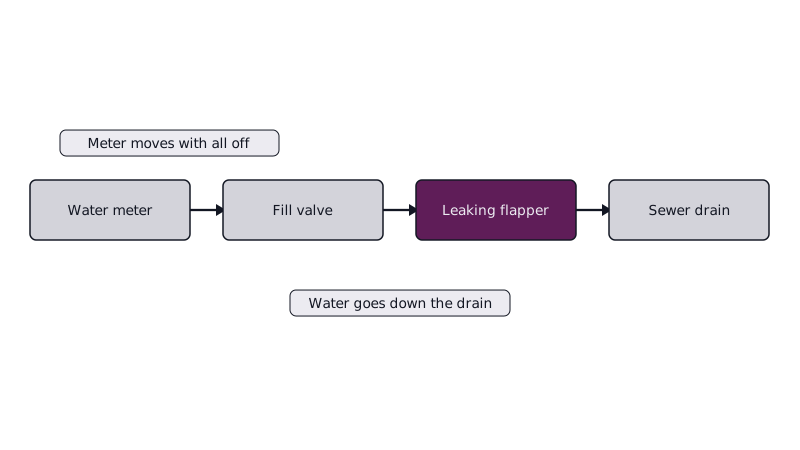
If the bill has jumped for no clear reason, start with the dye test above. Then watch the meter with all fixtures switched off; a moving dial means a leak somewhere. The checks are laid out in a high water bill and no sign of a leak.
What about the flapper, the gasket and other parts in the tank?
Replace them together if the toilet is old. The flapper is the rubber seal sitting low in the tank, and a worn one leaks water into the bowl. A flapper or gasket set costs little. A bad seal is the other big cause of a running toilet, and it is not fixed by a new fill valve.
If you have a flush valve seat that feels rough or pitted, the flapper will not seal on it, and a seat repair kit or a new flush valve is the answer. The gasket and bolts between tank and bowl are another leak point: water pooling around the toilet base after a flush points there. See pages on flapper repair, running toilet fixes and the overflow tube.
Hard water leaves crust on rubber seals and small valves. Third-party estimates put Murrieta tap water in the moderately hard to hard range, so old fill valves and flappers wear faster than the box suggests. Check your water district's report for your address.
Common questions
Is a universal fill valve as good as the original?
For most toilets, yes. Universal valves are adjustable in height and fit standard tanks. Measure from the tank bottom to the overflow tube top, and match the model's range. Some one-piece or pressure-assist toilets need the maker's own part, so check the model before you buy.
Why does my toilet fill and then trickle for a minute?
That pattern points to the flapper leaking slowly, a tank level adjusted too high, or debris holding the fill valve open. Lower the float, run the dye test, and flush a few times to rinse debris. If the trickle continues, replace the valve.
How much water might a running toilet waste?
A toilet that runs nonstop wastes far more than a faint trickle, and the amount depends on the flow. The EPA's 9,300-plus gallons a year is an average over household leaks of every kind, not a figure for a single toilet. Run the dye test or watch the water meter dial to learn which case you have.
Does an adult have to stay for a fill valve visit?
Yes, an adult should let the plumber in, agree the scope and check the toilet after the fix. The swap is short, so there is little waiting. The plumber may ask you to move things off the floor around the toilet, and to leave the bathroom door open for access.
References
- General home plumbing practice; the household leak figure is from EPA WaterSense guidance
Last changed