A sink faucet leaks because a seal wore out, and which seal depends on the design. Count the handles, look at where the water escapes (spout, handle, base) and the repair becomes clear. If the cabinet below is also wet, the cause may be the drain or a disposal; see the garbage disposal and sink repair page.
Which type of faucet do I have?
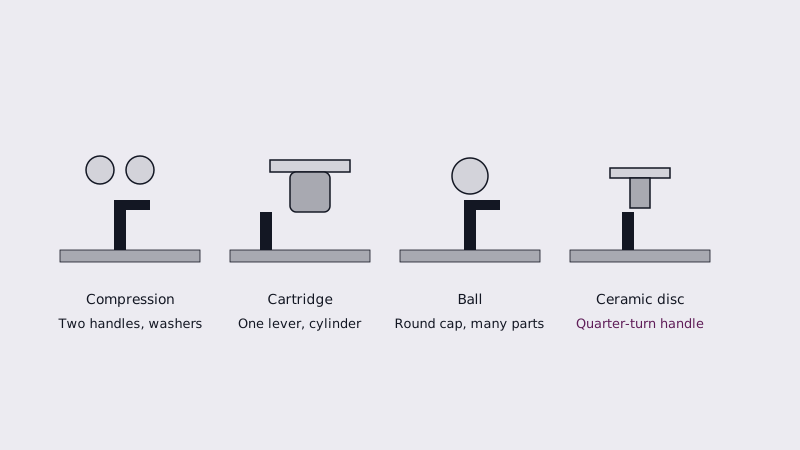
Count handles and feel how they move. Two knobs you turn many times is a compression faucet with rubber washers. A single lever that you lift and swing is a cartridge, ball or ceramic disc type. A handle that turns a quarter or half turn with a smooth stop is usually ceramic disc. The brand name on the trim helps when buying parts.
A rough key: two handles, compression or cartridge. One handle with a round cap over a ball under the lever, ball type. One lever, a short smooth action and often a tall cylinder under the handle, cartridge or ceramic disc. If you are unsure, remove the handle and look; photograph what you find and bring the worn part with you when you shop for a replacement.
Which spot is the leak starting from?
Dripping out of the spout means an internal seal has worn. Seepage around the spout base is a sign of tired O-rings. Dampness under the handle suggests a loose packing nut or a worn seal. Water pooling in the cabinet could be the supply lines, the drain, or the faucet body itself. Use paper towels to trace.
Let the faucet run for about a minute with a dry towel under the pipes. A drip at a connection that tightens by hand is fixed with a quarter turn. Crusty green or white buildup on a fitting signals a slow leak of long standing; replace that part.
What is the repair for a dripping compression faucet?
Start under the sink by turning off both shutoff valves, then open the tap so it drains. Remove the handle, unscrew the packing nut, pull the stem out, and replace the rubber washer plus any O-ring. A pitted seat in the body should be smoothed or replaced. Put it back together and reopen the shutoffs slowly. It is the simplest design to repair.
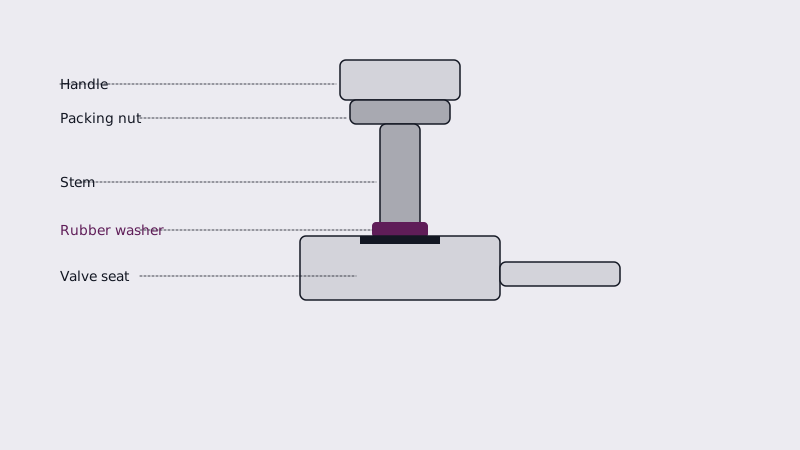
A compression faucet drips at the spout once the washer hardens or the seat wears. A repair kit with assorted washers makes the job cheap. Do not overtighten the stem when reseating it, because that wears the new washer fast.
How are cartridge, ball and disc faucets repaired?
With the shutoffs closed, lift off the handle and any cap, then pull the cartridge, ball assembly or disc cylinder, whichever your design has. Replace the cartridge, or the seals and springs on a ball faucet, with exact matches. Grease the O-rings and put everything back in the same order. Test with the aerator off.
Ceramic disc cylinders rarely fail but can clog with grit; clean them and the seals. A ball faucet has lots of small parts, so a kit is usually easier than buying pieces. The more specific guides cover single-handle faucets and two-handle faucets, and the overall faucet guide ties them together.
What if the water is under the sink, close to the garbage disposal?
Look at the disposal's seals before blaming the faucet. A leak from the top flange, the dishwasher hose connection, or the drain elbow is common, while water from the underside or the body means the unit has failed. Tighten what is loose and replace what is cracked. A failed disposal is replaced, not repaired.
If your drain is slow as well as leaking, the problem may be a clog backing up through the sink; read clearing a clogged garbage disposal drain and leaking pipe under a sink. Disposal wiring is electrical, so unplug the unit or switch off its circuit before reaching in, and never put a hand into the grinder.
Should you replace the faucet instead of repairing it?
Replace when parts are no longer made, the finish is worn through, the body is corroded or you have repaired it more than once. Repair when the fixture is sound and a cartridge or washer is the only issue. Hard water scale may be the reason for repeat failures; a softener helps in that case.
The kitchen or bathroom faucet is a fixture many homeowners swap themselves, though shutoff valves that will not close can stop the job. For the cost side, see what a faucet replacement costs and faucet installation cost. Third-party estimates rate Murrieta-area water as moderately hard to hard; check your water district's report.
When should you bring in a plumber?
Call if the shutoffs will not hold, if the water cannot be stopped, if fittings are corroded to the pipe, if the faucet is wall-mounted with no access, or if you find leaks you cannot trace. Also call for any gas appliance or disposal wiring issues. The plumber can also fit new shutoff valves.
Fill in the price request form and we forward it to a nearby plumbing company; companies taking requests pay us a fee, and one of them contacts you. Our other services are on the home page.
Common questions
Can I just tighten the handle to stop the drip?
A loose packing nut can leak at the handle, so a gentle snug can help there. A spout drip, though, is a worn seal, and cranking the handle tighter only wears it faster and can score the seat. Replace the worn washer, cartridge or disc instead of forcing it.
How much water does a dripping faucet waste?
Even a steady drip accumulates across weeks and months, and hot-water drips also waste the energy used to heat it. EPA puts the typical household's leakage at upward of 9,300 gallons per year, and dripping faucets are among the common sources.
What tools do I need?
Usually an adjustable wrench, a screwdriver and a set of hex keys, pliers, plumber's grease, a small towel and the right replacement parts. A cartridge puller or a seat-dressing tool helps on some models, and a flashlight helps in the cabinet.
Must the water to the whole house be shut off?
Usually not. Most sink faucets have small shutoff valves of their own beneath the sink. Close both, open the tap to drain it, and you are set to work. If a shutoff is stuck or drips, close the whole-house valve instead and get a plumber to deal with it.
References
Last changed