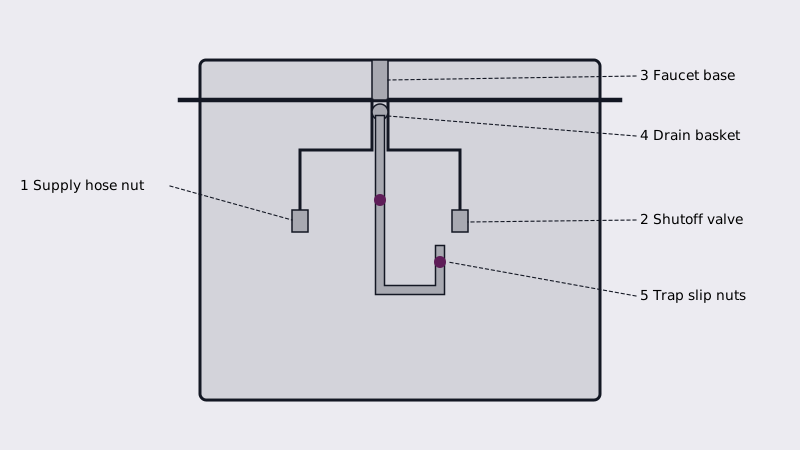
Empty the cabinet and wipe each pipe dry with a towel. Spread a dry paper towel over the cabinet floor, then run the sink. Whichever spot soaks first tells you which of five suspects to treat. This guide sits beside garbage disposal repair, since many kitchen leaks start at the disposal or its connections.
Where is the water under your sink really coming from?
Sort the leak by when it appears. Drips only while water runs usually come from the faucet's own connections or the drain. Drips that appear after you drain the basin come from the trap and its slip nuts. Water that is present all the time, even with everything off, is a supply line, stop valve or the faucet body under pressure.
Mark each place on the towel. Then check these five points in order: the two supply hoses and their nuts at the faucet, the shutoff valves at the wall, the faucet base from above, the drain basket at the sink bottom, and the P-trap joints. In a kitchen, the dishwasher hose and the disposal flange add two more.
An old trick works well: run your dry fingertip along each pipe and nut. Skin finds a bead of water far better than eyes do. Do this with a flashlight and shut the lights off in the room, because the beads shine.
How can you stop a slip nut or drain trap from leaking?
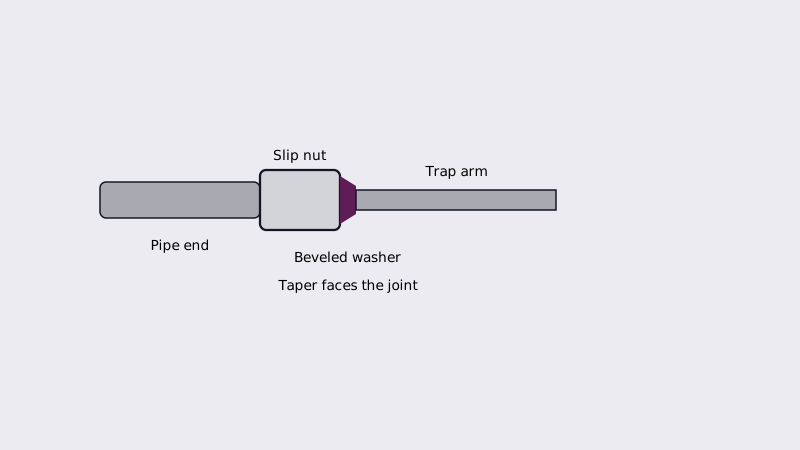
Hand-tighten the plastic slip nut in small quarter-turn steps. If it still weeps, unscrew it, check that the beveled washer is seated the right way, with the taper facing the joint, replace a cracked or flattened washer, and rethread. Do not use a wrench on plastic nuts beyond a gentle snug, since they crack.
If the trap itself has a pinhole, a hairline crack or a rotted section, replace it. Plastic traps are cheap, and kits come in standard sizes for 1 1/4 and 1 1/2 inch drains. Dry-fit the pieces before tightening, keep the drain line sloped slightly down toward the wall, and run water for several minutes afterward, checking with a dry paper towel.
Metal traps that are corroded through need replacement, not tape. A leak where the trap meets the pipe stub in the wall is another story, a drain problem that a plumber should inspect.
What if the supply line or shutoff valve is the one leaking?
When the hose or its nut is wet with the water running, close the angle stop below it, disconnect the hose, and fit a braided stainless replacement matching the original length and thread. A valve that drips around its stem may stop after a slight turn of the packing nut. If a valve cannot be closed fully, it needs replacing.
Tighten the new hose nut by hand, then give it roughly a quarter turn using a wrench. Over-tightening crushes the washer. Reopen the water slowly and watch with a dry towel for a few minutes. Supply hose should be changed every five to ten years anyway, so if the old one is brittle or bulged, do not reuse it.
A shutoff that is stuck is a common reason homeowners give up. If it resists, leave it alone, since too much force can crack the valve and leave you closing the main. A plumber can swap the valve, and doing so before the next emergency is worthwhile. Hard water makes these valves seize; third-party estimates put Murrieta tap water in the moderately hard to hard range, so older ones may be crusted.
Why is the garbage disposal leaking underneath?
Check three places on a disposal: the flange at the top where it meets the sink, the drain pipe connection on the side, and the dishwasher inlet. A leak from the body or the seam at the bottom is a failed seal, and the unit needs replacing. A leak at a flange or pipe can often be reseated.
Run the disposal with the sink basin full and the cabinet door open while someone watches. If water drips from the housing itself, shut it down. Fixtures with an internal seal failure cannot be repaired economically. If the leak is only at the top ring, the mounting ring may be loose, or the plumber's putty under the flange has dried out. See also garbage disposal installation when a swap is the answer.
How do you fix a leak at the faucet base?
Water that collects under the sink but only when the faucet is on may be coming from the faucet's own seals. Check beneath the sink basin for drips from the mounting nut or the hose connections on the faucet body. A cracked faucet body or a bad cartridge seal means the faucet is close to worn out.
When the faucet also drips above the counter, repairing a dripping sink faucet covers it. If the faucet is old, worn and dripping, replacing it is often better than hunting for parts, and the plumber's quote should include new supply lines. Compare faucet replacement cost.
Is it a pipe in the wall rather than the sink?
If water appears at the back of the cabinet or comes from the wall with no fixture nearby, the leak may be in a supply line or drain inside the wall. Shut the sink valves and check whether it stops. If water still arrives, close the main valve and call a plumber, since reaching a pipe in a wall means opening it with care.
A damp cabinet floor can also come from a leak in the room above or from a neighboring fixture's drain. Use the paper-towel test again after turning off every fixture except the sink. For leaks in walls and ceilings, leaking water pipe repair has more. The EPA says an average household loses more than 9,300 gallons per year to leaks, and a slow drip behind a cabinet door can go unnoticed for months.
When is a temporary fix acceptable?
A silicone repair tape wrap, an epoxy stick or a rubber clamp can slow a leak on a metal or plastic pipe until a plumber comes. Turn off the supply beforehand, and apply them only to dry, clean pipe. They are not permanent, and none belongs on a pressurized line you cannot see or reach.
If it is a drain leak, a bowl under the trap is a fair temporary measure. Use a bucket and avoid running the sink. For a supply leak, shut the angle stop. A leak the valve can halt is not an emergency; one it cannot halt is.
Water damage to a cabinet floor starts quickly with particleboard. Dry it, remove swollen material, and ask the plumber to look for mold and soft spots. Do not put electrical devices in a wet cabinet.
When is it time to bring in a plumber?
Get help if the shutoff valves will not close, the water comes from inside the wall, the pipes are old or corroded, the paper-towel test leaves the source hidden, or the disposal body itself is leaking. These jobs need parts, tools and a pressure test.
We give your request to a nearby plumbing business that comes out and quotes the job, and that business pays us a fee for the request. California generally requires a contractor license when a job reaches $1,000 or more, or whenever it needs a permit. Send details on the price request page. You can see the other jobs we pass along on the home page.
Common questions
Why does my sink drain leak only when I pull the plug?
A full basin pushes more water through the drain at once, which finds a loose slip nut, a cracked washer or a leaking basket seal. Tighten the nuts by hand, check the washers and, if the basket leaks, remove it and reseat it with fresh plumber's putty or a rubber gasket.
Is plumber's tape the right fix for a leaking drain?
PTFE plumber's tape belongs on threaded water connections, not slip joints. For a drain leak at a slip nut, fix the washer or nut. For a crack, replace the section. A rubber patch or epoxy wrap can be a short-term measure for a pinhole, not a permanent repair.
What is the best sealant for a sink drain?
Plumber's putty seals the drain flange or basket to the sink in many installations, and silicone is used with some materials. Follow the instructions of the drain maker, since some sinks and stainless baskets call for silicone instead of putty. Neither fixes a joint in the trap.
Is a small drip below the sink an emergency?
Normally no, as long as the angle stops or simply leaving the sink unused will halt it. Set a bucket underneath, put a towel in the cabinet and book a repair. It turns urgent when you cannot shut the water off, when electrical items are nearby, or when you smell mold.
Do I need a plumber, or can a handyman do it?
Many owners handle tightening nuts and swapping hoses and traps themselves. A contractor license is generally required in California for work of $1,000 or more and for anything requiring a permit. Leave a wall repair, a main valve, or any pipe inside a wall to a plumber.
References
Last changed