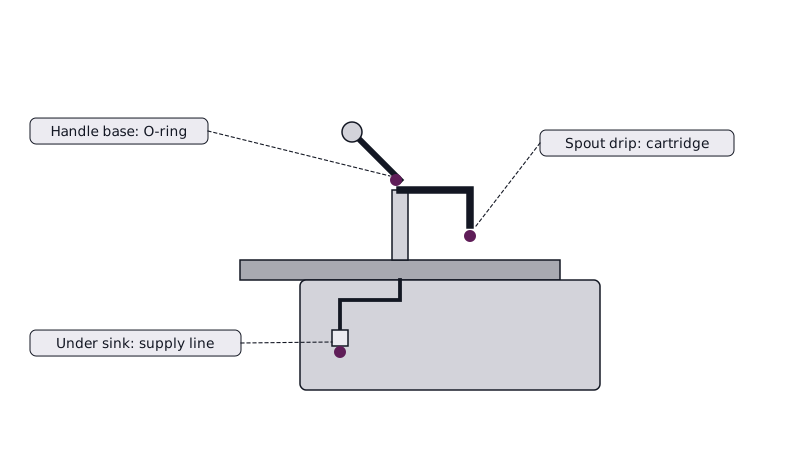
Shut the water off under the fixture, take the handle apart, and look at what is inside. When the spout drips, the washer, seat or cartridge is worn. A faucet that weeps around the handle has a dry O-ring. This page covers the common types, from kitchen to garden hose, and where faucets, sinks, showers and disposals turn into a plumber job.
What is actually leaking when a faucet drips?
Three different parts cause three different leaks. A spout that drips with the handle shut means the cartridge, seat or washer has worn out. Dampness at the handle base or the spout swivel suggests a dry O-ring. When water collects below the sink and the faucet is not running, the source is a drain fitting, a supply line or a shutoff valve instead.
Look before you buy parts. Dry the area with a towel, wrap a strip of tissue around the base, and run the tap. The paper tells you where the wet appears.
A compression faucet has its own handle for hot and for cold, each turned through several rotations, and rubber washers inside wear flat. Cartridge, ball and ceramic-disc faucets, common in homes of the 1990s to 2010s, use a sealed cartridge or disc that gets scored by grit and mineral scale. Third-party estimates rate Murrieta tap water moderately hard to hard, so scale on a cartridge is a common finding. Check your water district's report for a figure for your address.
Where does a repair stop being a weekend job?
Call a plumber when the shutoff valve will not close fully, green crust or pitting appears at the base, reaching the fixture means opening a wall, or a repair kit did not end the drip. Any of these means the parts are only half the problem. A seized or leaking stop valve is the commonest trap.
A faucet that leaks beneath the sink along with a disposal may involve both fixtures, and a drain fitting that weeps under a disposal needs different parts. If you want to replace a disposal while the cabinet is empty, ask for that in the same visit. Fitting one involves mounting hardware, an electrical connection and a dishwasher knockout, so many people choose to hire it.
Booking is simple: send a quote request naming the fixture, the brand if known, and whether the stop valves still close. We pass it to nearby plumbing businesses that pay this site a fee for introductions, and whichever one replies sets the price and does the work. For other jobs, visit the home page.
Does a bathroom or Delta faucet repair differ from the kitchen one?
A bathroom faucet follows the same routine as the kitchen one, with a smaller body. A Delta two-handle uses a stem and rubber seat; a Delta single-handle uses a cartridge or ball with springs and seats. Name the brand and model, and the parts counter finds the exact repair kit in one look.
Delta, Moen and others print a model number under the sink or on the cartridge. If you cannot find it, an exact cartridge pulled from the faucet works as a sample. Single-handle Delta kits often include the seats and springs together, so replace them as a set rather than one at a time.
A pedestal or vessel sink adds a snag: the supply valves may be tucked behind the wall or cabinet. If the valves will not turn fully off, or leak when you move them, stop and see the section on when to call.
Can you stop an outdoor, garden or hose faucet from leaking?
A hose bib dripping from the spout needs a new washer on the stem. One leaking from the handle needs packing nut tightening or a new packing washer. Shut the supply to the line, remove the handle, undo the packing nut, replace the washer or string packing, and reassemble. A split pipe behind the faucet is a different problem.
Outdoor faucets in the Murrieta area rarely freeze, but they bake. Sun cracks rubber, and a hose left on all summer strains the threads. If the faucet is the frost-free kind with a long stem, a drip from the spout after shutoff often means the whole stem must be replaced, and on a stucco or foundation wall that falls to a plumber.
Fit a cheap vacuum breaker, the little cap on a hose bib, if yours does not have one. It protects the house water from siphoning back in from the hose.
How do you handle a tub spout or shower handle that drips?
The valve hides behind a wall plate. When the access panel holds no stops, the main house valve is your shutoff. Remove the handle and trim ring, pull out the cartridge or stem, and swap it. Brass stems and plastic cartridges look alike across brands, so carry the worn one with you when you shop.
Drips from the tub spout, with the handle fully off, mean the seat or cartridge is gone. A trickle from the showerhead only after you shut off the shower is the same fault. Water seeping through the wall around the handle plate means the sealed valve body or the pipe behind it, and that needs a plumber before it becomes a stain on a ceiling below.
A single-lever shower valve usually has a replaceable cartridge, and it can be swapped without cutting walls. Older fixtures with separate hot and cold stems may need pliers that fit tight spaces, so check the handle style before buying parts.
How do you repair a kitchen faucet that drips?
Close both stop valves below the basin, then open the spout to bleed off pressure. Plug the drain opening with a rag so no screw can disappear down it. Pop the handle cap, back out the screw, lift the handle off, and withdraw the cartridge or stem. A hardware store clerk can match it. Fit the new part, then reopen the valves gently.
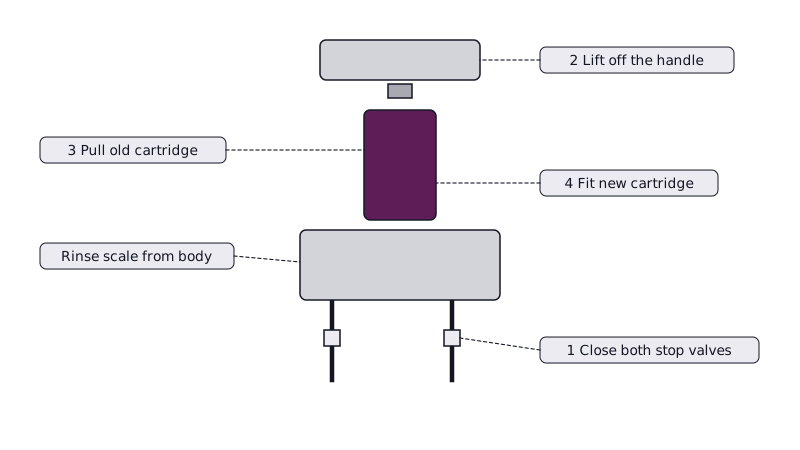
Photograph each step. A single-handle kitchen faucet usually has a retaining clip or nut that holds the cartridge, and a pull-down hose that can stay untouched. Use an old toothbrush to clear mineral flakes from the valve body ahead of fitting the replacement cartridge. Silicone plumber's grease on the O-rings keeps them supple.
If the body is pitted, corroded at the base, or the spout cracks, the faucet is spent. Replacing it costs about the same as several rounds of parts, and the price page on faucet replacement cost covers what to expect.
Common questions
Is a drip worth fixing for the water bill alone?
Usually. Drips look small beside a running toilet, but EPA data put a typical household's leak loss above 9,300 gallons annually, and a cartridge or washer is cheap beside that waste. Treat the fix as a tidy-up that pays for itself. Check how a leak affects a bill.
How do I know which cartridge to buy?
Bring the worn cartridge to the store, or note the brand and model stamped under the sink or on the handle. Match length, splines and the shape of the base by eye. Buying a full repair kit for that model is safer than guessing. If the brand is unknown, a plumber can often identify it in one visit.
Is it necessary to shut the water for the entire house?
Not for most sinks. Look for oval handles under the sink, called stop valves, and turn them clockwise. Tub and shower valves often lack stops, so the main valve is the answer unless an access panel shows individual ones. If the stop valve leaks when moved, replace it before anything else.
Is a faucet leak under the sink always the faucet?
No. Under-sink water often comes from the supply lines, the stop valves, the drain trap or the disposal flange. Wipe everything dry, then run each fixture alone and watch for the drip. The first place the paper tissue turns wet names the source, and it saves buying the wrong parts.
How long should a repaired faucet last?
A new cartridge or washer commonly lasts for years if the water is clean, though mineral scale shortens it. If you fix the same faucet twice in a year, or the finish has pitted, replacing the whole fixture is usually the better deal. A plumber can say which of the two applies to you.
References
- General home plumbing practice; no price figures on this page
Last changed