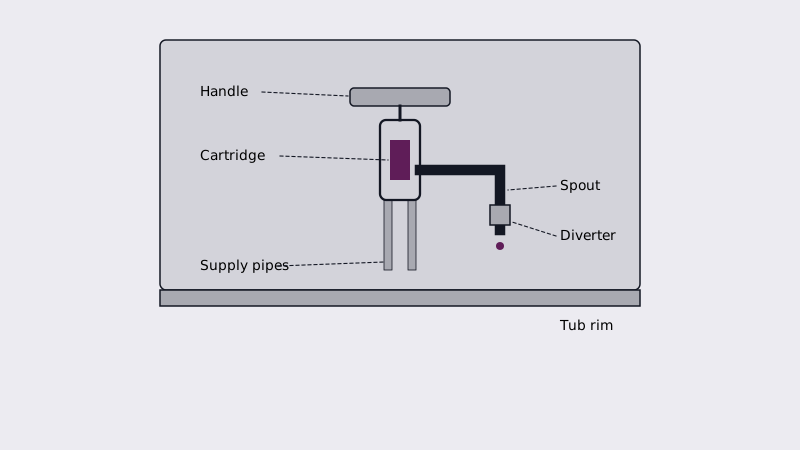
To stop a tub faucet leaking, you shut off the water, remove the handle, locate the worn part, replace it and test. Water dripping from the spout generally points to an old washer or cartridge, whereas water around the handle suggests an O-ring or packing. This page belongs to the faucets, sinks, showers and disposals help group.
What type of tub faucet do you have?
Count the handles and look at how they move. Two handles are usually compression or cartridge valves, one lever that slides or twists is a single-handle cartridge or ball valve. Compression faucets turn many times and use rubber washers, while cartridge faucets move a quarter or half turn. The type decides which part to buy.
Photograph the faucet and, after the handle comes off, the part inside. Brand names are often printed on the handle or cap. Carry the old piece into the shop when buying a replacement, since each cartridge fits only one make and model. If you cannot identify it, a plumber can usually tell at a glance.
The three-handle tub and shower combination is common in older homes, with one handle for hot, one for cold and one for the diverter. Each valve can leak on its own, so work out which one is dripping before you open anything.
How do I replace the worn parts?
Start by levering off the handle cap and undoing the screw, then draw the handle off and take out the trim and the stem or cartridge. Put in a fresh washer, O-ring or whole cartridge, then rebuild the faucet backwards and let the water return gradually. Lay the parts out in the sequence they came off, and swap both O-rings if the valve has two.
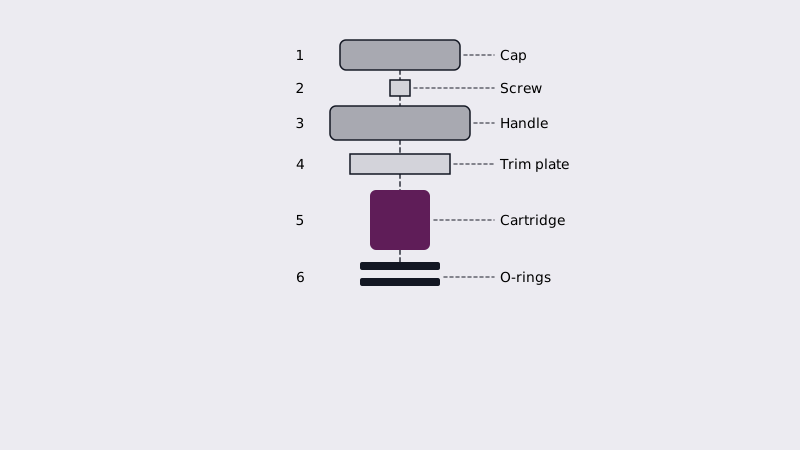
Here is the order that suits most tubs:
- Shut the water, open the faucet and plug the drain.
- Take away the cap, screw and handle.
- Unscrew the escutcheon plate, plus any retaining clip or nut.
- Draw the cartridge out in a straight line, or unscrew the stem on a compression valve.
- Install the new washer, seat or cartridge, and smear the O-rings lightly with plumber's silicone grease.
- Reassemble, turn the water on gradually, and look for drips from the spout and handle.
A compression stem may leave a worn seat in the wall. A seat wrench removes and replaces it. If the seat is pitted and cannot be changed, a plumber has a better chance of fixing it than a second round of washers.
Why does the spout still drip, or the showerhead leak while the tub runs?
A spout that drips after a new cartridge may mean a damaged seat, a cartridge sitting loose, or mineral scale on the sealing surface. If the showerhead dribbles while the tub is filling, the diverter has worn out. The diverter may be in the spout itself or in the valve.
A spout with a lift knob usually holds the diverter inside it, and replacing the spout is simple: it unscrews or is held by a set screw underneath. A leak at the joint between the spout and the wall, shown by water running behind the wall, needs care, since caulk will not fix a leaking pipe. Check inside the wall access if you have one.
Hard water makes this worse. Third-party estimates generally rate Murrieta tap water as moderately hard to hard, and scale both roughens seats and clogs up cartridges. Check your water district report or use a test strip for your address. Descaling parts in vinegar sometimes saves them.
How do you get help with a tub faucet?
Describe the faucet type, the place it leaks and what you have tried on the price request form. We then pass the request to a nearby plumbing company. Companies that take requests pay us a fee, and each writes its own quote. The home page explains how it works.
Photos of the faucet and the leak help the first conversation. If you have a spare cartridge or know the brand, say so.
Does the same approach apply to sink faucets and disposals?
Mostly yes: close the water, identify the type, replace the worn part, then test. Sink faucets have small stop valves beneath the cabinet, which makes the job easier than at a tub, where the main valve is often the only shutoff. Details differ by type, so see two-handle faucets and single-handle faucets.
Garbage disposal leaks are a separate matter, because the trouble lies in the flange, the drain connection or the dishwasher hose, not a valve. If water drips under the sink near a disposal, inspect the connections or ask about a disposal replacement. Our overview of faucet leaks covers the kitchen side, and the plumber who visits can look at fixtures in several rooms during one trip.
In older homes, fixtures can be corroded and parts hard to find, so replacing the whole faucet may be cheaper. Have the plumber price both options.
At what point should a plumber take over?
Call one when the shutoff cannot be closed, corroded parts snap, the leak continues after new parts, water shows in the wall or ceiling, or you would have to cut into the wall. California generally expects a contractor license for work totaling $1,000 or more in labor and materials, as well as anything needing a permit.
A small drip is worth stopping early on cost grounds alone. EPA WaterSense says a typical household loses upward of 9,300 gallons a year to leaks. Replacing a tub valve inside the wall, or a faulty shower pan, is a bigger job than a cartridge swap, and the bathtub faucet repair guide shows where that line falls.
How do I cut the water to a tub faucet?
Use the main valve unless the tub has its own stop valves, which are often behind an access panel in the wall on the opposite side. Open the tub faucet to drain the line and plug the drain so small screws cannot drop in. Confirm that nothing flows before taking anything apart.
Since many tubs have no local shutoff, the main valve is usually the practical choice. Find it before you start: it is often on the street side of the house or on the garage wall near the water heater. If the valve will not turn, phone a plumber instead of forcing it. Turn the water back on only when you are ready to test.
Common questions
What tools do I need to fix a tub faucet?
Gather screwdrivers, an adjustable wrench, pliers, replacement parts, plumber's grease and a towel, plus a seat wrench if the valve is a compression type. A cartridge puller helps on some brands. Use a rag under pliers to avoid scratching the finish. Buy the part after you have seen the old one.
How much water does a dripping tub faucet waste?
Even a slow drip adds up to many gallons a day, and EPA WaterSense cites typical household leaks at more than 9,300 gallons a year. A drip that shows up on your meter test is worth fixing soon, because it also stains the tub and wears the seat.
What makes a tub faucet drip only during a shower?
Blame the diverter, the spout or the showerhead rather than the valve. Check whether water leaves the spout during a shower. A worn diverter lets water escape the wrong way and is fixed by replacing the spout or diverter part.
Can I work on the tub faucet while the main stays open?
Only when the tub has working local stop valves. Otherwise, close the main, because a valve that fails with the stem out can flood the bathroom. If you cannot find any shutoff, do not guess: have a plumber isolate the line before taking the faucet apart.
Last changed