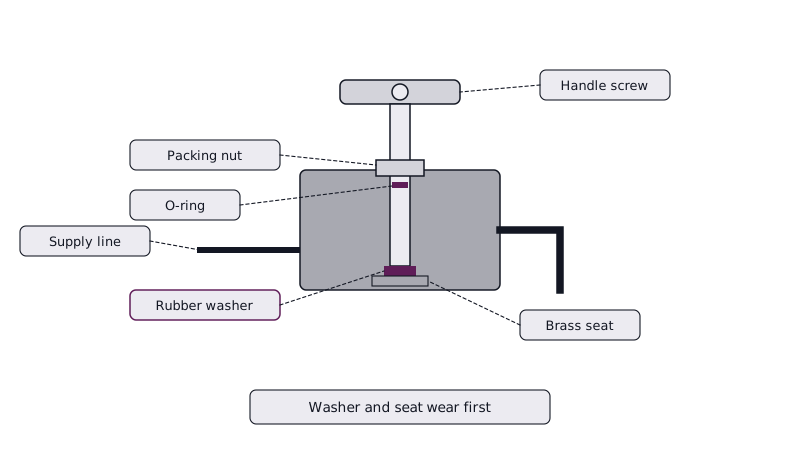
Identify which handle drips, close that side's shutoff valve beneath the sink, pull out the handle and stem, and swap in a new rubber washer, O-ring or whole cartridge. A drip at the spout points to a worn washer or seat; leakage at the handle points to the O-ring or packing. The related jobs are listed under sink, faucet and disposal repair.
Two-handle faucets come in two broad designs, compression and cartridge, and the repair differs. Doing the steps in order avoids breaking an old handle or dropping a small part down the drain, which is an annoying mistake above a sink with a garbage disposal.
Where should I start on a leaking two-handle faucet?
Work out whether the drip comes from the spout or from the base of the handle, and on which side. If a spout drip stops once you tighten one handle hard, suspect that side's washer or seat. Moisture at the handle suggests the O-ring or the packing nut. Wetness beneath the sink suggests a supply line or valve.
Wipe the faucet dry with a towel and observe it for a minute. Run only the hot side, then only the cold, so you know which stem to open.
If both sides drip, or the faucet is old, pitted or hard to turn, consider replacing it instead. Our pages on faucet replacement cost and how a faucet install is quoted cover that route.
Which type of two-handle faucet do I have?
A compression faucet turns several times to close and presses a rubber washer against a seat. A cartridge or ceramic disc faucet turns a quarter or half turn and has a sealed cartridge. If your handles spin more than a full turn, it is compression, and the washer is the usual wear part.
Older homes, including some near Old Town Murrieta, are likelier to have compression faucets, while homes built in recent decades often have cartridges or discs. Both types appear in Murrieta, so look rather than assume.
A cartridge faucet needs the exact cartridge from the maker, so note the brand before shopping. A compression faucet takes generic washers, but get the right size and shape (flat or beveled).
What are the steps for swapping a washer or O-ring?
Shut the supply valve beneath the sink and open the tap to drain it. Lift away the decorative cap, take out the screw, pull the handle off, loosen the packing nut, and withdraw the stem. Fit a new rubber washer and any O-ring, inspect the brass seat, then put it together and test. Plug the drain first so no screw can fall in.
As a numbered list:
- Shut off water and plug the drain.
- Take off the cap, screw and handle.
- Loosen the packing nut with an adjustable wrench, wrapping a cloth around the faucet to protect the finish.
- Unscrew the stem and examine the washer and O-ring.
- Fit new ones, with a thin film of plumber's grease on the O-ring.
- Smooth a rough seat with a seat dressing tool, or swap it out using a seat wrench.
- Put the faucet together, then crack the supply open slowly and check for leaks.
Bring the old washer along to the hardware store so the size matches.
What if water escapes at the handle, not the spout?
Check the stem O-ring and the packing nut. Tighten the packing nut a little first, because a loose one lets water creep up the stem. If that fails, replace the O-ring and, on older faucets, repack the stem with packing string or a new washer.
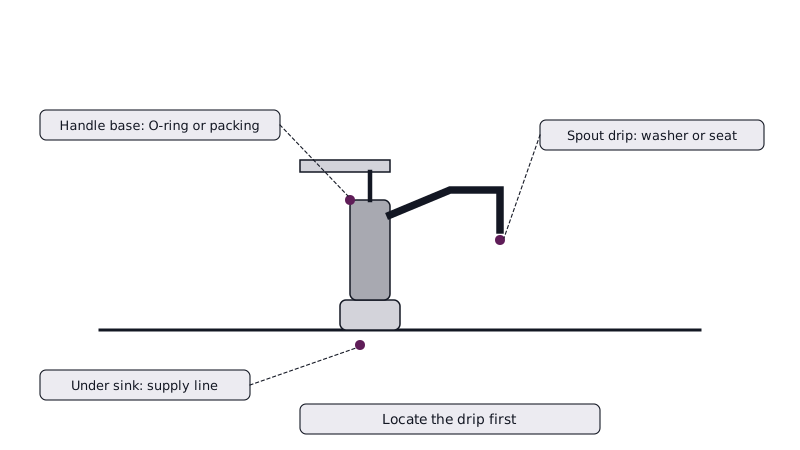
A leaking handle can also mean a worn stem with threads that no longer grip. Replace the whole stem, which costs little, instead of repeating small repairs.
Corroded old faucets can seize, and forcing them can snap a handle or twist a pipe. Spray the nut with penetrating oil and wait before you work. If the fixture will not budge, a plumber has the tools to avoid a bigger mess. For other variants, look at fixing a leaky sink faucet and the leaky faucet guide, and the single-handle version if your faucet is a different design.
Should a dripping faucet be fixed promptly?
Yes. The EPA says a tap that drips every second can lose more than 3,000 gallons annually, and household leaks overall average over 9,300 gallons. Hard water, which is usually moderately hard to hard in Murrieta, scores seats and washers faster, so drips tend to return unless the part is replaced fully.
A drip is also a clue about pressure and scale. Washers on a high-pressure system wear quickly. If the same faucet needs a repair every year, have the house pressure checked. The effect on your bill is discussed in whether a leaky faucet raises your water bill.
Water that collects under the sink can damage the cabinet and spread to the floor. A slow leak at the supply line is easy to miss; the page on leaking pipes under a sink covers how to find it.
When should a plumber handle it?
Make the call if the shutoff valves will not close, the stem will not come out, the seat is past what a dressing tool can fix, the faucet leaks inside the wall, or the handles feel loose and cracked. A new faucet may be the sensible fix then, and Murrieta Creek Plumbing can pass the request on to a nearby plumbing business.
Before starting, the plumber gives a written quote. No price is printed here, because none is sourced for Murrieta.
The form sends each request to one local plumbing business that quotes and does the work, and the businesses that take requests pay us a fee. Phone lines are open 9am to 5pm on weekdays. Other jobs appear on the home page.
Common questions
What causes a drip when both handles are fully tight?
The seat or the washer is likely damaged, and tightening harder only wears the rubber further. A rough or pitted seat cuts into a new washer, so smooth or replace it. If a handle has lost its threads, replace the stem. A faucet that never seals needs more than a new washer.
Is the main shutoff needed for a two-handle faucet repair?
Yes, provided the valves beneath the sink work. Close the one for the leaking side, or both. Stuck or leaking valves mean you must close the house's main shutoff. Do not force an old valve; a plumber can replace it.
Do I need special tools?
For most jobs you need just a screwdriver, an adjustable wrench, a seat wrench, a small tube of plumber's grease, and a handle puller if a handle is stubborn. Wrap a cloth around the faucet body to protect the finish. Everything is cheap and sits in the plumbing aisle of a hardware store.
How long does a washer repair last?
Often several years, though it depends on water hardness, house pressure and how firmly the handle gets cranked shut. Closing a handle gently, just until the drip stops, lengthens the life of the washer. A repair that fails within a year points to a damaged seat or a pressure problem.
Would a whole new faucet be the better choice?
Sometimes. Replacement can spare you repeated repairs if the faucet is aged, corroded or failing in several places, and a new faucet gives you modern cartridges that are easier to service. Compare both options when you get a written quote, and ask what each includes before choosing.
References
Last changed