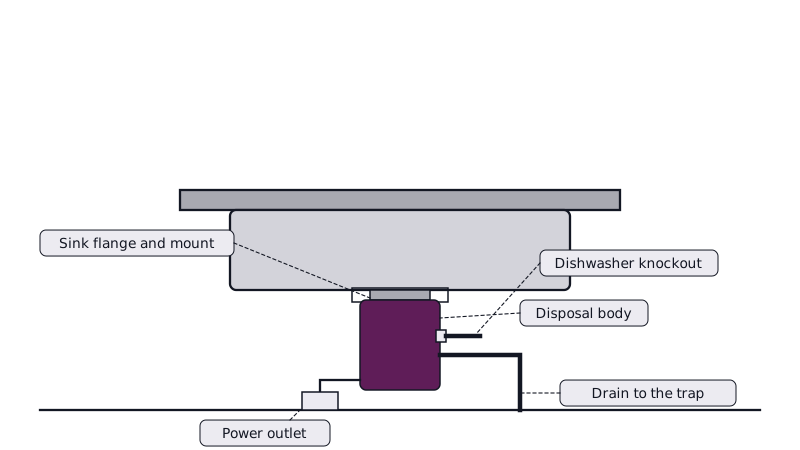
A garbage disposal install replaces or adds the grinder under your kitchen sink. The job covers taking out the old unit, mounting the new one on the sink flange, connecting the drain line and the dishwasher hose, and wiring or plugging it in. With the right power setup it takes a few hours. Our faucets, sinks, showers and disposals page shows the wider repair side.
What does a garbage disposal installation actually involve?
The plumber disconnects the drain and power, removes the old unit from its mounting ring, cleans the sink flange, then seats the new unit and reconnects the discharge pipe, dishwasher hose and electrical supply. Then it tests for leaks and runs the grinder. A first-time install adds mounting hardware, a power source and sometimes a switch.
The steps run like this:
- Cut power at the breaker first, then unplug the unit or disconnect its wires.
- Disconnect the drain trap and dishwasher hose.
- Release the old unit from the mounting assembly and lower it out.
- Clean the sink flange. Fresh plumber's putty or a gasket gives a good seal.
- Fit the new mounting assembly, then hang the unit and lock it.
- Remove the dishwasher knockout plug if a dishwasher connects. This is the step that gets missed, and it blocks the dishwasher drain.
- Reconnect the discharge pipe, hose and power.
- Run water, test for leaks, test the grinder.
If you are hunting for a "removal and installation" quote, ask whether disposal of the old unit is included.
How do I choose a disposal for my kitchen?
Match the unit to how you cook and what your cabinet allows. Motor size is the main spec, with larger motors handling tougher scraps and running quieter. Check the height under the sink, the type of feed, the mounting system and the power connection. A better unit often costs more but lasts longer.
Things worth comparing:
- Motor power. Basic units are fine for light use. Larger households that cook a lot benefit from more.
- Continuous feed or batch feed. Continuous runs with a switch. Batch needs the stopper in place, which some people prefer for safety.
- Noise insulation. Quieter models have insulation around the grinder, useful for open-plan kitchens.
- Size. Some units are tall and may hit a shelf or a small cabinet's plumbing.
- Plug or hard-wire. See below.
Septic lots deserve a note. Some rural properties are on a septic system rather than a sewer, and a disposal adds solids to the tank. If you are on septic, ask the plumber or your septic service whether a disposal suits your setup.
Does the disposal need a plug or hard wiring?
Either. A plug-in unit connects to an outlet under the sink through a cord. A hard-wired unit is connected directly to the circuit in a junction box. Some models come with a cord and some without, and the kit tells you. A contractor, not guesswork, should handle any electrical work that changes the circuit or adds an outlet.
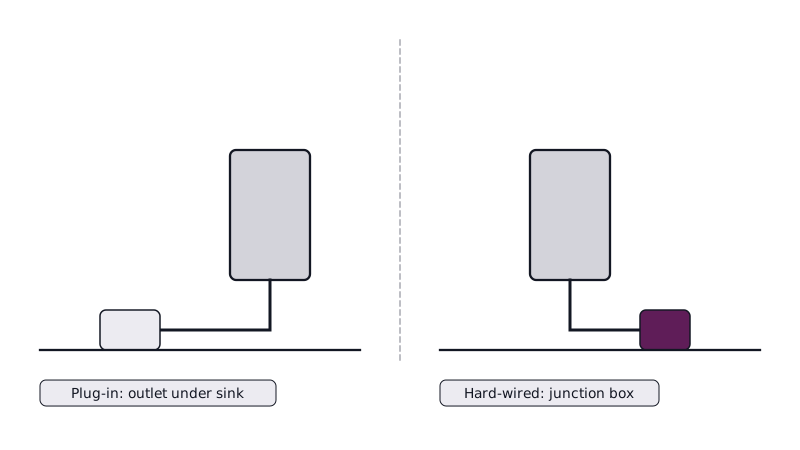
For a straight swap, most people reuse what is already there, plug or hard-wire, and the plumber follows the same arrangement. Problems start when an older home has an unusual setup: a missing box cover, damaged wire insulation or a switch that does not match. Older houses with original wiring are the most likely to show this.
To change from a wall switch to a push button, see air switch garbage disposal installation. Where an outlet must be added, an electrician with a California license should handle it, though a permit may apply. The City of Murrieta Building and Safety Division can say what applies inside the city. Outside the city, in places like French Valley and Winchester, the county offices take over.
What makes a disposal install cost more or less?
The unit you choose, the state of the mounting and wiring, the sink material, whether a dishwasher connects, whether an outlet or switch is added, and how much trap and pipe needs replacing all change the price. We list no figure, since the plumber who visits quotes after seeing the kitchen.
Look at the following when comparing quotes:
- Is the disposal included, or are you supplying it?
- Are a new mounting ring and power cord covered in the quote?
- Is old unit removal included?
- Is a new trap, drain pipe or dishwasher hose included?
- Is any electrical work part of it, or priced apart?
- Is there a minimum call-out fee?
A quote that lists every line makes comparisons fair. For related jobs, read about garbage disposal repair, or clearing a garbage disposal blockage if you only have a clog.
Should you repair an old disposal rather than replace it?
Sometimes. A jam, a tripped reset or a loose connection is cheap to fix. A leaking body, a seized motor or a rusted housing is not. If the unit is more than about ten years old, or has failed more than once, replacing it usually makes more sense than another repair.
Quick triage:
- Hums but does not spin: jam. Unplug, turn the hex key in the socket underneath to free it, press reset.
- Silent: look at the reset button, then the outlet or breaker.
- Leaks from the sides or bottom: the housing is failing. Replace.
- Leaks at the top: the flange seal or putty. Repairable.
- Smells: food buildup. Clean the splash guard and run citrus peels or ice, then check the trap.
Hard water leaves mineral buildup in drains and on seals over time. Check your water district's report if scale is a concern.
How do I arrange an installation?
Note the sink type, the number of bowls, whether you have a dishwasher, whether the existing disposal is plug-in or hard-wired and what you want to buy. Then fill in the quote page. Requests are forwarded to local plumbing businesses, which pay us a fee, and the one that visits names the price. Other help is on the Murrieta Creek Plumbing home page.
Common questions
How many hours should the installation take?
Once the tools and unit are on site, a like-for-like swap often runs one to two hours. A first-time install, with new wiring and a drain change, takes longer. The plumber can estimate once they know the sink and the power arrangement. Leave time for a final test.
What should I ask before work begins?
Find out whether the old unit is hauled off, whether the dishwasher knockout will be cleared, whether any electrical work is needed, what warranty the unit carries and what the plumber's workmanship covers. Ask for the brand and model so you can check reviews and specs.
Do I need an electrician as well?
Not when swapping a plug-in unit, or a hard-wired one that is already wired correctly. If an outlet must be added, a switch moved or wiring is damaged, someone holding a California contractor license should do the work. The plumber can tell you at the visit.
Can a disposal go on any sink?
Most standard kitchen sinks have a 3.5 inch drain opening that suits a disposal, though some sinks, such as certain composite or specialty types, have limits. Tell the plumber the sink brand and material. Bar sinks and very small cabinets may need a compact model.
Last changed