Repiping removes the old water supply lines and runs new ones, usually in PEX or copper, to every fixture, with walls opened only where needed. It is not a homeowner project: the work needs a California permit and a contractor license. Our overview of repiping and pipe replacement answers whether you need one at all. This page is about the method.
What happens, step by step, when a house is repiped?
A crew shuts off and drains the water, plans new routes, opens small access holes in drywall, runs new lines out from the main shutoff to every fixture, connects them, pressure tests the system, and calls for a city or county inspection before patching the walls. The old pipe is either pulled or abandoned in place.
In more detail, a typical sequence runs like this:
- Walkthrough and plan. The plumber counts fixtures, picks the manifold location or the trunk-and-branch layout, and flags where walls must open.
- Water off. You need a backup plan for drinking water, toilets and showers. Ask how long the house will be dry.
- Rough-in. New lines go in through attics, crawlspaces, closets and the backs of cabinets. PEX bends around corners, so fewer holes are needed.
- Connections. Each fixture gets a new valve and supply.
- Pressure test. The system is filled and held under pressure before anyone closes a wall.
- Inspection. The building office signs off.
- Patching. Drywall is closed, but painting is usually separate unless the quote includes it.
The reasons are on a companion page, why repipe a house, and timing is covered by the repiping timeline.
Should the new pipe be PEX or copper?
PEX is a common answer for many houses: it costs less to install, bends through framing and avoids the pinhole trouble that afflicts copper. Copper has a long track record and suits people who like rigid metal pipe. The plumbing code approves both, and the plumber should say why one was chosen.
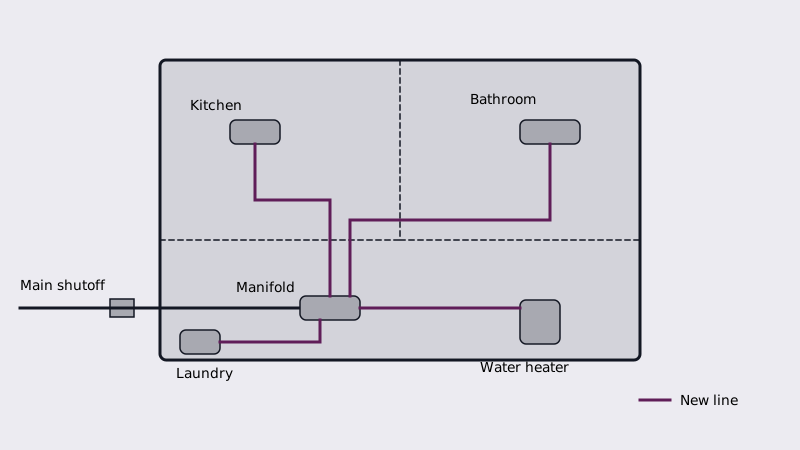
To repipe with PEX, the plumber runs flexible tubing from a central manifold, one line per fixture, with crimp or expansion fittings at the joints. Fewer joints inside the walls means fewer places to leak. How to repipe with copper: rigid tubes are cut, fitted and soldered at every turn, which takes more time and more skill with a torch inside an attic.
Water hardness plays a part too. Third-party estimates generally rate Murrieta tap water moderately hard to hard, and your district's water report has the real number for your address. Scale from hard water, together with other water chemistry, is blamed for pinholes in copper. A water district can tell you what it delivers. Our side-by-side on PEX versus copper goes deeper, and PEX repipe pricing covers what drives cost.
What is the approach to repiping a slab-foundation home?
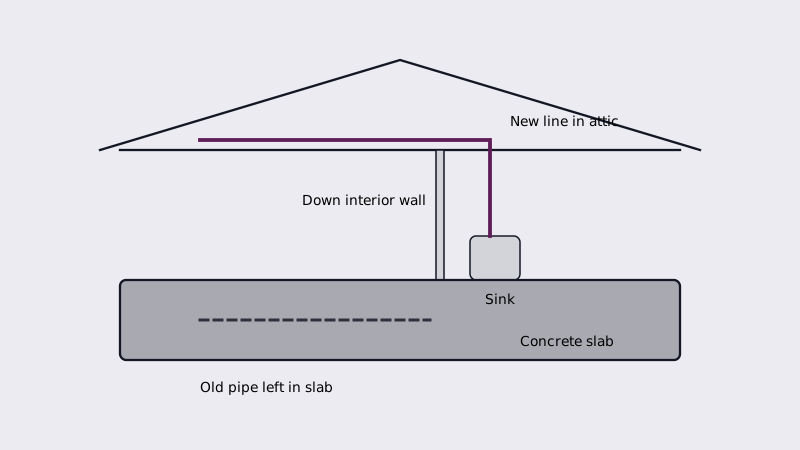
Plumbers generally leave a slab foundation's concrete intact. The old lines stay unused, and new ones go across the attic and then down inside interior walls, a method called a reroute. No jackhammering is needed and the floors stay alone, but more wall openings result.
Many homes here date from the 1990s onward, and where the foundation is a slab, reroutes are common. Third-party census-based tallies put the median Murrieta home near the year 2000, so the older tract homes have reached an age where original copper can show wear. Check slab leak repair or repipe if the trigger is a leak under the floor, and slab leak detection if you are not sure it is under the slab.
Reroute caveat: lines in the attic must be insulated, and the plumber should explain how they will handle ceiling and wall patching. Ask for it in writing.
Is repiping my own home allowed?
Seldom, as a matter of law. Repiping is permitted work, and any job with a permit calls for a California contractor license. The permit also brings an inspection that guards you should something be wrong. Homeowners can do prep, such as clearing closets and moving furniture, and can paint afterward.
Even if the permit rules were different, the work is large. A full repipe is days of cutting, fitting and testing across the whole house, with a water shutoff that leaves family and pets without a working kitchen or bath. Mistakes show up months later, behind drywall. The State's contractor board lets you check any business by license number, and you should do it before agreeing to anything or paying a deposit.
Your address decides where the permit is pulled. Addresses in the city of Murrieta go through Building and Safety at 951-461-6062. Riverside County covers French Valley and Winchester, and San Diego County covers Fallbrook, Rainbow and De Luz. Ask the plumber who obtains it, and what the inspection stages are.
What should I check before agreeing to a repipe?
Look up the contractor's license on the state board's website, get the scope in writing (pipe type, fixtures, patching, painting), and ask who obtains the permit. Also confirm what becomes of the old pipe, how the water-off periods are handled, and whether the pressure regulator will be replaced or tested.
That final item matters. California's plumbing code caps water pressure inside the house at 80 psi, and a new system fed by a failing regulator will be stressed from the first day. See water pressure regulator replacement for the related fix.
Also ask whether a defective or old material is the reason. Polybutylene, installed until the mid-1990s, has a reputation for failing; see polybutylene replacement. Galvanized steel in older homes corrodes inside, see galvanized replacement.
Once you are ready to proceed, request a quote with a description of the house: year built, slab or crawlspace, and any leaks so far.
What if I only need part of the house done?
A partial repipe is possible when the trouble is isolated: a single wing, a kitchen, or a bathroom group. The risk is that the remaining old pipe fails next. Have the plumber examine the pipe being left in place and state in writing its condition, and which repairs you accept by skipping it.
Mixed materials need dielectric fittings where steel and copper meet, to prevent galvanic corrosion. A plumber who has planned the transition properly will tell you where it happens. If they have not mentioned it, ask.
Common questions
How long is a whole-house repipe likely to last?
House size, floors and material all matter. Small single-story houses can finish in a few days, larger or two-story homes take longer, and drywall repair adds time. Expect a schedule from the plumber that states when the water is off, since that is what you will notice most.
Do new pipes cure low water pressure?
Only when the old pipe is the cause. Corroded or scaled lines restrict flow, and new pipe can restore it. Repiping will not fix a dying regulator, a valve left partly open or a problem with the municipal supply, so measure the pressure first.
Do I have to leave the house during a repipe?
Not always, but plan for disruption. The water is off for stretches, noise is constant, and dust gets into rooms. Many families relocate pets and valuables away from work areas. Ask the plumber about a typical day and a plan for toilet and drinking water.
The rest of our guides start from plumber in Murrieta.
Last changed