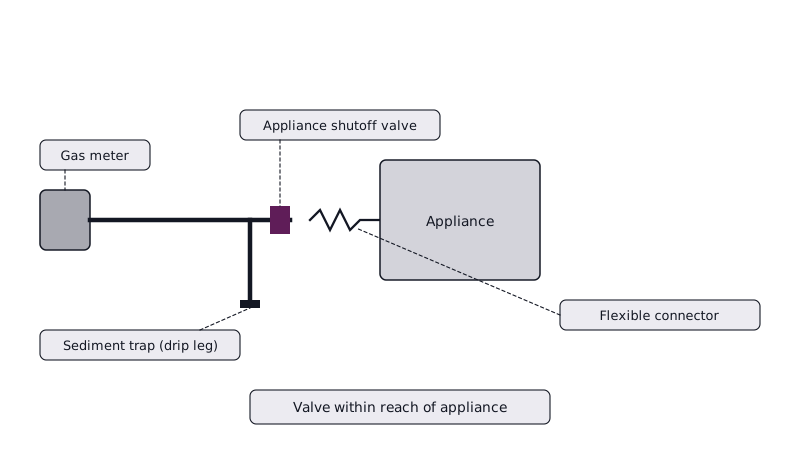
The California Plumbing Code, with its fuel gas chapter, covers home gas piping in Murrieta, along with whatever the local building office adds. Doing the work requires a contractor's license, and normally a permit plus an inspection too. For who does that work, see the gas plumber page. Smelling gas at this moment? Jump to the safety paragraph below.
If I smell gas, what do I do first?
Leave the building immediately with everyone inside, and leave the door open if you can do so without delay. Do not flip switches, use a phone or light anything on the way out. Once you reach the yard or a neighbor's home, phone SoCalGas at 1-800-427-2200, or dial 911 instead if anyone is in danger. Stay outside until the utility says it is safe.
SoCalGas is the expected gas utility for Murrieta and nearby Riverside County areas, but we did not check territory street by street, and some rural homes run on propane or electricity. If you are not sure who supplies your gas, the bill or the meter tag names the company. For propane, call the tank supplier on the tank label.
Never attempt a gas leak repair yourself. Soapy water on a joint can help a plumber find it, but tightening a gas fitting without testing is not safe.
Which code applies to home gas piping in Murrieta?
The California Plumbing Code is adopted statewide and updated in cycles, and it contains the rules for fuel gas piping. Cities and counties enforce it and may add local amendments. Which edition applies depends on your permit date, so ask the building office. The code covers materials, sizing, supports, shutoffs, testing and appliance connections.
Do not read the code as a DIY manual; it is a minimum standard for what an inspector will accept. The manufacturer's instructions for each appliance also have the force of requirements, and a conflict goes to the stricter. For Murrieta, the contact is the city's Building and Safety office, 951-461-6062 (city page; confirm), in Wildomar it is its city Building and Safety counter at 951-677-7751 (listed), and French Valley and Winchester fall under Riverside County Building and Safety (per county listing; confirm before visiting).
Permits for Fallbrook, Rainbow and De Luz come from San Diego County's Planning and Development Services, since those places sit in that county. Gas there may come from a different utility than SoCalGas, so ask.
Who may install or alter gas piping?
State law sends most gas piping work in California to a contractor with the right state license, and permit jobs of any kind follow the same rule. Owner-builders can sometimes pull permits for their own home, but gas work is high-risk and many offices expect every joint to be inspected. Check with the building office on what it allows before you buy a single fitting.
Look up a contractor's license number through the Contractors State License Board website, and get that number from the contractor in writing. Compare the license classification with the work: plumbing contractors commonly handle gas piping, but confirm with the board. For the dollar thresholds that apply to contracts and deposits, read the board's current page.
Appliance connections, such as a water heater, range or dryer, are part of the system. A water heater replacement in particular brings a permit and, for a tankless unit, a larger line; see gas tankless water heater installation.
How does the code treat pipe materials and flexible lines?
Common choices are steel black iron pipe or corrugated stainless tubing, plus copper in some cases, or approved plastic when buried. Each has its rules. Flexible appliance connectors are short, listed, and not meant to run through walls. Corrugated stainless tubing must be bonded to the electrical grounding system as its maker specifies.
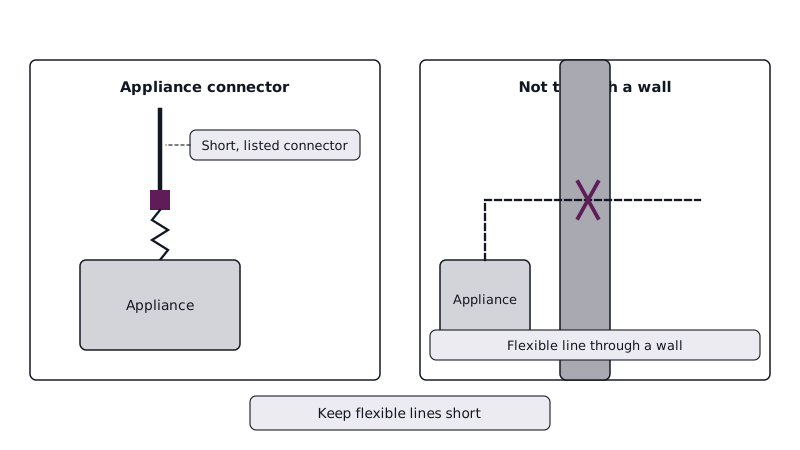
Questions about a half-inch flexible line come up often. Whether such a line can serve a given appliance depends on its length, the appliance's input rating, and the pressure, so sizing is by tables or calculation, and a plumber does it. See half-inch flexible gas lines for the common mistakes.
Other points the code addresses: a shutoff valve that can be reached at each appliance, a sediment trap (drip leg) at many appliances, shielding for pipe that passes through framing or masonry, clearances from vents and electrical, and no gas piping in some concealed or unventilated spaces. Exact wording and exceptions are in the code and may be amended locally.
Why are permits, inspections and pressure tests part of it?
A pressure test holds air or inert gas in the new piping at a set pressure for a set time and watches for a drop, which finds leaks before the gas is turned on. The inspector witnesses it and signs off. Skipping the permit means no test record, possible trouble selling the house, and risk to the people inside.
The plumber usually pulls the permit and schedules the inspections. Once the pipe is approved, the utility or the plumber turns the gas on and checks pilot lights. After any work, test every appliance for proper flame and ventilation, and check carbon monoxide alarms.
Gas appliances and venting also have rules: a water heater needs a vent of the right size and slope, and a combustion air supply in tight spaces. Water heater replacements also need earthquake bracing under California law.
What about earthquake shutoff valves and cost?
An automatic earthquake shutoff valve cuts off the gas line once it senses strong shaking. California has rules about them in certain situations, though specifics vary with the building and its permit. See emergency gas shutoff valves for earthquakes and how an earthquake gas valve is installed.
For the cost side, the gas line cost guide explains what shapes a quote, while the gas line plumbing page shows common jobs. Distance from the meter, pipe size, trenching or wall access and permits all matter. No dollar figures appear here, as we have not verified any local ones.
Murrieta Creek Plumbing passes gas work requests to a local plumber, and the business that quotes pays a fee for the introduction. Use the quote request and tell us the appliance, the distance from the meter and whether the house is on gas now.
Common questions
May I run my own gas line to a barbecue or fire pit?
California treats that as gas piping, so it takes a contractor license and normally a permit. Outdoor lines are buried or run with approved materials, and joints must be tested. A flexible hose from a quick-connect is a different thing and has to be a listed part for that appliance.
Do I need a permit when swapping out a gas appliance?
Often yes, especially for a water heater, because it touches gas, venting and earthquake bracing. Replacing a range with a like model may not need one, but the connector and shutoff still have to be right. Ask your building office, since the rules differ by city and county.
Does the gas company inspect my house piping?
SoCalGas looks after the line up to and including its meter and responds to leak calls. The piping after the meter belongs to the owner and falls under the building code and your permit inspections. For a suspected leak, call the utility first, then a plumber to repair.
Is propane covered by the same code?
Propane piping is covered by the same fuel gas rules in many respects, with differences in pressure, regulators and tank placement. Some rural properties run on propane rather than piped natural gas, so confirm your fuel type and ask the plumber to explain which rules apply before planning any work.
How can I check the condition of my gas pipes?
Signs of trouble are a rotten-egg smell, hissing, plants dying above a buried line, rust or flaking on exposed pipe, and a meter dial that moves with all appliances off. A plumber can pressure-test the system. Do not rely on the smell alone, since people can lose their sense of it.
Last changed