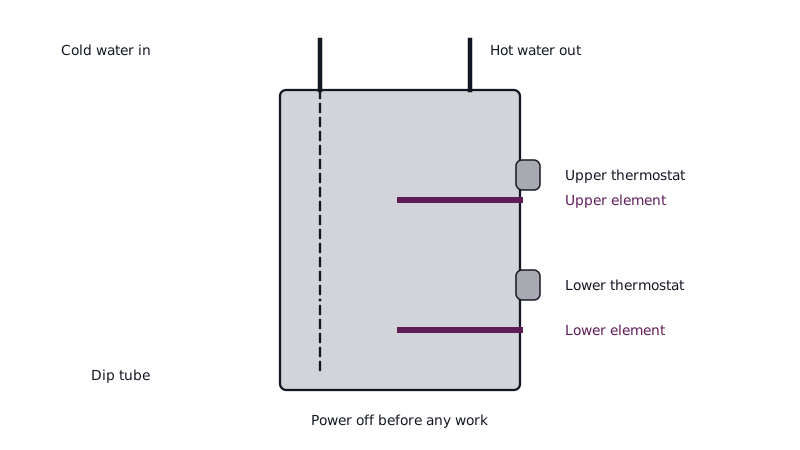
If your electric tank heater makes only warm water, or hot water that vanishes in a few minutes, a burnt element is the leading suspect. Each element is a replaceable part, and a plumber can swap one in well under a day. Before you pay, rule out the breaker and thermostat. Water heater repair is the parent page, and it covers other faults.
How do I know the element has failed and not something else?
A failed element leaves a pattern. When no hot water arrives at all, suspect the upper element, a thermostat or a tripped limit switch. Only a small tank's worth of hot water that fades fast suggests the lower element. The only proof is a meter test with the power off, which reveals an open circuit or a short against the metal case.
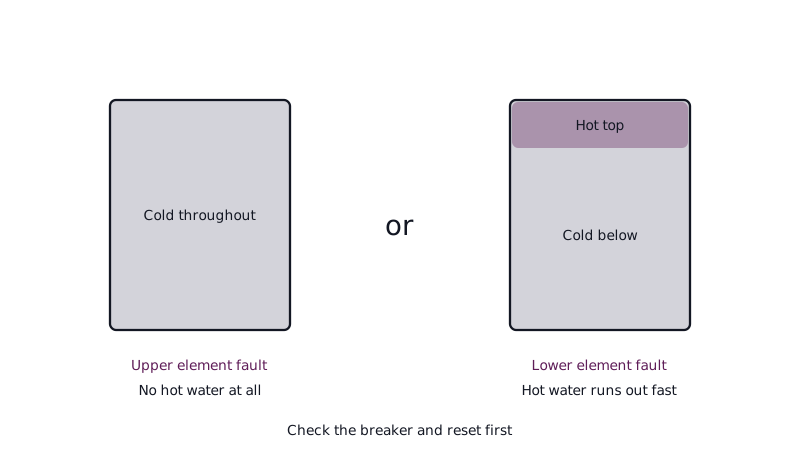
Rule out the easy things first: the breaker, the heater's disconnect switch, and the red reset on the top thermostat. If the reset trips again after you press it, a shorted element is common, and power should stay off until it is replaced. Gas heaters have no elements at all, and for those the equivalent trouble is covered on thermocouple replacement. For symptoms that blur together, see the no hot water guide.
What do I need to match when buying an element?
Match four things: voltage, wattage, the style of mounting (screw-in or bolt-flange) and the length. You will find each one on the data plate of the heater or on the tag of the old element. A wrong wattage can overload the circuit or underheat the tank. Low-density elements are a common upgrade for hard water because they spread heat over more surface and scale less.
Bring the old element when you shop, and take a photo of the heater's label. Heaters from different makers use different thread and flange types, so universal elements do not always fit. A plumber carries common ones. Make sure the quote includes the part, a fresh gasket, and taking away the old element.
When the heater is so old that parts are scarce, or the fittings show rust, a new element may be wasted money. A leaking tank cannot be mended; read water heater leaks.
Can I replace the element myself?
It is manageable for a careful, handy owner, but it mixes electricity with water, so stop if unsure. The order of work: switch off the breaker and confirm with a tester that the power is dead, shut the cold supply, empty the tank to a level beneath the element, remove the cover and unhook the wires, then use an element wrench to unscrew the old part. Fit the new gasketed element, refill, and only then restore power.
The unforgiving part is the last step. Never power a tank before it is full, since an element running dry burns out in seconds. Leave a hot tap open until water flows steadily, then restore power. Do not work on a hot tank, and be aware that scalding is a real risk with a heater that has been running.
A contractor license is needed in California for jobs above a small dollar threshold and for permit jobs. Swapping an element like for like counts as a repair, and whether it triggers a permit is a question for your building office. Replacing the whole heater is generally permitted work. Murrieta's Building and Safety lists 951-461-6062, and Wildomar's lists 951-677-7751.
What makes elements burn out so quickly here?
Scale is the usual reason. Hard water leaves mineral crust on the element, which makes it run hotter than designed and burn through. Third-party estimates rate Murrieta tap water as moderately hard to hard in general (roughly 6 to 11 grains per gallon in 2023 to 2025 report years), and your district's own report has your address's number, so check which district bills you.
Sediment that settles on the tank floor also buries the lower element. That is why a heater that has not been flushed for years often loses its lower element first. A full-tank flush before swapping helps the new one last. If elements die every year or two, the water chemistry or the tank condition is the real problem, and it may be time to think about a replacement heater, see how often a heater should be replaced.
A water softener changes the picture, see water softener installation.
What if the water is hot but runs out quickly?
That pattern can come from a failed lower element, a broken dip tube, a mixing valve problem or sediment. Test the lower element first with a meter, then have the plumber look at the dip tube, which carries cold water down to the base of the tank. When it breaks, cold water mixes in at the top, so hot water is lost fast.
Also consider demand. A new bathtub, an extra family member or a long soak can outgrow a 40 gallon tank. If the element tests fine and the tank is the wrong size, see what a 50 gallon heater costs to replace.
When is it time to let a plumber take the job?
Phone when the breaker trips repeatedly, the wiring looks scorched, the tank has been leaking, you find rust at the element flange, the heater is old, or you are not comfortable working on 240 volt power. A plumber also checks the thermostats, the high-limit switch and the relief valve while the cover is off.
A visit can combine tasks. If the tank needs flushing, an anode rod is spent, or the dip tube is broken, doing it together saves a trip. See the anode rod page and dip tube replacement. To start, request a price with the heater's brand, age and what it does. The plumber home page is also there for other services.
A burning smell means you cut the breaker and keep away from the heater. A gas smell anywhere in the home means going outdoors, using the SoCalGas line, 1-800-427-2200, and calling 911 if you feel in danger.
Common questions
How long does swapping an element take?
With the part in hand, a plumber needs roughly one to two hours for the draining, swap and refill. A tank full of sediment, a stuck element or a bad thermostat adds time. Ask for the part cost and labor to be shown separately on the quote.
Should I replace both elements at once?
Often yes when the heater is several years old, because the second element has seen the same scale and heat. Replacing both while the tank is drained saves a second visit, though it is not required. Ask the plumber to test the other element and advise.
Do I lose the tank's warmth when I swap an element?
You lose some heat while draining, and the tank takes time to reheat after refilling. Plan for hot water to be unavailable for the rest of the visit, plus recovery time that depends on the tank size and the element wattage.
Is a new element enough if the tank is old?
Sometimes, but not if the tank is nearly at the end of its working life. Tank heaters are commonly said to last around 10 to 15 years, and a tankless gas unit around 20 per ENERGY STAR. If the heater has passed 10 years and shows rust, price a replacement beside the repair.
Last changed