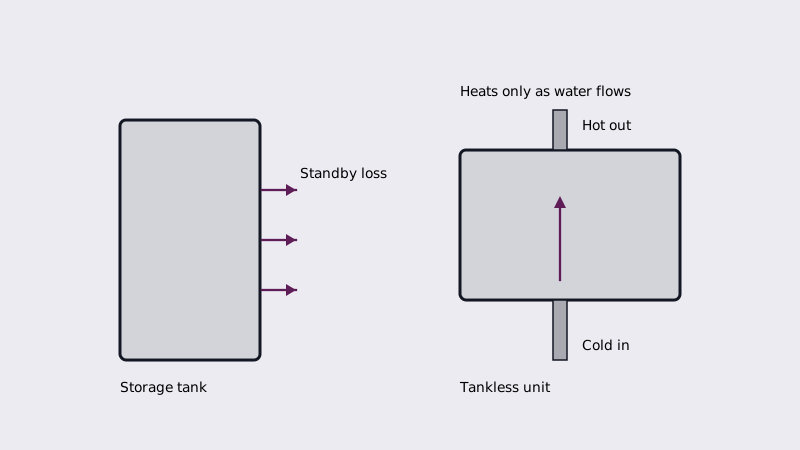
Choose a gas tankless heater if you want endless hot water, lower gas use and a longer life, and you can accept a higher install cost, a gas line check and regular descaling. Choose a tank if your budget is tight, your gas line is modest and you want the simplest swap. Water heater repair gives more background; the comparison itself follows below.
What are the genuine advantages and drawbacks of each type?
Tankless: warms water on demand, so nothing is lost while idle and the supply never runs dry; it lasts about 20 years per ENERGY STAR and needs less floor space. Tank: the purchase and fitting are cheaper, the existing gas and vent are reused, and recovery after a long run is slow. Tankless costs more up front and needs maintenance. A tank wastes heat and ends sooner.
In a table:
| Gas tankless | Gas tank | |
|---|---|---|
| Life expectancy | About 20 years per ENERGY STAR | Commonly cited 10 to 15 years |
| Hot water supply | Continuous, limited by flow rate | Limited by tank size and recovery |
| Upfront cost | Higher | Lower |
| Gas and vent | Larger gas line often needed, special vent | Existing gas line and flue often reused |
| Space | Wall-mounted, small | Floor-standing, bulky |
| Upkeep | Descaling, filter cleaning | Flushing, anode rod |
| Failure style | Error codes, scale on the heat exchanger | Leaks, sediment, burner or thermocouple failure |
Neither type suits every house. Our advice is to match the choice to the household and the gas supply, and to ask for a written quote that lists the gas and vent work item by item.
How much energy does a tankless heater save?
ENERGY STAR says an ENERGY STAR gas tankless unit saves a family of four about $95 per year, or $1,800 over its lifetime, on gas bills compared to a standard gas storage model. That is a modest saving, and it shifts with your hot water habits, your gas price and the unit you buy.
The savings come mainly from avoiding standby loss, the heat a tank loses to the room while it waits. Savings are bigger for small households that use little hot water. For a large household using hot water all day, the gap narrows. Take any quoted saving and set it against the extra install cost to judge payback. Do not rely on a salesperson's single figure. A tank with good insulation and a recent efficiency rating closes some of the gap.
Can my current gas line feed a tankless unit?
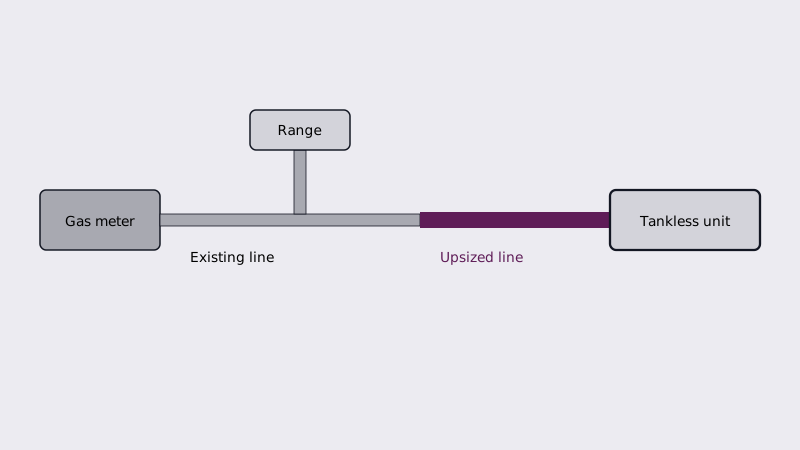
Often the gas line must be upgraded. At full fire a tankless heater pulls several times more gas than a tank does, and a standard half-inch line from a small meter may be too small for it. The plumber measures the run, counts the other gas appliances and checks the meter's capacity, then sizes the pipe by the code.
Gas piping and venting are contractor work and require a permit. When gas is in the air, exit the building ahead of everything else, then call SoCalGas on 1-800-427-2200 from outdoors, and use 911 should you feel in danger. Gas is expected to come from SoCalGas where your street has service, with some rural homes on propane or electricity instead, so confirm your fuel first. Related pages cover gas tankless installation as well as residential gas piping codes.
Venting is the other piece. Tankless units exhaust through special vents that can run through walls or roofs and must meet clearances, so the location of the old heater may not be the best place for the new one.
How does hard water affect tankless and tank heaters?
Both suffer from scale, and tankless units can be hit harder because the heat exchanger has narrow passages. Outside estimates generally rate Murrieta tap water as moderately hard up to hard, so expect to plan for it: descale a tankless periodically, flush a tank and check its anode rod.
Ask for the maker's descaling interval and whether your district's hardness changes it. Your water district's report has the real number for your address, and which district bills you is on your bill. A softener or scale inhibitor can help. Neglect is the usual cause of early failure in either type. See tankless service and repair and the anode rod.
What does installation include, and who takes care of the permit?
In most cases either swap needs a permit. A tank swap involves draining, disconnecting, setting, connecting gas, vent and water, bracing and testing. A tankless install adds wall mounting, a vent run, a condensate drain for high-efficiency models, possibly a larger gas line, a power connection and sometimes a recirculation setup.
The plumber usually pulls the permit, after which an inspector checks gas, vent, relief and bracing. Murrieta's Building and Safety lists 951-461-6062 for the city. Wildomar's counter lists 951-677-7751, and Riverside County handles unincorporated areas such as French Valley and Winchester. For cost structure, see tankless installation cost and 50 gallon replacement.
A note on air quality rules: the regional air board chose in June 2025 not to amend its rules 1111 and 1121, so do not buy or skip a heater because of a rumored mandate. Decide for your own house.
So which one should I choose?
Pick a tank when money is tight, the unit sits in a spot that suits it, and your gas line is small. Pick tankless if you want a long life, you plan to stay in the house, the gas and vent can be done at reasonable cost, and you are willing to maintain it. Households that run two showers and a dishwasher together should check the flow rating.
Either way, find out the model, the efficiency rating, the warranty terms, the cost of the permit and strapping, and who handles the inspection. Once you are set, request a quote and include the heater's age, fuel and location, or go back to the plumber home page.
Common questions
Does tankless really mean endless hot water?
Not without limit. The unit heats as much water per minute as its flow rating and the incoming temperature allow. If too many fixtures draw together, the water turns lukewarm. Size the unit to the number of fixtures that run together.
Is a tankless heater harder to repair?
What happens in a power outage?
During a blackout, most gas tankless units shut down, because the controls and fan run on electricity. Many tank heaters with a standing pilot carry on. Worried about outages? Ask the plumber whether a battery backup suits the tankless, or pick a tank.
Can I swap a tank for a tankless in the same spot?
Sometimes, but the vent and gas line usually change. A tankless unit hangs on a wall, so the old floor space frees up, and the vent may need a new path. The plumber checks clearances and code before quoting, and the written quote should show vent and gas work as separate lines.
Last changed