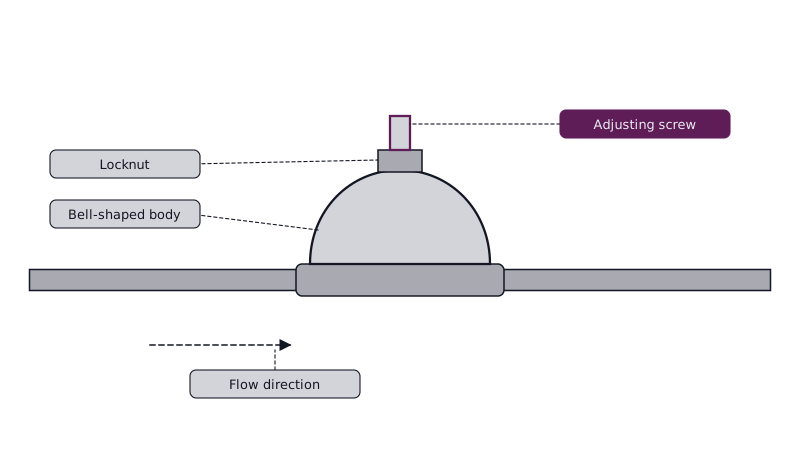
Expect to find the water pressure regulator on the main line where it enters the house or property, usually directly past the main shutoff valve. The body is brass, bell-like and roughly fist-sized, often topped with a bolt and locknut. Common spots are the garage wall, a side yard, a utility closet or a ground-level box. Our water pressure and valves page covers what to do with it.
Where should I look first?
Locate the house's main shutoff valve, then follow the pipe on the far side of it, in the stretch before the first branch. The regulator is generally within a few feet. Try the garage near the water heater, the outside wall nearest the street, a side yard pipe run, or a utility closet.
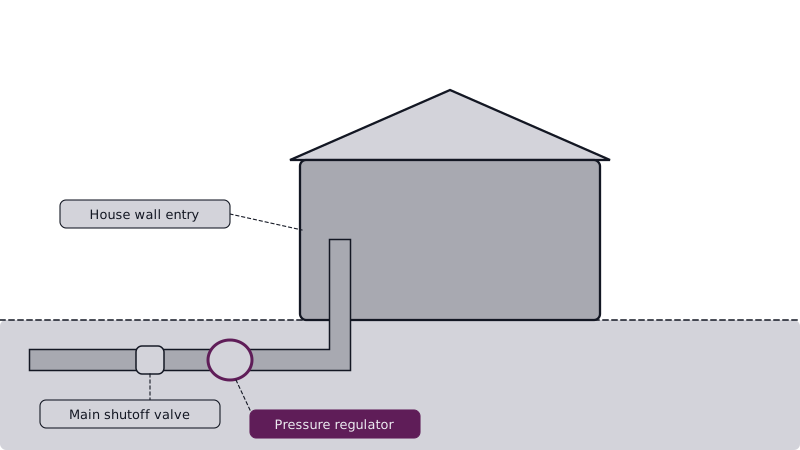
Search in this order:
- The main shutoff. Often a lever-handled ball valve, or an older round gate valve. Follow the pipe downstream.
- The garage. In some houses the line enters through the garage wall, close to the water heater.
- Outside, along the wall. Inspect the pipe at the front hose bib, or run along the side of the house. Some regulators sit in a plastic or concrete box in the ground, set in a planter or along the foundation.
- Utility closet or crawlspace. Where the line enters under the house.
- Next to the water heater. The cold supply passes there, and some installers place the regulator close by.
Look for a bell. Water meters, backflow devices and shutoffs look different: a meter has a dial, a backflow preventer is larger with test ports, and a shutoff has a lever or wheel.
How do I recognize a regulator when I see one?
Look for a brass or bronze housing, bell-shaped, with the water line passing through it. An adjusting screw sits on top, usually with a locknut, and sometimes a cap. Arrows on the body show flow direction. Some have a small gauge port. A label with a psi range may be cast on it.
Identification tips:
- The body is wider in the middle than the pipe on each side.
- It sits on the line, not at the end of it.
- It may have a union or two on the ends, so it can be unscrewed and swapped.
- It is not a valve you turn on and off. The top screw sets the pressure.
- Brands vary, but the shape is similar.
Never turn the screw without a gauge attached. A blind adjustment can push pressure over 80 psi, the California Plumbing Code ceiling, or lower it until showers dribble. If you want to adjust, see our notes on water heater pressure regulator basics for how a gauge test works.
What should I do if no regulator turns up?
Some houses have none, some bury one in a box, and some put it outside the area you searched. We cannot say that any given house has one, even though most Murrieta homes are fairly new. Check the plans or ask a plumber.
Things to try:
- Look at the area around your meter. The water meter box belongs to your water district. Do not open or turn anything in it other than reading the dial, and do not touch the district's valve. Your regulator should be on your side.
- Check old inspection papers or the home's disclosure documents for mention of a regulator or pressure reducing valve.
- Run a pressure gauge test. A steady reading well under 80 psi suggests something is holding pressure down. A reading well above 80 means you either have none or it has failed.
Pressure in the street depends on the district and your elevation. A few districts serve Murrieta, most often Eastern Municipal Water District, and your bill names the one that supplies you. The district's customer service can tell you typical pressure in your area, and a pressure rating helps decide if a regulator is needed.
How do I confirm the regulator is working?
Thread a pressure gauge on to an outside hose bib, check that nothing indoors is running, and read the dial. Then take a second reading after using hot water. If pressure sits within a sensible range and does not creep upward overnight, the valve is working as it should. A reading over 80 psi, or a steady climb, means the valve is failing or set wrong.
A few tests:
- Static reading with water off in the house.
- Dynamic reading with a tap running. A big drop suggests a clogged regulator or undersized supply.
- A reading at a quiet time, like late at night. Rising pressure points to a regulator that is creeping.
- Note any water hammer, dripping relief valve or leaky fixtures. Those are consequences of high pressure.
Failed regulators can stick open, letting full street pressure through, or stick shut, causing weak flow. Read about the cost to replace one in what a regulator installation costs.
At what point should a plumber step in?
Get help if you cannot find the regulator, the gauge reads above 80 psi, the pressure creeps up, the valve leaks, or you want it moved or replaced. A replacement means shutting down the main and cutting into the line, so many homeowners leave it to a plumber. A permit may apply in some places.
Permits inside the city come from the City of Murrieta Building and Safety Division, while county offices cover unincorporated places like French Valley and Winchester. Ask the plumber which applies. Some rural lots run on a private well with a pressure tank; there the pressure control works differently, so tell the plumber.
To arrange a visit, use the quote page. Requests are forwarded by us to local plumbing businesses that pay us a fee, and the business that visits sets the price. The Murrieta Creek Plumbing home page has other help, and the how it works page describes the process.
Common questions
Is the regulator inside or outside the house?
Either. Many are indoors in a garage or utility closet. Others sit in an outdoor box or along an exterior wall. What they share is a position on the main, past the shutoff and ahead of the point where the water branches through the house. If your main line enters outside, the regulator may too.
Can I see the pressure setting without a gauge?
Not reliably. The screw on top adjusts the setting, but it does not show a number, and some regulators have a gauge port to attach a gauge. The easy way to read your pressure is a gauge that threads onto a hose bib, which takes a minute.
Is the regulator the district's or mine?
Generally yours, installed after the meter on your side. The meter and the valves around it belong to your water district. If you are unsure where your responsibility starts, call the district. A plumber will know where the line splits between the two.
How can I tell whether a regulator is necessary?
Measure pressure. If the reading tops 80 psi, you need a regulator. If it is in a normal range and stable, you may be fine. Signs of excess pressure are banging pipes, dripping relief valves and failing fixtures. A gauge test settles the question quickly.
Last changed