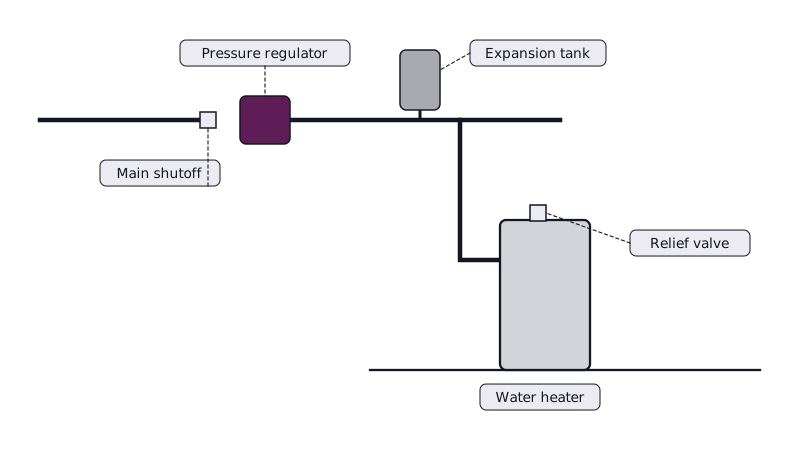
Most water heaters do not have a pressure regulator built in. The one that protects your heater is a valve shaped like a bell, fitted on the main water line into the house, usually near the shutoff. The heater adds its own safeguards: a relief valve and often an expansion tank. If any of the three fails, pressure builds and parts wear out. For the bigger picture, read our guide to water heater repair.
Does a water heater have its own pressure regulator?
No. A standard tank heater has a safety valve that responds to both heat and pressure, opening to vent water when either runs too high, but it does not regulate anything. Regulation happens at the house level, on the main line, where a pressure reducing valve brings the street supply down to a level the plumbing can handle.
Three devices share the job:
- Pressure reducing valve (regulator). Lowers the incoming pressure to a steady set point for the whole house.
- Temperature and pressure relief valve. The safety valve on the tank, which opens in an emergency. Commonly rated around 150 psi, though the label on yours is the one to trust.
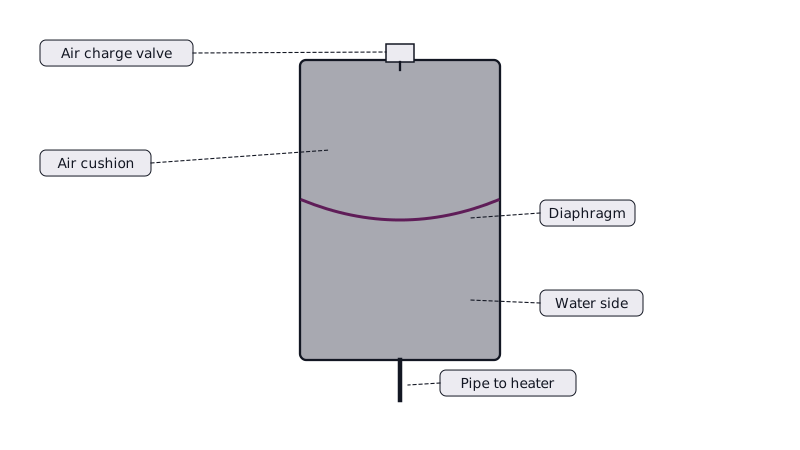
- Thermal expansion tank. A compact tank holding an air cushion, which takes up the water growth when the heater warms a fill of water.
Once a regulator or check valve seals the house plumbing off from the street, warmed water has nowhere to escape, so pressure climbs. That is why many homes with regulators also need an expansion tank. The expansion tank replacement page covers the detail.
How can I locate the regulator that serves my heater?
Trace the main water line back from where it enters the house. The regulator is usually a bell-shaped brass fitting near the shutoff, in a garage, a side yard, an outdoor box or a utility closet. A gauge or screw on top may adjust it. If you cannot find one, your home may not have one, or the district pressure is low.
Details on locating it are in where a pressure regulator is located. If your supply pressure comes in too low rather than too high, our overview of water pressure and valves helps.
Your water district supplies the street pressure. Murrieta water comes from one of a few districts, most often Eastern Municipal Water District; check your bill to see which one is yours. Pressure differs by elevation, so two homes in the same town can see very different readings.
How do I check whether the pressure is too high for my heater?
Thread a pressure gauge on to the washing machine tap or an outdoor hose bib, check that no water is running indoors, and note the dial. Next, draw hot water for a short while, turn it off, and take a second reading. The cap under the California Plumbing Code is 80 psi, and anything higher strains the heater and fixtures.
A good test:
- Buy or borrow a hose-thread gauge, one with a drag needle to catch peaks if you can.
- Fit it on an outdoor hose bib, then open the bib.
- Read at a quiet time, such as the middle of the night or the early morning, when street pressure is often highest.
- Read again after the heater has cycled.
- Write both numbers down.
If the second reading is much higher than the first, thermal expansion is the cause, and a missing or failed expansion tank is likely. If both readings are high, the regulator has failed or was set too high.
What are signs that the regulator or expansion tank has failed?
Water dripping at the discharge pipe of the relief valve, banging pipes, toilets that run on or fill noisily, faucets that spit, dripping fixtures and a heater that dies early are the classic signs. Fixture hoses burst more often when pressure is high. A water bill that creeps up with no visible leak can be a clue as well.
How the pieces point to a cause:
- Relief valve drips only after hot water use: thermal expansion, likely the expansion tank.
- Relief valve drips constantly: high static pressure, possibly a failed regulator.
- Hammering when valves close: high pressure, trapped air gone, or loose pipes.
- Pressure climbing at night: a regulator creeping up.
Press on the expansion tank's air valve with a gauge, with water drained from it. Water coming out of the valve means the bladder has failed. A hollow sound at the top and a dull sound at the bottom is another sign.
Can I replace the regulator or relief valve myself?
A regulator swap is within reach of a confident DIYer, but it means shutting off the whole house and cutting into the main line, so leaks and bad fittings are a risk. Relief valve replacement involves draining the tank. In either case, ask your building office whether a permit applies, as water heater work often needs one.
When the work touches the water heater itself, a permit is generally needed in California for a replacement, and the unit must be braced for earthquakes. The City of Murrieta Building and Safety Division issues permits inside city limits. Unincorporated areas like French Valley and Winchester go through the county office. Gas-line work is regulated too; if you smell gas, get out first, and once you are safely outdoors call SoCalGas at 1-800-427-2200.
Never plug or cap a relief valve discharge, because it is the final protection if a tank overheats or over-pressurizes. Keep the discharge pipe pointed downward and clear.
For costs, see what a regulator installation costs and water heater relief valve replacement.
At what point do I need a plumber for this?
Call when your gauge reads above 80 psi, the relief valve keeps dripping, the regulator is buried or corroded, you cannot find the expansion tank, or you see leaks at the heater. The plumber can test the pressure at the main, check the tank's air charge and set the regulator correctly.
Before the visit, write down your readings and when the drip happens. For help, send the details through the quote page. Requests go to local plumbing businesses, which pay us a fee, and whichever business visits sets the price. For other jobs, visit the Murrieta Creek Plumbing home page.
Common questions
Which psi should the regulator be set to?
The limit in the code is 80 psi, and many plumbers set regulators well below that, as the manufacturer's range and fixture ratings allow. We do not state one number for every home. Ask the plumber for the figure they choose and why, and write it down.
Can a bad regulator damage my water heater?
Yes. Constant high pressure strains the tank, the fittings, the relief valve and the connectors, and can shorten the life of the whole system. It also wears out toilets, faucets and appliance hoses. Fixing pressure early costs less than replacing parts one by one.
Do tankless heaters need a regulator?
They are plumbed from the same house supply, so the same pressure limit applies. Tankless units also have minimum and maximum flow ratings. A setting that is too low may starve a tankless unit of flow, so it loses heat. Read the manual and ask the plumber to set it correctly.
How long does a pressure regulator last?
There is no fixed lifespan, though many run for years before wearing out. Hard water scale can foul the internals. If pressure creeps up at night, or readings differ between tests, the valve may be nearing the end. A pressure gauge is the cheap way to watch it.
Last changed