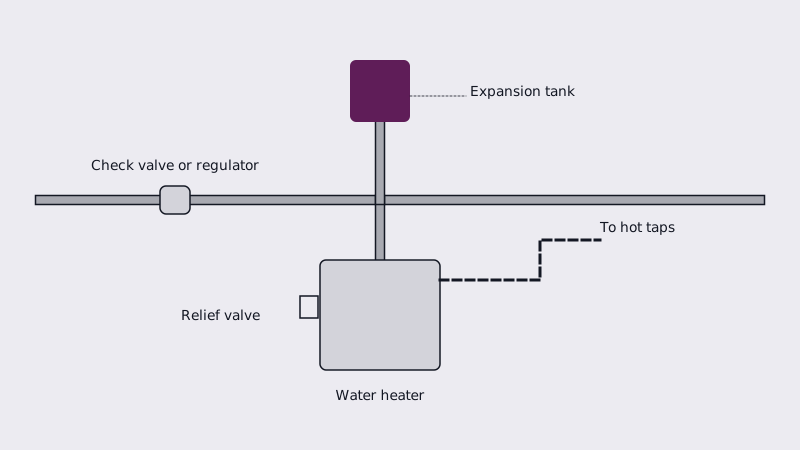
Heating water makes it expand. In an open system the extra volume pushes back into the street main. Once a pressure regulator or check valve sits on the supply, the expanding water has no outlet and pressure rises. The expansion tank absorbs that surplus. This page covers testing, replacing and judging whether you need one, within the wider water heater repair picture.
Why does a water heater need an expansion tank at all?
It is a small steel tank split by a rubber diaphragm, with air behind one side and water behind the other. As the heater warms water, the extra volume squeezes into the tank against the air cushion, then returns when pressure drops. Without it, a closed plumbing system sees pressure spikes that stress the heater, the relief valve and every fixture.
Expansion tanks are often needed when a house has a pressure regulator, a check valve or a backflow device at the meter, which closes the system. They are not needed everywhere, and we will not claim the code requires one in all cases. The local building office or the plumber can tell you what your house needs.
Look above the heater on the cold water line. A small tank, often blue or gray, about the size of a football to a basketball, hangs from the pipe or sits on a bracket. If you have a heater and no tank, your system may be open, or the plumbing was built without one.
How do I know an expansion tank has gone bad?
Signs include a relief valve that dribbles or discharges, banging pipes when the heater cycles, pressure that spikes above normal when the heater runs, a faucet that drips after heating, and a tank that is heavy or full of water. The simplest test is the valve on the tank: press its stem briefly. Air should come out, not water.
Begin by turning off power or gas to the heater, then shut the house's cold water supply, release pressure by opening a hot tap, and test. Water from the air valve means the diaphragm has burst and the tank is waterlogged. A good tank sounds hollow when tapped high up and dull lower down; one that sounds dull all over is full.
Pressure is the second test. A hose bib gauge reads static pressure. The plumbing code limits it to 80 psi (CPC 608.2). Above that, a regulator is the first fix; see water pressure regulator replacement and adjusting a regulator valve. A swollen or spraying tank is not a repair job: replace it.
What does replacing an expansion tank involve?
After shutting off the cold supply and relieving pressure, the plumber cuts or unscrews the old tank and fits a correctly sized new one on a tee branching from the cold line, sets its air charge to match household pressure, and checks for leaks. It is a short job when access is good, with more time needed when the tank is high or tight.
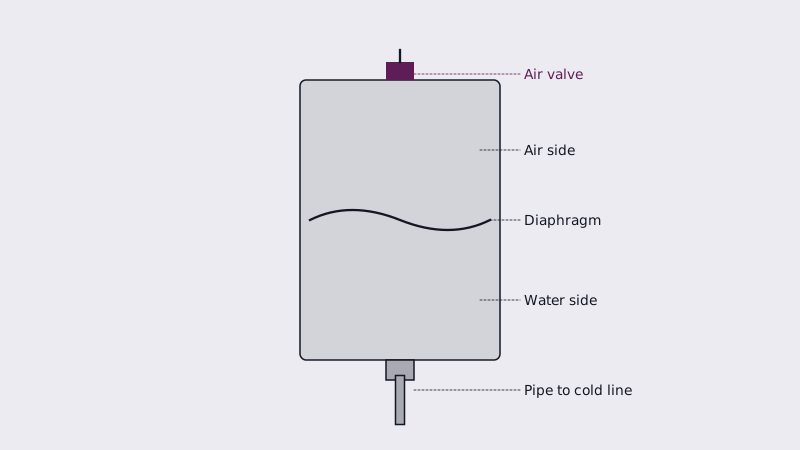
The air charge matters most. A tank must be precharged with a tire gauge to match the water pressure at the house, typically between 40 and 80 psi depending on the regulator setting, with the water drained from the tank side. A tank installed at the factory pressure of the wrong setting does not do its job. A plumber should confirm the number with a gauge.
Support matters too. A tank hung only by its pipe can stress the fitting over time. A bracket from the wall or a strap helps. Sizing follows the heater volume; a two-gallon tank is common on a 40 to 50 gallon heater, and bigger heaters may need more.
California generally requires a permit for water heater work, and replacement tanks have to be braced for earthquakes. Within Murrieta, applications go through the city's Building and Safety office, reachable on 951-461-6062 (city page; confirm), while French Valley and Winchester use the county.
Can I replace it myself?
If you are comfortable with threaded fittings, a wrench and a pressure gauge, it is a reasonable job. Turn off the water and power, relieve pressure, remove the old tank, wrap new threads with tape or dope, install, set the air charge, then reopen the supply gradually and watch for drips. Skip the job if the pipe is corroded, or if a nearby gas line would have to be disturbed.
Leave gas piping alone, because a contractor license is required in California for it. Should you smell gas, leave the house, then ring SoCalGas at 1-800-427-2200 from outdoors, or 911 should anyone be in danger.
Keep a record of the air pressure you set, and mark the date on the tank. Plan to check it every year or two with the gauge: a falling air charge is common, and a quick top-up with a bicycle pump extends life.
What is the lifespan of these tanks, and does hard water matter?
Expansion tanks commonly last about 5 to 10 years, though some run longer. Heat, pressure swings and a failed charge shorten life. Hard water, which third-party estimates put at roughly 6 to 11 grains per gallon in Murrieta (check your district report), mostly harms the heater itself through scale, but also loads the relief valve and fittings.
If your tank is old when the heater is replaced, replace the tank with it. Mismatched ages cause a second visit. Check the relief valve too, which guards against dangerous pressure and temperature; see water heater relief valve replacement. For the regulator side, the page on pressure regulator at the water heater helps.
Banging pipes can have other causes; water hammer explains them. A dripping relief valve might also just mean worn seals.
Murrieta Creek Plumbing passes whatever you send to a nearby plumbing company; whichever one quotes pays us a fee for the introduction. Fill out the quote request with the heater size and age.
Common questions
Is an expansion tank required in California?
Not as a blanket rule we can point to. A tank is often needed when the house plumbing is a closed system, which depends on its regulator, check valves and any backflow device. Because the code language and local amendments can change, the building office of your city or county, or the plumber, should confirm for your address.
Which way should the expansion tank be installed?
Vertical or horizontal installations both work if the tank is rated for them and supported properly. Many are installed upright, hanging from the pipe with a bracket. Follow the label on the tank. Install on the cold supply line to the heater, before the heater inlet.
Why does my relief valve drip when the heater runs?
The pressure rises as water heats, and with no way to absorb it, the valve opens. A failed expansion tank or a high household pressure is the usual cause. Replacing the relief valve alone treats the symptom, so check pressure and the tank first.
What air pressure should I set?
Match the tank to your water pressure at the house, measured with a gauge. Common settings are between 40 and 80 psi, but the correct number is your measured static pressure. Check with the tank disconnected from water pressure, and correct it with a pump.
Can a bad tank hurt my water heater?
It can contribute to early failure. Repeated pressure spikes stress the tank, the relief valve and the joints, and an ignored relief valve drip can grow into a real leak. Replacing a bad expansion tank costs far less than replacing a whole heater.
Last changed