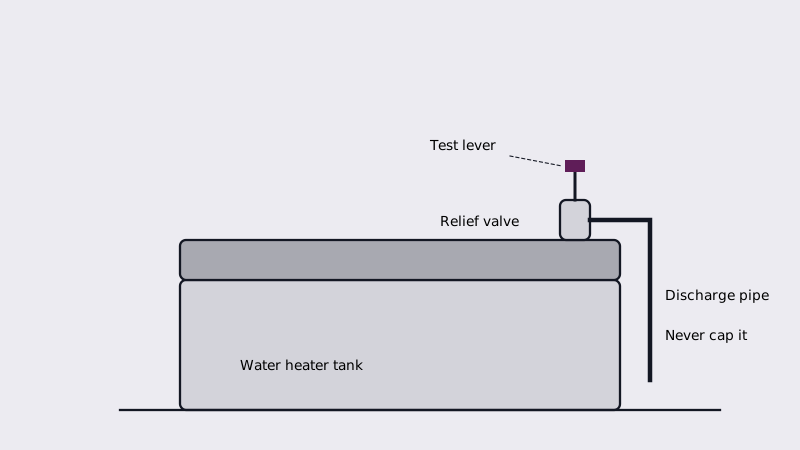
Mounted on the top or side of the tank, this valve opens if heat or pressure climbs too high. Its single task is critical, and it has to work on the one occasion it matters. Replace it when it leaks steadily, when the test lever does nothing or when it is badly crusted. It is part of any water heater repair, and usually a short job.
Why is the relief valve on my water heater dripping?
A valve that drips can be doing its job or can be failing. A drip that appears when the heater fires and stops later points to pressure rising from thermal expansion. A constant drip, even when the heater is idle, suggests worn seat or grit under the seal, or house pressure that stays too high.
Three checks narrow it down. First, attach a gauge to a hose spigot and read the house pressure: the limit in the plumbing code is 80 psi. Second, find out if an expansion tank is installed on the cold line over the heater. Third, read the rating printed on the valve and check it against the tank's rating. Replacing a valve that was reacting to a real pressure problem fixes nothing, because the new one will drip too.
Do not touch a valve that is hot and spitting steam or very hot water. Keep away, turn the heater off, and ring a plumber. See expansion tank replacement and the water heater pressure regulator for the usual root causes.
How do you test a relief valve?
Put a bucket under the discharge pipe, stand off to one side, raise the test lever for about a second so water flows, then let it snap shut. Water should flow and then stop. If none comes out, or the drip continues after the lever is released, replace the valve. Hot water can scald, so take care.
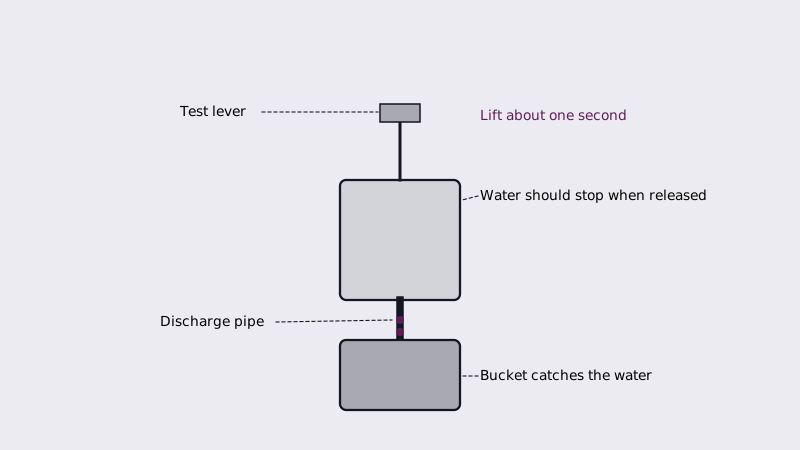
The heater maker's manual suggests testing it once a year. Skip the test if the discharge pipe is damaged or missing, because scalding water would land somewhere unwanted. If the lever is stuck solid, do not force it with pliers. A valve that has been stuck for years may pass water the first time and then never reseat, which is why you should swap it with the supply shut and a replacement ready.
Before you start, read the label on the tank for the valve's pressure and temperature rating, and make sure the new one matches. A valve with a lower rating than the tank's working pressure will weep, and a higher one gives less protection.
When should a relief valve be replaced?
Replace it when it leaks and the cause is not pressure, when the lever is frozen, when the valve is corroded or crusted, when the heater has been replaced and the old valve is a leftover, or when it is more than about ten years old and you are working on the heater anyway. A tank without a working valve is a hazard.
Replacing only the valve means a cheap part and a quick visit, and the call-out fee is often the larger piece. That is why many plumbers do it during other work, such as flushing, changing an anode rod or adding an expansion tank. Combining jobs saves a trip.
Can you replace a relief valve yourself?
Some owners do, but it involves turning off the power or gas, shutting the water supply, draining part of the tank, unscrewing a valve under spring tension and sealing threads properly. If you have gas, the burner control also needs care. A mistake on a safety part has a high cost, so a lot of homeowners leave it to a plumber.
To see what is involved, here is the sequence. Turn off the breaker, or set the gas valve to pilot or off. Close the cold inlet, open an indoor hot faucet to let air in, and drain a few gallons until the level drops below the valve. Next take off the discharge pipe, then unscrew the old valve, wrap the new one's threads with approved sealant and tighten it, and reconnect the discharge pipe. Refill the tank while a hot tap stays open until water flows steadily, then restore power.
The discharge pipe rules matter. It must point downward, not be capped or plugged, and end where hot water will not hurt anyone. Never cap it. Ask a plumber if yours does not look right.
What does the discharge pipe have to do?
The discharge pipe leads water away from the valve and delivers it somewhere safe, typically down toward the floor or outside. It should not be reduced in size, valved, threaded at the end or capped. A pipe with a cap on it can turn a pressure relief into a failure.
In garages you often see it ending a few inches above a drain or a floor. If it runs outside, check that it does not discharge onto a spot where people walk. Inspectors check this on a permitted water heater replacement. For addresses in the city, questions go to the City of Murrieta Building and Safety Division, 951-461-6062. Addresses in Wildomar, Riverside County and San Diego County have their own offices.
Does replacing the valve need a permit?
A relief valve replaced on its own is a repair, and permit rules for such small parts differ by office, so ask yours. Replacing the water heater itself needs a permit in California. A new heater is installed with a new valve and a discharge pipe the inspector checks.
Our area has several building offices, depending on your address, so for a firm answer phone the one that covers your street. The plumber you use will also know. Jobs that need a permit, or that reach $1,000 in labor and materials, require a California contractor license. You can look a license up at the state contractor board.
What does replacement cost?
A valve is a modest purchase and the job is short, so the labor and trip charge usually drive the price. No figure is published here. A plumber quotes after seeing the heater, and the total changes if an expansion tank, a new discharge pipe or a full replacement is also needed.
Have the price written down, and ask whether it covers the discharge pipe, shutoff valve, and any needed tank draining. If your heater is more than about 12 years old, sediment and corrosion may lead the plumber to suggest a replacement unit instead; set that against our heater replacement cost guide. We pass your request to one nearby plumbing business, which sets its own price, and those businesses pay us a fee for requests they take. Details can go through the price request page, and the Murrieta Creek Plumbing home page covers the other jobs we pass on.
Common questions
Should a relief valve ever drip?
A few drops when the heater is heating can be normal if pressure builds from expansion, but it is a sign that something needs fixing. Steady dripping is not normal. Check the house pressure, check for an expansion tank, and test the valve. Do not plug the discharge pipe.
What happens if the relief valve fails?
If the heater overheats or pressure builds and the valve cannot open, the tank can burst, with scalding water and damage. This is rare but serious, which is why the valve exists. It is a legal and safety item on every tank. Never cap or block the valve or its pipe.
How long does a relief valve last?
There is no fixed number. Valves can last many years, but mineral buildup in hard water and lack of testing shorten life. Third-party estimates often put Murrieta tap water in the moderately hard to hard range, so exercise the lever once a year and replace the valve if it sticks or drips.
Should the heater be turned off to replace the valve?
Yes. Cut the power, or turn the gas valve to off or pilot, close the cold water inlet, and wait for the water to cool before starting. Hot water at the valve can scald. If you smell gas, leave the building before anything else, then use the SoCalGas line, 1-800-427-2200, from a safe place outside, and call 911 when anyone is in danger.
Is the relief valve the same as an expansion tank?
No. The expansion tank absorbs extra volume as water heats. The relief valve is a last-resort safety device that opens when pressure or temperature goes too high. A home with a dripping valve often needs the expansion tank checked, not just a new valve.
Last changed