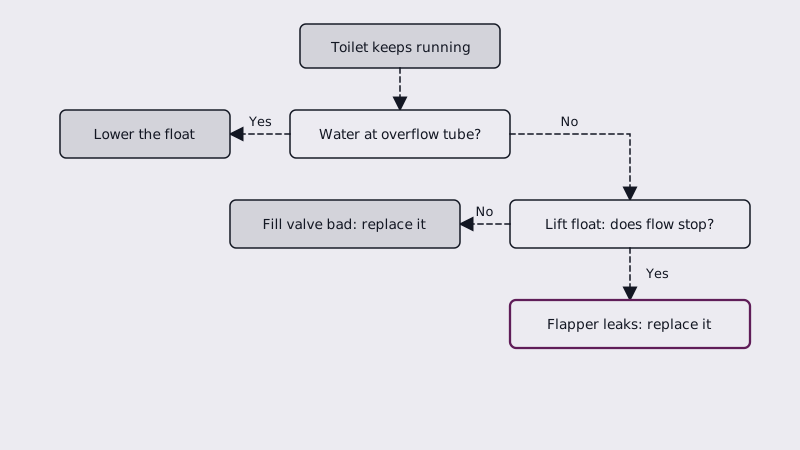
Lift the lid and look into the tank. Nearly every toilet that keeps running has one of four faults: a flapper that does not seal, a chain that snags, a float adjusted too high, or a fill valve stuck open. Inspect the chain first, then test the flapper with a little food coloring, then look at the water level. The wider repair list is at toilet repair.
The reason to act is the water. The EPA says the average home loses more than 9,300 gallons per year to leaks, and a toilet seeping silently into the bowl is a classic source. A running toilet makes so little noise that nobody notices for weeks, until the bill arrives or a ghost flush wakes the house.
What keeps my toilet running after it has flushed?
Something is preventing the tank from sealing or the fill valve from closing. The flapper may be leaking so the tank keeps refilling, the chain may be caught under the flapper, the float may sit so high that water spills down the overflow tube, or the fill valve may have failed. Watching where the water moves shows which.
Quick test: raise the float or the float cup by hand. If the water stops, the fill valve works and the float needs a lower setting. If it keeps flowing, the valve itself is bad. Water sitting at the rim of the overflow tube means a float problem. A level below the tube with a refill that never ends means the flapper leaks.
Details on each part live on the pages for the flapper, the fill valve and the overflow tube.
What should I check first?
Start with the chain. One that is too long slips under the flapper and props it open a crack, while one that is too short keeps it lifted. The correct amount is about 0.5 inch of play while the flapper sits closed. Jiggle the handle: if the running stops, the chain or the handle linkage was the problem.
The handle itself can be at fault. A flush handle that is bent, loose or not returning to rest keeps the lift arm raised. Tighten the nut inside the tank, but go carefully, because it turns the opposite way on many models. If the handle does not work at all, the chain may have come loose or the arm snapped; both are inexpensive parts.
If the toilet runs only when you press the handle in a certain way, replace the handle assembly. The page on flush repair covers weak flushes and handles.
How can I check the flapper for a leak?
Put a few drops of food coloring in the tank, wait ten minutes and do not flush, then check the bowl. Colored water there proves the flapper leaks. Flush afterwards so the dye does not stain. The flapper is the most common culprit and the cheapest fix; replace it and clean the seat.
Another test: close the wall valve, mark the tank level, and see whether it drops. A drop means water is escaping past the flapper.
Hard water scale, chlorine tablets in the tank and age ruin flappers. The EPA suggests replacing one at least every five years. Murrieta water is usually moderately hard to hard, so seats collect mineral film, and a good wipe makes the new flapper seal better.
How do I adjust the float or the fill valve?
If the water rises beyond the overflow tube mark, lower the float. On a float-cup valve, use the adjustment screw; on an older ball-float design, bend or slide the float arm. Aim for a water line near one inch below the rim of the overflow tube. If the valve still will not shut off, replace it.
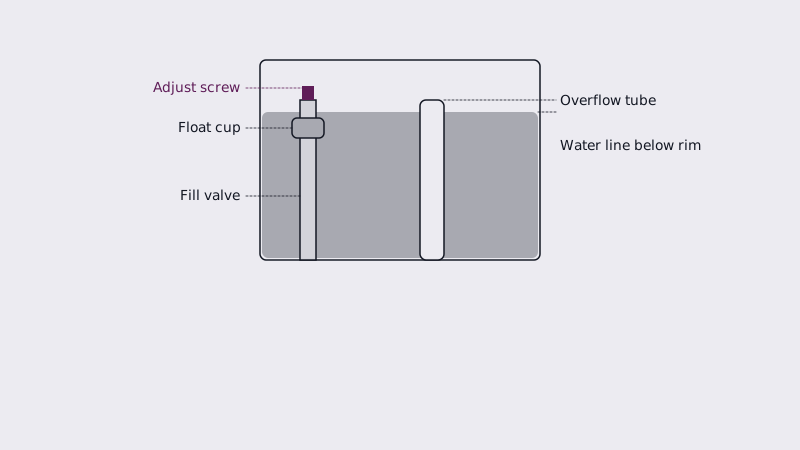
Fitting a fill valve kit is straightforward. Close the water, drain the tank, unscrew the supply line and lift out the old valve. Drop in the new one, set to the height in its instructions, then reconnect everything and test.
Never leave the supply line cross-threaded or overtightened, because plastic nuts crack. Snug by hand plus a quarter turn is enough. If the wall valve itself refuses to close, that is its own repair, covered on the shut-off valve page.
If the fill valve whistles or hisses as well, house pressure may be high. A gauge on an outdoor faucet settles it.
Does a toilet that runs push up my water bill?
Yes, and by a lot. A toilet leaking nonstop can burn through many gallons every hour, and the EPA notes that repairing easy leaks can trim a water bill by roughly 10 percent. Whether the toilet leaks or simply runs, it belongs on the list of causes for an unexpectedly high bill.
What you pay depends on your district and your rate tier. In Murrieta the supplier may be Eastern Municipal Water District, Western Water's Murrieta Division or, in some areas, Rancho California Water District, so look at your own bill to see which. Meter readings help: with all fixtures off, a moving dial means something is leaking.
For the wider checklist, start with a bill that is high but shows no leak, then read reasons a water bill climbs.
When should I hand this to a plumber?
Call one if the shutoff valve leaks or will not turn, the tank or bowl is cracked, parts have corroded, the toilet rocks or seeps at its base, or fresh parts in the tank have not cured the running. If it carries on after you replace both, a worn seat probably needs a new flush valve.
For a different route through the same problem, see the reasons a toilet keeps running, plus the steps in fixing a running toilet.
You get a written quote before any work starts. No sourced Murrieta price is available to us, so none is printed. Requests sent through the form are passed to a nearby plumbing company, which quotes and does the repair, and the companies that take requests pay us a fee. The Murrieta Creek Plumbing home page lists other jobs.
Common questions
What causes a toilet to start up briefly on its own?
That is a ghost flush. Water seeps slowly past the flapper until the tank level falls and the fill valve opens for a moment. Fit a new flapper and clean the seat. If ghost flushes continue, inspect the flush valve seat for pitting.
What if the flush handle will not work?
The chain may have slipped off the lever arm, the arm may be bent, or the handle nut may be loose. Lift the lid, hook the chain back on leaving half an inch of slack, and tighten the nut. If the arm is broken, replace the handle set.
Will a leaky toilet make my water bill jump?
Yes. A quiet leak into the bowl runs around the clock. According to the EPA, the typical home loses more than 9,300 gallons annually, with toilets high on the list of common sources. A dye test will confirm it within ten minutes.
Is it safe to leave a running toilet until the weekend?
For a day or two, yes, but every hour of running wastes water and adds to the bill. If you are away or at work, close the wall valve at the back of the bowl, and open it only when you need to flush. Then repair the cause at the weekend.
Do I need to replace the whole toilet?
Rarely. Most running toilets need only a flapper, a fill valve or a small adjustment to the float or chain. Replace the whole toilet only when the tank or bowl is cracked, or when it still leaks at the base after a new wax ring and bolts.
References
Last changed